Member SNAPshots: February 2026
Our Member SNAPshot series shines a spotlight on the early-career researchers who make up the Scientist Network for Advancing Policy. Each post highlights the breadth of science or technology research, policy, and advocacy work our members are engaged in both within and outside of SNAP. We look forward to featuring these snapshots regularly to celebrate our community.
Member: Brendon Davis
Johns Hopkins University
How did you first become involved in science policy and/or SNAP?
When I moved to Baltimore, just an hour away from D.C., I became enthralled in the role that scientists play in government. I joined the Science Policy and Diplomacy Group (SPDG) at Johns Hopkins to explore questions around expertise in policymaking, as well as to explore career paths in science policy. Just in my first year with the group, I got so invested in this that I organized three Hill Days in which graduate students went to Capitol Hill to advocate for various policy initiatives. I found the work of communicating science and influencing policy both important and fulfilling.
My time with SPDG has led to many connections with both policy professionals and early-career scientists interested in science policy. As messages began to bounce between science policy groups about forming a national coalition of early-career scientists, I was ready to jump in immediately. I remember some of the first Zoom calls discussing what this group could be, and I am still impressed and how quickly SNAP coalesced and started executing on initiatives.
Tell us about your research!
I study adult stem cells, which are responsible for maintaining tissues by making new cells. Oftentimes, when a stem cell divides, one of the resulting cells stays a stem cell while the other becomes a different type of cell. I am interested in the role that proteins called histones play in this process. Histones are the packing peanuts that DNA is wrapped around, and they can be modified to change which genes are expressed in a cell. I found that certain stem cells in fruit flies have half the normal levels of a DNA-copying protein called polymerase α, and the reduced levels of polymerase α affect how these stem cells incorporate histones.
Excitingly, reducing polymerase α in normal fruit fly cells makes those cells incorporate histones like stem cells. Making cells more like stem cells can have significant implications for tissue regeneration. I measured the ability of tissues to maintain stem cells as they age, and reducing polymerase α improves the ability of non-stem cells to turn into stem cells when an original stem cell dies. These results suggest that reducing (but not eliminating) polymerase α maintains tissues over aging or during stress. Ongoing work in my lab is translating this finding from flies to humans, including determining how this can be used for cell therapies that require transforming patient cells into stem cells for life-saving treatments.
By the way, I am presenting my work at the 2026 AAAS meeting this week!
What are you involved with in SNAP?
I was first involved with planning and editing for the McClintock Letters initiative, including organizing some local op-ed writing workshops at my campus. Recently, I have been working on a written piece authored by SNAP members on how to implement science communication and advocacy training into the core curricula for graduate programs. As part of crafting this piece, fellow SNAP member Rose Albert and I attended a conference with leading policy and sociology scholars, and we shared the activities and goals of SNAP to much excitement!
I am incredibly excited for Stance on Science and the light it will shed on science policy issues throughout this year, leading up to the midterms. Because science does not always get the airtime to discuss the many scientific disciplines and the nuances of policies governing science and technology, this initiative will provide a level of science policy depth that has often been absent in elections.
Tell us about something you are passionate about.
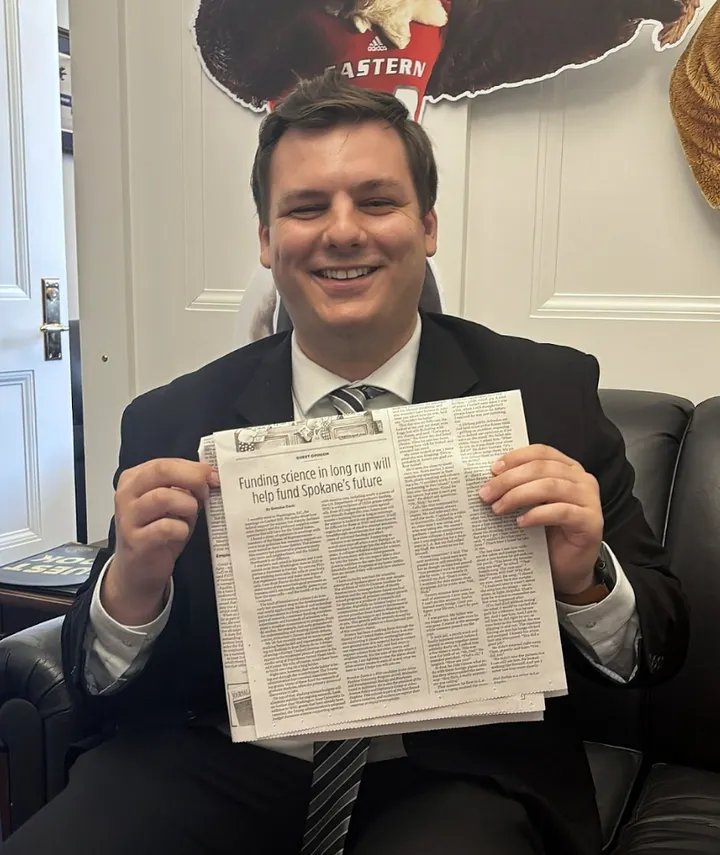
In June 2025, I was at the U.S. Capitol advocating for science funding when I walked into the office of the Representative for my hometown and noticed that a local newspaper was sitting on the front desk. In that exact issue of the newspaper was an op-ed I had written as part of SNAP’s McClintock Letters initiative. After I met with staffers in the office, I pointed to my op-ed if they wanted further information about my journey with science. The McClintock Letters was focused on the power of scientists reaching out to their local communities and elected officials, so seeing my op-ed make its way to my hometown Representative’s office on Capitol Hill spoke to the potential effectiveness and impact of writing for a local audience.
What’s your favorite science memory?
My first experiment in graduate school involved culturing cardiac cells. I had never cultured cells before, but fortunately I had a fantastic postdoc mentor who walked me through the process. The first time we looked at my cells together under the microscope, I could see each cell contracting rhythmically, just like very small versions of a beating heart. It was a true “magic of science” moment, being fortunate enough to observe a phenomenon of nature firsthand. I went on to work with that postdoc to understand how various signaling molecules affect the ability for neurons to control the “beating” of cardiac cells.
If someone asked your sibling what you study, what would they say?
I asked my brother this question, and his exact response was: I usually just say “molecular biology.” And then if someone wants me to explain more, I say “something with fruit fly DNA.”
All factually correct.
Member: Ashley Eng
University of California, Berkeley
How did you first become involved in science policy and/or SNAP?
Organizing with SNAP has been my first science policy experience! While I was a community organizer in my hometown spanning efforts in the public schools to the local government, I had never found an outlet to combine my work (science) with my side interests (organizing). Towards the end of college, I was convinced I had to choose between these two passions, as I wasn’t aware of a way to overlap government policy and organizing with science, beyond community outreach. But last spring I wrote a McClintock Letter, discovered science policy, and have been plugged into SNAP since then.
Tell us about your research!
Soil is packed with bacteria and other microbes, not visible to the naked eye. These microbes are drivers of terrestrial biogeochemical cycling. They shape how nutrients, such as carbon, flow through our ecosystem through absorbing and releasing greenhouse gasses like carbon dioxide. As plants grow, their roots secrete nutrients (e.g. sugars) into the surrounding soil, known as the rhizosphere. Like us, bacteria need food to survive and thrive, and they can both compete or work together with their neighbors to feed on these nutrients. However, the ability of bacteria to utilize these nutrients can depend on micronutrients, such as vitamins, that are exclusively produced by bacteria. While it is known that plant exuded nutrients shape bacterial communities in the rhizosphere, little is known about how sharing of bacteria-produced micronutrients impacts bacterial communities in the rhizosphere.
I am interested in investigating why soil bacteria produce these micronutrients, using vitamin B12 as a model micronutrient. I seek to explore beneficial traits that may be associated with vitamin B12 production or dependence. I use a combination of experimental tools, such as constructing simplified bacterial communities in the lab, as well as computational tools, such as genome analyses and modelling. Learning more about bacteria in the rhizosphere can teach us about how bacteria work together to use resources set up by plants, which may ultimately inform strategies for climate change mitigation.
What are you involved with in SNAP?
Currently, I’m helping organize the Stance on Science initiative, which aims to hold candidates accountable for science policy and evidence- based decision- making while increasing transparency between voters and candidates. With a rising need to promote pro-science positions, I feel passionate about connecting communities with science, demonstrating how science can affect daily lives — even in decision making in government. I’m excited to work with the coalition of SNAPpers involved in this initiative.
Tell us about something you are passionate about!
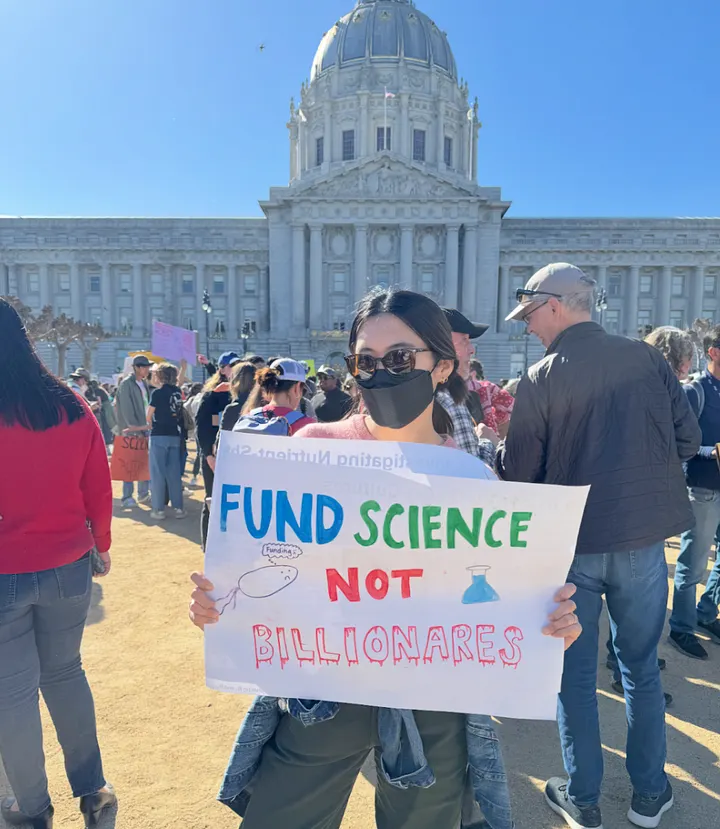
Last year, my lab mates and I attended a rally in San Francisco to advocate for science funding at the height of science funding cuts. Many of us spend all day at the bench or at our computers, so it was both powerful and inspirational to be together in community demonstrating our collective power and seeing each other as real people.
What does your family think you do?
Something about bacteria, soil, and dirt?
What’s your favorite science memory?
When I was an undergrad, my labmate and I spent weeks trying to develop and troubleshoot a method that ultimately failed. Our goal was to develop a high- throughput assay to track bacterial growth on solid media using density measurements and imaging. Those few weeks involved homemade photo boxes, flat bed scanners, 6-, 24-, and 48- well plates, and solid media (what bacteria can grow on) of varying compositions. Although we ultimately did not complete what we had envisioned, it still remains one of my favorite memories because of the fun we had trying, failing, laughing, and trying again.
Member: Bryce Wedig
Washington University in St. Louis
How did you first become involved in science policy and/or SNAP?
I got involved in science policy through a graduate student organization at WashU centered around science communication and science policy. I initially joined to meet people outside of my department. But through discussing science policy I started to see the ways that it matters for my science: issues like light pollution, radio interference, and most of all, NASA Astrophysics funding. Then, participating in the American Astronomical Society’s Congressional Visits Day turned me into a confident and steadfast advocate for policies that support astrophysics. As for SNAP, I was a participant in the 2025 AAAS CASE Workshop where SNAP was founded.
Tell us about your research!
85% of the stuff in the Universe is an invisible and elusive substance that we imaginatively call “dark matter.” We’ve known that dark matter is out there for nearly 100 years but we still don’t know what it is, and it’s one of the biggest questions in physics today. Some are looking at dark matter on Earth in labs or deep underground, or looking at dark matter in our galaxy, but I’m looking at dark matter many billions of light years away in distant galaxies.
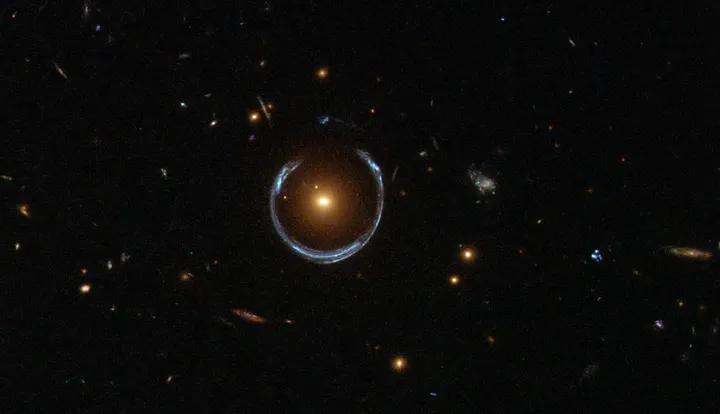
Image Credit: NASA, ESA
Very rarely, galaxies will line up in the sky, one right behind the other. When this happens (see photo above), the closer galaxy (yellow dot) wraps the light from the distant galaxy (blue ring) around itself. The distant galaxy doesn’t actually look like a ring — its light is being dramatically warped so it just appears that way to us. This effect, called “gravitational lensing,” is due to the mass of the closer galaxy, most of which is in dark matter. By studying how the distant galaxy appears in these rare configurations, we can learn about the dark matter in the closer galaxy.
These galaxies are incredibly tiny and dim: like the thickness of your fingernail from across a football field and 10 trillion times dimmer than the Moon. To take pictures of them, I use space telescopes like the James Webb Space Telescope — a satellite the size of a tennis court and the height of a three-story building.
On a normal day, I’ll write code to simulate space telescope images (like the ones below) or analyze real images.
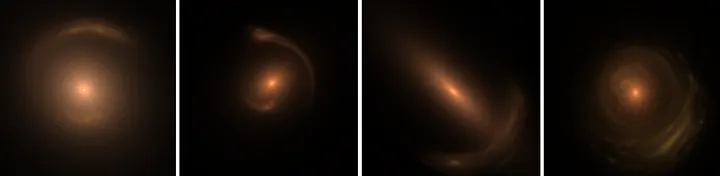
Simulated Habitable Worlds Observatory images generated with my software package
What are you involved with in SNAP?
I’m one of the maintainers of the SNAP website. Even though my day job is coding, I just can’t get enough of it.
My main motivation for being in SNAP is to represent physics, astronomy, and math in the science policy space. I’m looking forward to opportunities to advocate for robust and sustained federal funding for basic research and to support others in doing so.
Tell us about something you are passionate about.
Many scientists are “hands-on” with their work, but I don’t get to experience that. I don’t work with beakers or petri dishes. The objects I study are billions of light years away and the tools I use are satellites and supercomputers. I envy that tactile connection — the ability to hold your research in your hands.
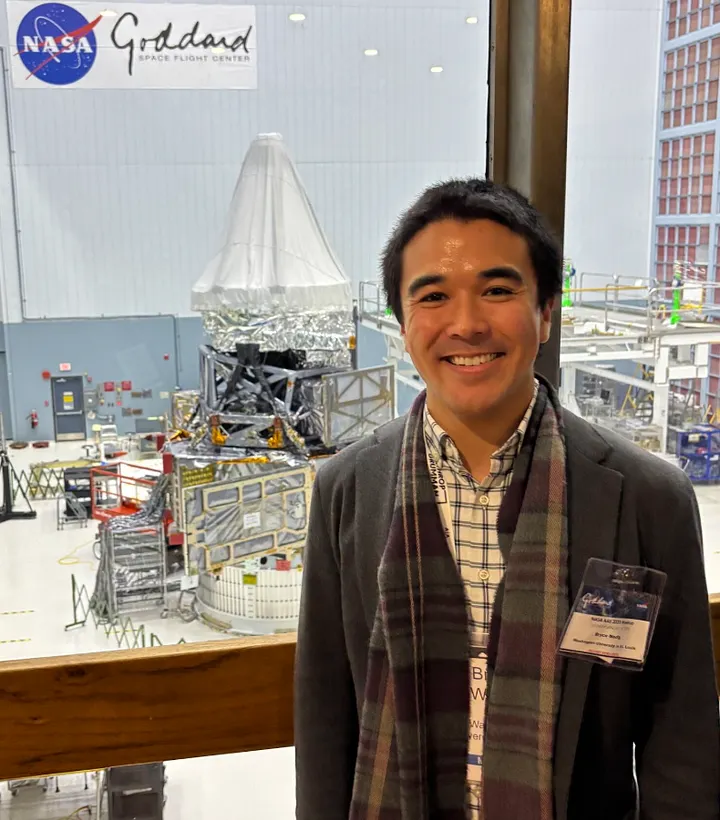
Last January, I got to see the Roman Space Telescope in person at NASA’s Goddard Space Flight Center. After having written tens of thousands of lines of code to faithfully simulate the images of distant galaxies that this instrument will one day take, I was giddy to see it in person. A few months later, amidst rumors that the President’s Budget Request would cancel Roman, I went to Capitol Hill to share my story about its importance — and today, Roman is on track. This fall, it’ll thunder into the sky and make its way to a peaceful spot in our celestial neighborhood to start a mission that will show us the Universe like we’ve never seen it before.
What’s your favorite science memory?
In my first year of college, I was doing an experiment with a lab partner on the quantum nature of light (it was the single-photon double-slit experiment, for my fellow nerds). I had heard about how quantum mechanics is weird — think Schrödinger’s cat being “alive and dead and the same time” — but it hadn’t clicked with me yet. In the experiment, we were firing single particles of light at a pair of little doors and measuring the light on the other side. Intuitively, when both doors are open, all the light should make it through to the other side, and closing one door should block some light so you’d measure less light. But when we closed one door and more light made it through, I assumed we’d done something wrong. My lab partner stopped me and said something like “no, it’s working correctly — that’s the whole point.” That “eureka” moment sent me firmly down the path of doing physics and thinking about what physics tells us about the nature of reality.
What does your family think you do?
Space telescopes, writing code, funny-looking galaxies?
Recognition:
Thanks to Brendon, Ashley, and Bryce for their responses! This article was edited by many individuals of the SNAP team, including Isako Di Tomassi, Jordan Williams, and Emily Selland.
Read more about SNAP and its members on our website.