Happy Birthday, SNAP! Reflecting on an Eventful First Year at the AAAS Annual Meeting
Written by SNAP members Disha Patel and Jordan Williams
Disclaimer: Thoughts and views written in this blog reflect those of the writers only, and not necessarily those of every SNAP member or the SNAP coalition as a whole.
… science is so much more than doing research, giving a talk at a conference, or publishing a paper: science transcends the scientific community.
Scientists are often portrayed doing experiments in the laboratory, publishing ground-breaking research, or sharing scientific findings with fellow scientists. This portrayal of science excludes lawmakers, community members, and other stakeholders who interface with science, leaving the relationship between scientists and these non-scientific groups unclear. In reality, science and society are interconnected. The Annual Meeting of the American Association for the Advancement of Science (AAAS) serves as a reminder that science is so much more than doing research, giving a talk at a conference, or publishing a paper: science transcends the scientific community.
Whether they know it or not, science influences non-scientists in a myriad of ways. For example, scientific research informs policy decisions every day at the local, national, and international levels. Hence, as scientists, we must ask ourselves how do our research findings get translated into evidence-based policies? How can we gain and maintain the trust of our communities? How do we hold ourselves and our work to the highest scientific standards and ethical values? We can start by joining a community of like-minded individuals, scientists who seek the answers to these questions and understand that science must be made accessible to our everyday communities. The AAAS Annual Meeting provided the perfect opportunity for scientists to have these conversations and build community.
Last year at the AAAS Annual Meeting in Boston, a few highly motivated and inspired early career researchers (ECRs) connected with a vision to unite like-minded ECRs and make a difference. From that conversation, a Slack workspace to connect ECRs and their initiatives was born. This workspace evolved into Scientist Network for Advancing Policy (SNAP), a nationwide, non-partisan, grassroots coalition. One year later, 48 ECRs from 24 universities and institutions across the United States represented SNAP at the 2026 AAAS Annual Meeting. SNAP members attended sessions throughout the conference, made connections at SNAP’s exhibition booth, and highlighted the work of ECRs in science policy in our plenary discussion and evening reception. SNAP’s presence at the AAAS meeting was both impactful and invigorating.
SNAP at AAAS
SNAP’s Expo Booth
SNAP hosted a booth at the expo hall in shifts, allowing members to interact with other conference attendees over the three days. We shared SNAP’s origin, talked about our current initiatives, and spoke to many who offered support and potential collaborations. We encouraged fellow ECRs to sign up to join us and added over a hundred new people of all career stages to our mailing list. We loved interacting with our surrounding booths and talking to all the visitors who stopped by.
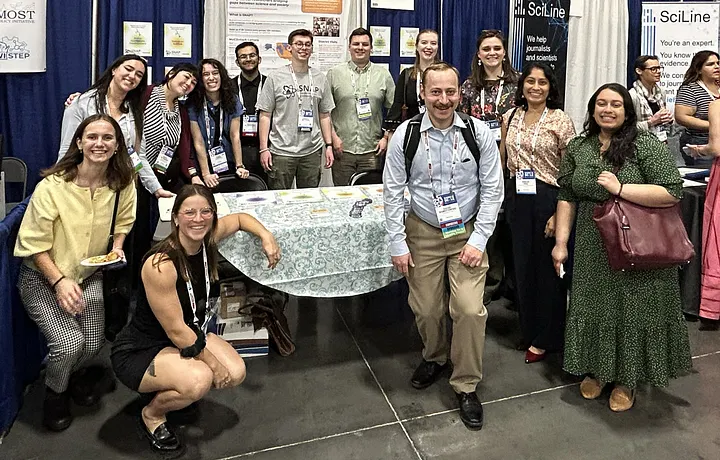
SNAP members gather around our expo table after the President’s opening address on Thursday, February 12th. Pictured: (back, left to right) Erin Morrow, Isako Di Tomassi, Alex Lando, Youssef El Gharably, Andrew Mattson, Brendon Davis, Mikayla Smith-Craven, Madison Haley, (front, left to right) Hannah Kubinski, Emma-Rose Newmeyer, David Ramotowski, Sneha Rao, Prianka Hashim
Photo credit: Jordan Williams
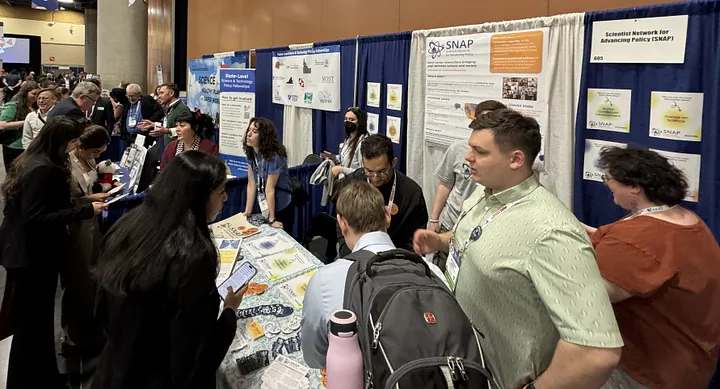
SNAP members were (happily) swamped at the expo booth on opening night, February 12th. We shared our mission, got sign-ups for our mailing list, and gave away merch.
Photo credit: Sneha Rao
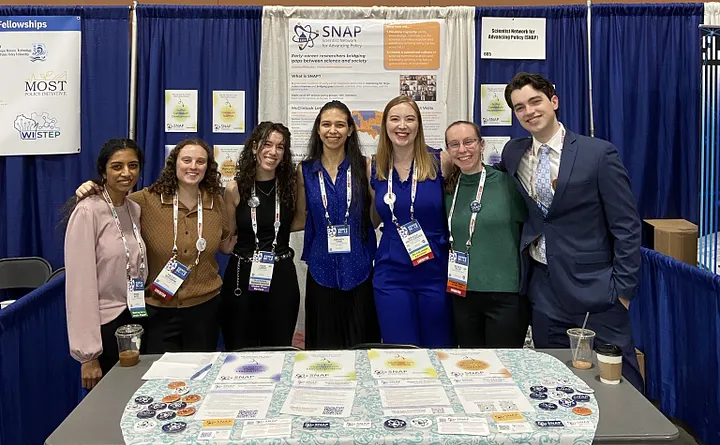
A group of SNAP members open up the expo booth on Friday, February 13th. Pictured (from left to right): Disha Patel, Hayley Sussman, Alex Lando, Amanda Finn, Mikayla Smith-Craven, Becca Blyn, and Miles Arnett.
Photo credit: Dimitris Boufidis
SNAP Plenary Discussion
The first AAAS meeting took place in 1848. In the 178 years since, graduate students had never taken the plenary stage. This year, SNAP changed that.
The first AAAS meeting took place in 1848. In the 178 years since, graduate students had never taken the plenary stage. This year, SNAP changed that. Five of SNAP’s founding members — Alex Rich (Yale), Erin Morrow (UCLA), Isako Di Tomassi (Cornell), JP Flores (UNC Chapel Hill), and Miles Arnett (UPenn) — shared how SNAP formed, what initiatives SNAP has implemented, and how ECRs face unique challenges in the current environment. Examples of these challenges include loss of funding opportunities [1–4], a shrinking number of spots in PhD programs [5, 6], and increased uncertainty in the job market [7–9].
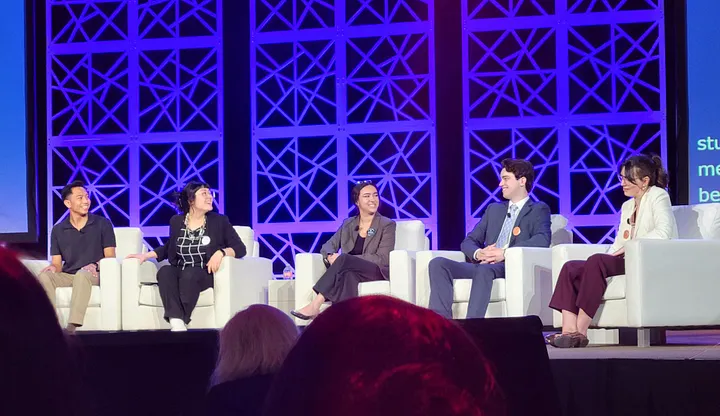
(from left to right) JP Flores, Isako Di Tomassi, Erin Morrow, Miles Arnett, and Alex Rich, some of the founding SNAP members, sit on the AAAS plenary stage and discuss the founding of SNAP and ECR involvement in science policy.
Photo credit: Katie Randolph
This panel, moderated by Science editor-in-chief Holden Thorp, shared insights on how these founding members created and grew the SNAP community, increased ECR engagement in science policy, and connected ECRs with their communities. And all while being graduate students themselves! The conversation emphasized changing the landscape of graduate student training. “The reality is that even if you are a PI and you’ve had that [science policy and communication] education at some point, it’s been driven home to you that understanding that is part of what it means to be a scientist,” emphasized Miles.
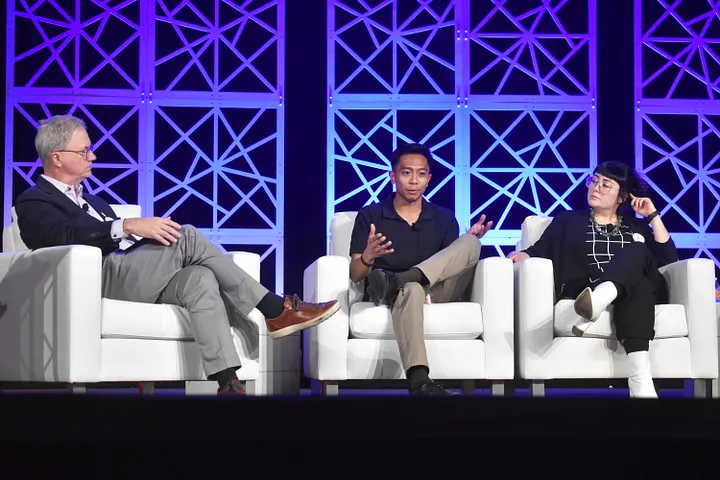
Moderator Holden Thorp (left) looks on as JP Flores (middle) answers a question, gesturing to make his point. Isako Di Tomassi (right) looks on as JP answers.
Photo credit: Naman Srivastava
The panel ended with a strong call to action through conversation and collaboration, where Alex pointed out that academics “talk about [public] mistrust in academia and none of the public is present. [We need to be thinking] about how do we actually talk together, work together, build infrastructure together and take action on public trust in higher education?” Building upon Alex’s point, JP added, “What is the actionable thing? What are people in this audience going to do when they go back to their home institutions on Monday?” emphasizing the importance of attending conferences and having conversations to ultimately channel that experience into tangible action to bring about change. The powerful discussion encouraged audience members to connect with the plenary speakers and other SNAP members with words of support and offers of collaboration, sharing that they too wish to see a change in the broader scientific landscape.
SNAP Reception
In the evening following SNAP’s historic plenary discussion, around 200 conference-goers attended the SNAP reception, which served as our introduction to the AAAS community in an informal and social setting. While the larger panels, workshops, and lectures provided great insight on scientific communication, policy, and outreach, the reception allowed SNAP members to better know the people behind the science, learn more about specific topics, and develop rapport with other AAAS attendees. The reception also provided additional opportunities for SNAP members to share more about SNAP, its mission and values, and the incredible work that SNAP members are doing.
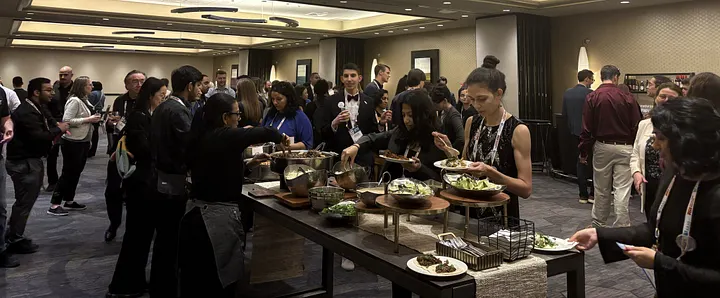
People mill around the reception area. Some get food, others are getting drinks. Conversations are heard all around.
Photo credit: Jordan Williams
We encouraged attendees to reflect on their work and how they communicate with others with a combination of playful and serious prompts on poster boards throughout the room. We asked questions like “What does your family think you do?”, “What would you change in academia?”, and “What brought you to this conference?”
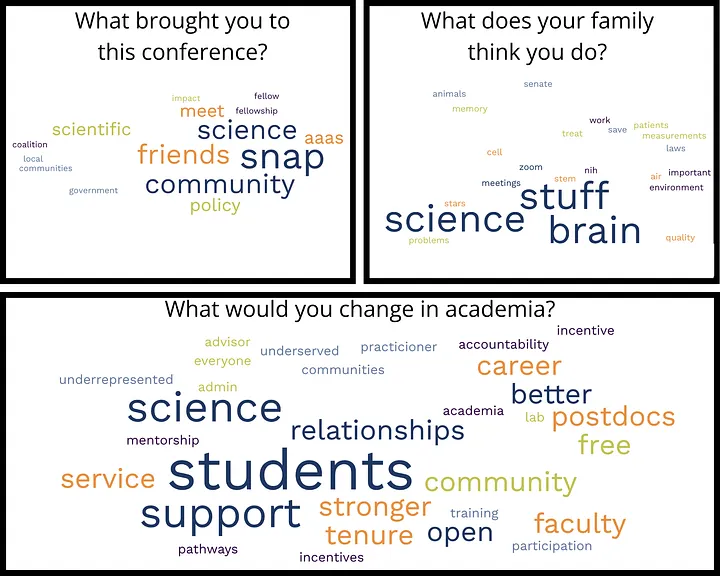
Word clouds generated from the responses we received at the SNAP reception to our poster board questions. What common themes can you spot?
We ended the reception by toasting to SNAP, what we’ve accomplished in one short year, and our future plans.
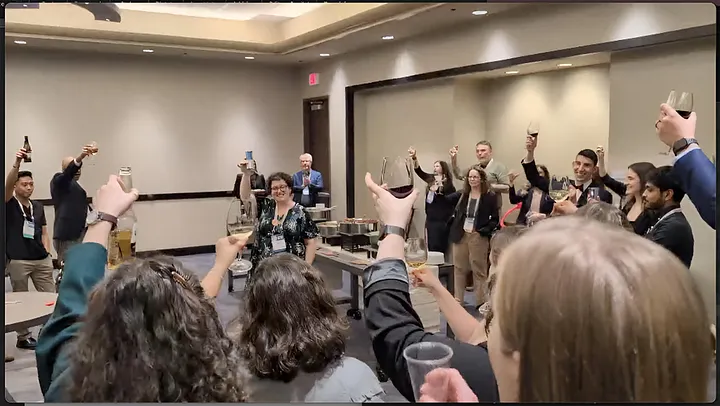
SNAP member Jordan Williams (center) offers a toast to thank those who attended the reception and asks the audience to continue supporting SNAP and ECRs in the science policy space.
Photo credit: Miles Arnett
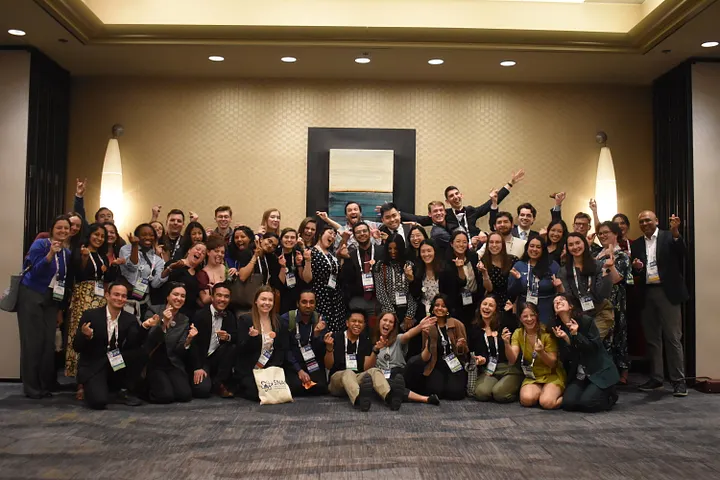
A silly group photo of all SNAP members present at the reception, along with AAAS CEO Sudip Parikh and AAAS Chief of Staff & Chief of Public Affairs Officer Andrew Black.
Photo credit: Naman Srivastava
Poster Presentations by SNAP Members
Poster presentations are an essential part of attending any scientific conference. We were fortunate enough to support seven SNAP members who presented on their research or past SNAP initiatives. SNAP members Alex Byrne, Ashley Eng, Brendon Davis, Bryce Wedig, David Ramotowski, Shreya Venkatesh, and SNAP affiliate Tim Mulderrig presented e-posters to judges, after which they answered questions from the judges. Unlike the discipline-specific conferences that scientists typically present research at, the broad audience challenged the presenters to avoid jargon. The judges often asked questions regarding the community applications of the presenters’ research, a novel question for some. The 3-minute time limit forced our members to condense the impact of their science into a few memorable sentences.
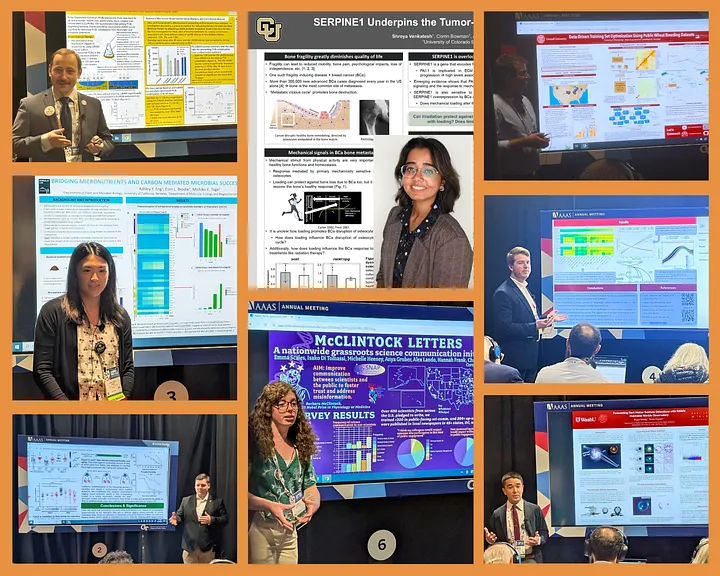
A collage of poster presentations from SNAP members and affiliates (left, top to bottom) David Ramotowski, Ashley Eng, Brendon Davis, (middle, top to bottom) Shreya Venkatesh, Emma Scales, (right, top to bottom) Tim Mulderrig (affiliate), Alex Byrne, and Bryce Wedig.
Photo credits: Bryce Wedig, Isako Di Tomassi, Shreya Venkatesh, Sneha Rao
SNAP establishes itself as a vital force for advocacy
SNAP brought a simple, yet powerful message to AAAS: ECRs can and will contribute to science policy in the United States. Any ECR can join SNAP, and any SNAP member can start and join an initiative. This setup has produced several successful projects, like the McClintock Letters Initiative [10] and the Congressional District Visits [11], whose impacts were noticed in the wider community. The invigorating energy from SNAP members was contagious as SNAP inspired fellow AAAS attendees to turn inspiration into action. AAAS attendees resonated with the points made in the plenary session, and there was a broader energy to contribute to SNAP’s mission and efforts to create change within the scientific community.
SNAP brought a simple, yet powerful message to AAAS: ECRs can and will contribute to science policy in the United States.
We are grateful for the funding we received from the Gordon & Betty Moore Foundation and the Joshua E. Neiman Memorial Travel Assistance Award to support our work, which allowed us to send 48 SNAP members to the AAAS Annual Meeting. This provided our members with an incredible opportunity to meet in person, celebrate all the past year’s successes, and make SNAP’s entrance into the science policy community. Now, in the wake of the AAAS Annual Meeting, we are looking forward to forging new connections and expanding our bases so that we can continue to work collectively in support of science and scientists.
Looking forward
How do newly-minted Ph.D.s effectively communicate the broader societal impacts of their work when most graduate programs do not provide them with opportunities to develop this skillset? The lack of training in scientific communication and the societal applications of our work means we must develop these skills independently, balancing research duties with outside professional development so we are able to articulate the importance of our work.
SNAP’s greatest strength lies in the bonds between its members. We are proud of the community we have built, in which members can learn and grow from one another through peer mentorship. SNAP serves as a reminder that great things can be done when people unite in support of a common cause. Over the past year of advocacy and outreach coordinated over online meetings and Slack messages, SNAP members gained deep admiration and respect for each other. Hence, it was incredibly special to meet each other in person. We spent the final evening of the conference hanging out and having casual conversations over pizza to reflect on what we learned at the conference and turn those lessons into action. Although there is always more work to be done, community-building is the first step to ensuring the future of science is safe.
The AAAS Annual Meeting reminded us that research does not exist within a vacuum. Successful research and applications are often due to community and collaboration, and scientists can continue to drive that by being a part of the community and policymaking spaces. As AAAS drew to a close, many were inspired to take action in ways to positively impact their societies, communities, and states. Attendees gained a new perspective on how scientific research can be used to help society and drive science-informed policy decisions.
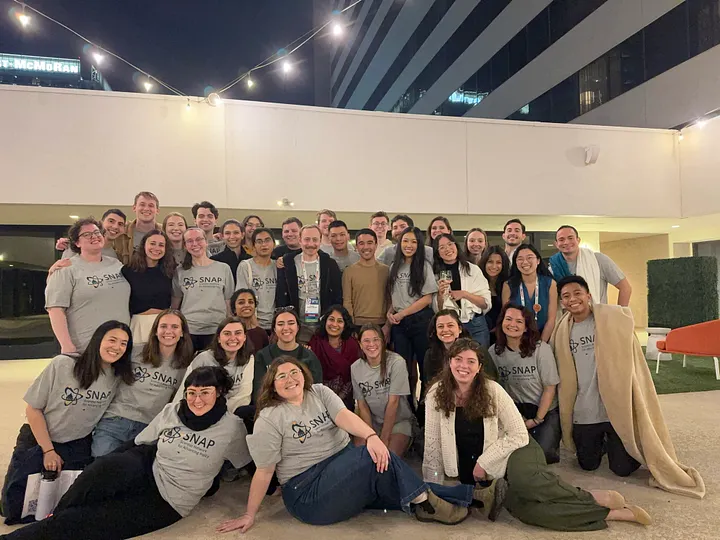
SNAP members celebrated their final night together with a pizza party and poolside hang out in matching SNAP t-shirts.
Photo credit: Emma Scales
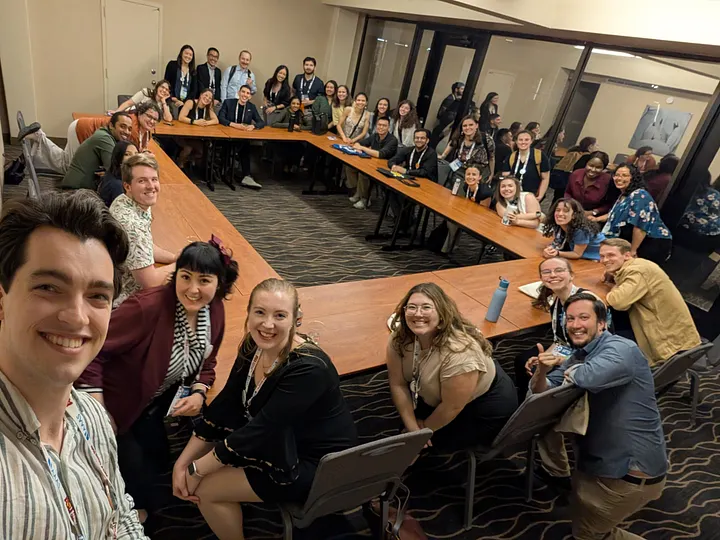
SNAP members gather in a hotel meeting room on the first night of the AAAS annual meeting to go over last minute checks.
Photo credit: Miles Arnett
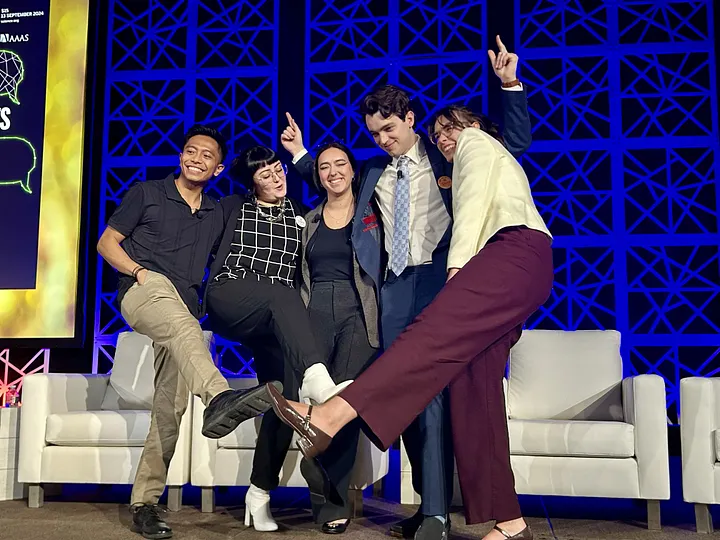
SNAP panelists (left to right) JP Flores, Isako Di Tomassi, Erin Morrow, Miles Arnett, and Alex Rich celebrate the end of a historic plenary discussion featuring ECRs.
Photo credit: Jordan Williams
Recognition:
This article was authored by SNAP members Disha Patel and Jordan Williams. Disha Patel is a biochemist studying protein folding and secretion by leveraging high-throughput methodologies. Jordan Williams is a pharmacology PhD candidate studying how to alter the lung’s innate immune responses to better treat chronic respiratory infections.
A special thanks to our fellow SNAP members who provided feedback on this blog post: Bryce Wedig, a PhD candidate in physics studying dark matter in distant galaxies; Cael Dant, a botanist studying carnivorous plant physiology and their ecological interactions with microbes; Emily Selland, an ecologist and public health scientist whose research focuses on sustainable and economically viable innovations for infectious disease control; Isako Di Tomassi, an agricultural researcher in the 3rd year of her PhD studying fungal and oomycete biology; and Kassandra Fernandez, an engineering education researcher and PhD candidate with a background in medical microbiology.
And finally, the biggest thank you we can possibly muster for all our fellow SNAP members. You all are the most incredible people we’ve ever met and we are beyond honored to reflect on the work you have done and will do. Here’s to many more meet-ups (both physical and virtual), Slack jokes, and “we’ll do it ourselves” moments!
References:
- Barbu, B. (2025, October 3). Last-minute changes for NSF graduate fellowships spark chaos. Chemical & Engineering News. https://cen.acs.org/policy/research-funding/Last-minute-changes-NSF-graduate/103/web/2025/10
- Langin, K. (2025, February 21). U.S. early-career researchers struggling amid chaos. Science. https://www.science.org/content/article/u-s-early-career-researchers-struggling-amid-chaos
- Kaiser, J. (2026, February 20). NIH research grant funding rates plummeted in 2025. Science. https://www.science.org/content/article/nih-research-grant-success-rates-plummeted-2025
- Gardner, E. (2026, February 6). Graduate Students’ NSF Fellowship Applications are Being “Returned Without Review”. Eos. https://eos.org/research-and-developments/graduate-students-nsf-fellowship-applications-are-being-returned-without-review
- Hersher, M., & Mervis, J. (2026, January 26). U.S. government has lost more than 10,000 STEM Ph.D.s since Trump took office. Science. https://www.science.org/content/article/u-s-government-has-lost-more-10-000-stem-ph-d-s-trump-took-office
- Palmer, K. (2025, April 11). The Ripple Effects of Draining the Ph.D. pool. Inside Higher Ed. https://www.insidehighered.com/news/students/graduate-students-and-postdocs/2025/04/11/how-drop-phd-students-could-affect-colleges
- Nietzel, M. T. (2026, January 29). Hard Times Have Come For The PhD Degree. Forbes. https://www.forbes.com/sites/michaeltnietzel/2026/01/29/hard-times-have-come-for-the-phd-degree/
- Nash, P. (2025, November 3). US to face $480bn yearly losses from shrinking STEM talent pool. The PIE News. https://thepienews.com/us-to-face-480bn-yearly-losses-from-shrinking-stem-talent-pool/
- Kozlov, M., Tollefson, J., & Garisto, D. (2026, January 20). US Science after a year of Trump: what has been lost and what remains. Nature. https://www.nature.com/immersive/d41586-026-00088-9/index.html
- The New York Academy of Sciences. (2025, June 2). The McClintock Letters Initiative to Support Science. NYAS. https://www.nyas.org/ideas-insights/blog/the-mcclintock-letters-initiative-to-support-science/
- Drake, J. (2025, December 3). Students Advocate For More Science Funding. Forbes. https://www.forbes.com/sites/johndrake/2025/12/03/students-advocate-for-more-science-funding/