The Lab Bench under Fascism
Written by SNAP member Emma Scales
*This article contains discussion of sensitive subjects including genocide, racism, and murder. It in no way encapsulates the full scale of atrocities committed by the fascist regimes discussed herein, nor does it attempt to.
Thoughts and views written in this blog reflect those of the author only, and not necessarily those of every SNAP member or the SNAP coalition as a whole.
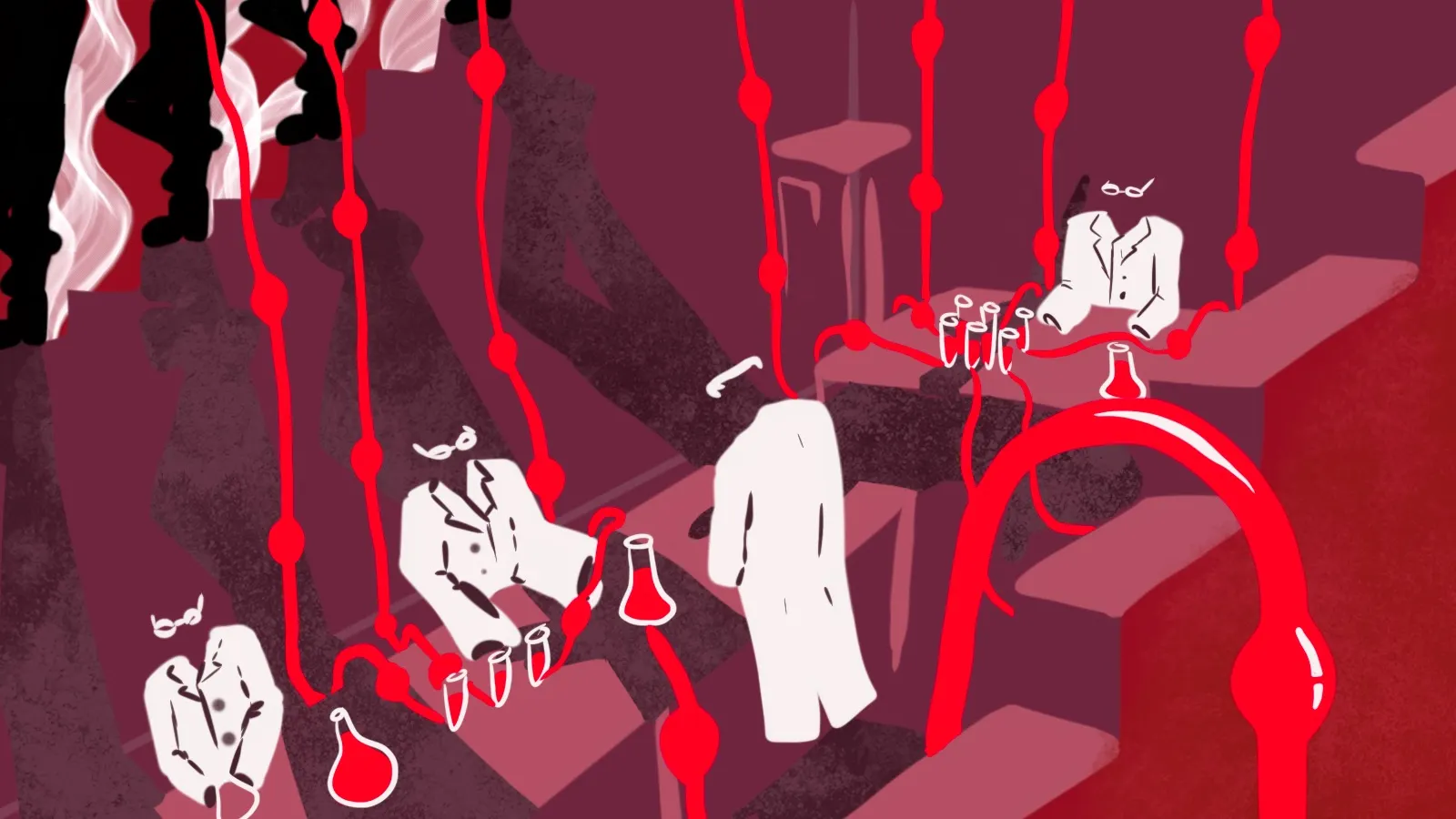
Illustration by Emma Scales
Around this time last year, prominent historians put out a smattering of thinkpieces in popular magazines and newspapers communicating a shared concern: the United States government was flirting with fascism [1-4]. Key tenets of their arguments were the government’s attacks on academia and suppression of intellectualism.
When historians sounded the alarm, they pointed to the federal government’s science and research policies as well [2]. What do these policies surrounding scientific research in the “hard sciences” like biology have to do with authoritarianism, and more specifically, fascism? A lot, as it turns out.
As a civically-engaged biologist and voracious history buff, I want to invite you down the rabbit hole with me to learn why ideologically-driven changes to science policy are alarming. This article takes a critical lens to how fascist regimes of the past wielded both the suppression and weaponization of scientific biological research1 as a double-edged sword, so we can evaluate our present from a sturdier foundation.
What is fascism?
Before we dig deeper, we must undertake the messy business of defining fascism. George Orwell famously wrote,
“The word Fascism has now no meaning… Words of this kind are often used in a consciously dishonest way. That is, the person who uses them has his own private definition, but allows his hearer to think he means something quite different.”
I am going to avoid this offense by being explicit about my relatively liberal definition of fascism for the purpose of this article.
A fascist regime is one that:
- Answers to a dictator or strongman figurehead enabled by a cult of personality or idea that demands unquestioning loyalty [5]
- Violently suppresses opposition through “micropolitical power” in everyday life [6]
- Justifies actions of “internal cleansing and external expansion” [5] with a guiding belief of national or ideological, and often racial or ethnic, superiority
In other words, as put succinctly by the King of Fascism himself, Benito Mussolini: “Everything in the State, nothing outside the State, nothing against the State” [7].
It would, of course, serve a modern fascist regime to disrupt and exert control over academic work that involves critical inspection of the past and present sociopolitical environment to deter criticism and opposition. But how can vast disruptions to the scientific research ecosystem be a harbinger of fascism?
Science under fascism
In researching science under fascism, I gained a deeper appreciation for how fascists work to spread their ideological framework throughout every level of society, truly earning historian Harry Harootunian’s descriptor as “micropolitical power” [6]. Like other aspects of life under fascism, the practice of science under a fascist regime often mirrors the regime itself: a coalescence of power under deified individuals in charge; eradication of science and scientists that contradict the regime; technological development that advances a “technological imaginary” [8] embedded in an ideology of national greatness and superiority above all else; and deeply flawed, often horrifyingly inhumane biomedical research designed to support ethnic superiority and racism.
This is all enabled and codified by science policy. In this way, research and development imbued with fascist ideology directly enables and actively advances the fascist regime. Drastic changes to science policy that widely alter and, where possible, weaponize the practice of science for the advancement of fascist goals is a critical and often overlooked tool of fascism.
Eradicating opposition
For fascism to take root, it must stamp out any opposition. In 1931, “Il Duce” Benito Mussolini, founder and head of the National Fascist Party of Italy, demanded university professors sign an oath of loyalty to him as a condition of employment2. In response to rumors of hesitancy to sign on, the state published the names of the only 11 professors who refused the oath out of more than 1,200 [9].
Months after Hitler came to power, the Nazi regime codified the expulsion of all “non-Aryan” university teachers and those “whose former political activity affords no guarantee that they will act in the interest of the national state at all times and without reservation” [10]. Over 20% of Germany’s university professors were dismissed, more than four fifths of whom were dismissed on antisemitic grounds, regardless of whether these academics were actually members of the Jewish community. Some of these scientists were successful in exile, perhaps most notably Albert Einstein, while others were permanently silenced and murdered by the Nazis or died by suicide [11]. Though less documentation of this exists, Imperial Japan also purged universities of academics deemed to contradict the military regime’s fascist goals in the late 1930’s through the 1940’s [12].
Later, U.S.-backed fascist regimes in Latin America in the 1970’s purged universities of ideological opponents and anyone suspected of harboring such views, often violently. In the first year of the military Junta rule of Argentina led by Jorge Rafael Videla, hundreds of university professors and scientists were dismissed on suspicion of opposition to the Junta, which could include something as minor as having international collaborators, or expressing doubt that unbiased science could be done in an “occidental and Christian” ethnostate [13]. Many of those who were fired were subsequently kidnapped, tortured, and even killed [13]. In Chilé under Augusto Pinochet, similar policies of overt violent repression were enacted, with students and faculty at universities suspected of supporting the deposed left-wing government dismissed, and even kidnapped, tortured, and/or killed. The legacy of this has been recently quantified by a research team led by Maria Angélica Bautista, showing that violent repression and the subsequent decline of enrollment in academic institutions as a whole enshrined in Chilean policy under Pinochet resulted in a loss of upward social mobility, especially for women, that persists long after democratization [14].
In each of these cases, fascist regimes targeted academia early in their rise, essentially as soon as they had accumulated enough power to exert influence over institutions of higher education. Whether through violent coercion, mass firings, or funding restrictions, these governments targeted academics broadly to ensure that the scientists and intellectuals who remained in influential positions would support, or at least not impede, the procession of fascism.
Scientists as complicit bystanders
I want to draw particular attention to scientists and educators who placated the government by peddling fascist ideology, or at the very least not refuting it, to advance their own careers. In Nazi Germany, the scientists who remained in the Third Reich after the political purge of academia enjoyed abundant funding from the federal government, even for projects that appear unrelated to the Nazis’ fascist goals of ethnic cleansing and conquest, especially in biological fields [15], but at an incalculable cost. Nearly 60% of biologists who remained in Germany declared as members of the Nazi party, and even those who didn’t, were able to secure funding by giving fodder to the Nazis’ impression of their own political system as “applied biology” [16]. Loyalty to the regime, or at least apathy to it, was a prerequisite for a scientific career under the Third Reich.
“[Scientists’] indifference, cynicism, and brutal careerism were essential to how fascism functioned” [17]
in Italy according to Massimo Mazzati, a History of Science professor at U.C. Berkley. In the years preceding the enactment of the 1938 race laws and following the 1931 oath of loyalty to Mussolini, the government tested the waters of public opinion with the dissemination of racist propaganda and publications defining race based on policies of oppression and segregation directed at mixed-race people living in the Italian colonies in Africa. These policies were met with silence from the academic community, though they privately considered their biological footing “foolish”, and so racism permeated Italian society uncontested by intellectuals who knew better. When the race laws were enacted, university administrators supplied lists of Jewish students and faculty to the government, double-checked for accuracy, immediately upon demand [17].
Scientists as active architects and buttresses of fascist policy and practice
The Italian race laws of 1938 were actually informed and preceded by the “Manifesto of Racial Scientists” drafted by anthropologists, zoologists, and other scientists, including prominent academics, who undoubtedly authored it at the behest of Mussolini, as the idea of an “Italian race” with “Aryan” origins is nonsensical [18]. While many Italians recognized that their ethnic ancestries were scattered throughout the Mediterranean and beyond, so-called biological scientists nonetheless supported the fabrication of a national racial identity. This manifesto served as the basis for the enactment of the race laws that essentially barred Jews and Africans from attending schools and joining professional society, and prohibited marriage between Italians and Jews, Africans, or any other “non-European” ethnic group [19]. Arguments for a superior Italian race were published biweekly by biologists, geneticists, and anthropologists in a journal of sorts, La Difesi de la Razza (Defense of the Race) from 1938 until 1945 [20].
During World War II, Axis Japan’s notorious Unit 731 program led by physicians, biologists, and chemists conducted horrific experiments on mostly Chinese victims, supposedly for the development of biological and chemical weapons and defenses against them. These experiments went far beyond that purpose and verged into outright torture [21]. One physician described the specialist in charge of Unit 731, Ishii Shiro, as “like a god to us, and we thought what he was doing was necessary for our country to win the war” [22]. In this way and others, this genocidal experimentation project was a microcosm of the larger fascist system, with a deified man at the helm regarded as infallible. Chilean scientists under Pinochet also conducted experimentation related to the development of chemical and biological warfare on political prisoners under the ANDREA program [23].
When it came to the most famous example of genocide that prompted the definition of the word itself, scientists were the wind beneath the Nazi Eagle’s wings. Geneticists advised and helped enforce the Law for the Prevention of Genetically Diseased Offspring, which codified the forced sterilization of disabled Germans in 1933. They wrote the doctrine separating “Aryans” and “non-Aryans” that formed the basis of the Nuremberg Laws and trained doctors and medical professionals in “genetic care” that allowed for the enactment of these laws [24]. Scientists and medical professionals formed the bedrock of and directly carried out national policies of sterilization and genocide that resulted in the forced sterilization of over 400,000 people and the deaths of six million Jewish people during the Holocaust and at least 250,000 mentally or physically disabled children, elderly people, adults with mental or chronic physical illness, non-Aryan people, and foreign forced laborers through gassing, lethal injection, or starvation under the Euthanasia Program [25].
To avoid the mistakes of the past, scientists must embrace their social responsibility
The truth is often uncomfortable, but we cannot neglect it; “those who do not learn history are doomed to repeat it” and whatnot. But what is the lesson to be learned from this deeply uncomfortable truth that our beloved scientific community, once thought immune to cynicism, directly and indirectly enabled the horrors committed under fascist regimes? It may be tempting to turn to more cynicism, to sympathize with scientists who were “forced” to choose their careers over the moral high ground. I would pitch an alternative takeaway grounded in a broader context.
Scientific progress often contradicts strongly held beliefs; it requires humility and flexibility of mind for a scientist to genuinely accept new findings and criticisms and integrate them into their approach. That kind of flexibility is not amenable to the advancement of fascist ideology, which insists upon infallibility and unquestioning loyalty to principles that are often at odds with reality. When viewed this way, the practice of science is inherently antifascist. Nonetheless, scientists are human, susceptible to the same manipulation and fearmongering tactics that fascists use to accumulate power, even to the draw of holding some of that power themselves, as exemplified by the fascist scientists discussed above.
This is why we must be vigilant and look out for our community. We need scientists who critically discuss what kinds of limitations are placed on research topics eligible for federal funding and pushes from the government toward research spending in specific subject areas. We need scientists who speak out, who consider the state of the world beyond issues immediately affecting their funding. We need scientists who are aware of the historical role of scientists in perpetuating fascist ideology rooted in racism, sexism, ableism, and other superiority complexes, so that we can recognize it and take action when we see the same ugly cycle rear its head. We need to remind ourselves of the horrific consequences of scientists neglecting their social responsibility3 to reinvigorate commitment to our own.
Fascism, for precisely these same reasons that make it seem so powerful, is weak. To rely on violence and coercion is to admit the foundation of your power lies in an ideological viewpoint that conflicts with reality. In other words, it is exceedingly vulnerable. It is debatable whether fascism would have risen to prominence without the support or indifference of scientists. Precisely because it has been so instrumental in the rise of fascist governments in the past, science can and should be a bulwark against fascist governments. We cannot make the same mistakes; we should know better.
Recognition:
Emma Scales is a fungal biologist and PhD candidate at Cornell University with a background in technical and journalistic writing and a passion for science communication who also serves as co-President of Cornell Advancing Science and Policy Club.
Special thanks to fellow SNAP members who provided feedback on this article: Amanda Finn, a Nutrition Sciences PhD candidate studying physiological and social determinants of insulin resistance in people with overweight/obesity; Jordan Williams, a pharmacology PhD candidate studying how to alter the lung’s innate immune responses to better treat chronic respiratory diseases; Kassandra Fernandez, an engineering education researcher and PhD candidate with a background in medical microbiology.
Footnotes:
- Note that I exclude the physical sciences and engineering advancements that fueled fascist war efforts and colonial development for brevity, but please let us know if you’d like to see a follow-up article to that effect.
- “I swear to be faithful to the King and his royal successors and the Fascist régime. I swear loyally to observe the Constitution and laws of the kingdom. I swear to exercise the office of teacher and to fulfill my academic duties with the aim of forming industrious and upright citizens, devoted to their country and the Fascist régime. I swear I do not belong nor will I belong to associations or parties whose activities are irreconcilable with the duties of my office.” The published resistors were: Bartolo Nigrisoli, pathologist at the University of Bologna; Giorgio Errera, chemist at the University of Pavia; Ernesto Buonariuti, Professor of Christian History; Giorgio Ievi, mathematician; Senator Vito Volterra, physicist at the University of Rome; Lionello Venturi, Professor of History and Art; Senator Francesco Ruffini, historian; Mario Carrara, physiologist at the University of Turin; Pietro Martinetti, Professor of Commercial Law at the University of Milan; Ernesto Ruffini of the University of Perugia, and Gaetano de Fantis [9].
- For compelling and thought-provoking arguments of scientists’ social responsibility, see Sakharov, A. The responsibility of scientists. Nature 291, 184–185 (1981). https://doi.org/10.1038/291184a0 and Bird SJ. 2014. Socially Responsible Science Is More than “Good Science”. J Microbiol Biol Educ. 15: https://doi.org/10.1128/jmbe.v15i2.870.
References:
- K. Chayka, “Techno-Fascism Comes to America,” The New Yorker, Mar. 26, 2025. [Online]. Available: https://www.newyorker.com/culture/infinite-scroll/techno-fascism-comes-to-america-elon-musk
- W. Broad, “Historians See Autocratic Playbook in Trump’s Attacks on Science,” The New York Times, Aug. 31, 2025. [Online]. Available: https://www.nytimes.com/2025/08/31/science/trump-science-autocrats.html
- M. Shore, T. Snyder, and J. Stanley, “We Study Fascism, and We’re Leaving the U.S.,” The New York Times, May 14, 2025. [Online]. Available: https://www.nytimes.com/video/opinion/100000010157022/yale-canada-fascism.html
- E. Manfredini and A. Acquistipace, “31 Nobel Laureates Warn: The Signs of Fascism are Here,” TIME, Jun. 14, 2025. [Online]. Available: https://time.com/7294056/signs-of-fascism-are-here/
- R. O. Paxton, The anatomy of fascism. New York: Knopf, 2004.
- H. D. Harootunian, Overcome by Modernity: History, Culture, and Community in Interwar Japan. Princeton: Princeton University Press, 2002.
- “Speech before the Chamber of Deputies, 26 May, 1927,” in Discorsi del 1927, Milano: Alpes, 1928, p. 157.
- A. S. Moore, Constructing East Asia: technology, ideology, and Empire in Japan’s wartime era 1931–1945. Stanford, Calif: Stanford Univ. Press, 2015.
- “FASCIST OATH DEMANDS FEALTY TO THE REGIME; Names of Eleven Professors Who Refused to Take It Are Revealed in Rome.,” The New York Times, Dec. 20, 1931. [Online]. Available: https://www.nytimes.com/1931/12/20/archives/fascist-oath-demands-fealty-to-the-regime-names-of-eleven.html
- United States Chief Counsel for the Prosecution of Axis Criminality, “Law for the Reestablishment of the Professional Civil Service (April 7, 1933),” in Nazi Conspiracy and Aggression, vol. III, Washington, DC: United States Government Printing Office, 1946, pp. 981–83.
- M. Grüttner, “The Expulsion of Academic Teaching Staff from German Universities, 1933–45,” J. Contemp. Hist., vol. 57, no. 3, pp. 513–533, Jul. 2022, doi: 10.1177/00220094211063074.
- M. Gonultas, “Resistance Against the State: A Study on the Defense of Academic Freedom in Pre-War Japan through the Takigawa Incident,” Glob. Perspect. Jpn., no. 8, pp. 140–153, Nov. 2025, doi: 10.62231/GP8.160001A05.
- Editorial Collective, “Repression of Scientists in Argentina,” Science for the People, vol. 9, no. 4, pp. 13–17, Aug. 1977. [Online]. Available: https://archive.scienceforthepeople.org/vol-9/v9n4/repression-of-scientists-in-argentina/
- M. A. Bautista, F. González, L. Martinez, P. Munoz, and M. Prem, “Dictatorship, Higher Education and Social Mobility,” SSRN Electron. J., 2023, doi: 10.2139/ssrn.4569458.
- U. Deichmann and U. Deichmann, Biologists under Hitler. Cambridge, Mass.: Harvard University Press, 1996.
- M. G. Ash, “Science, Technology, and Higher Education under Nazism,” Isis, vol. 86, no. 3, pp. 458–462, Sep. 1995, doi: 10.1086/357242.
- M. Mazzotti, “‘I Don’t Really Care. Do You?’: Scientists in the Grey Zone in 1930s Italy,” Los Angeles Review of Books, Jul. 18, 2019. [Online]. Available: https://lareviewofbooks.org/article/i-dont-really-care-do-you-scientists-in-the-grey-zone-in-1930s-italy/
- A. Gillette, “The origins of the ‘Manifesto of racial scientists,’” J. Mod. Ital. Stud., vol. 6, no. 3, pp. 305–323, Jan. 2001, doi: 10.1080/13545710110084253.
- “The Laws for the Defense of the Race,” Corriere della Sera, Milano, Nov. 11, 1938.
-
“La Difesa Della Razza Holocaust and Genocide Studies University of South Florida.” Accessed: Mar. 18, 2026. [Online]. Available: https://digitalcommons.usf.edu/razza/ - D. Barenblatt, A plague upon humanity: the secret genocide of Axis Japan’s germ warfare operation, 1. ed. New York: HarperCollins Publishers, 2004.
- F. Jacob, Japanese war crimes during World War II: atrocity and the psychology of collective violence. Santa Barbara, California: Praeger, 2018.
- K. Dewey, “Pinochet’s poisons: examining Chile’s historical interest in chemical and biological weapons,” Intell. Natl. Secur., vol. 39, no. 1, pp. 140–160, Jan. 2024, doi: 10.1080/02684527.2023.2258693.
- S. F. Weiss, The Nazi Symbiosis: human genetics and politics in the Third Reich. Chicago: Chicago University Press, 2010.
- “Euthanasia Program and Aktion T4,” Holocaust Encyclopedia. Accessed: Mar. 18, 2026. [Online]. Available: https://encyclopedia.ushmm.org/content/en/article/euthanasia-program