Scarlet Letters in Alabama's Academia
Written by SNAP member Amanda Finn
Footnotes are denoted with superscript. References are denoted with brackets.
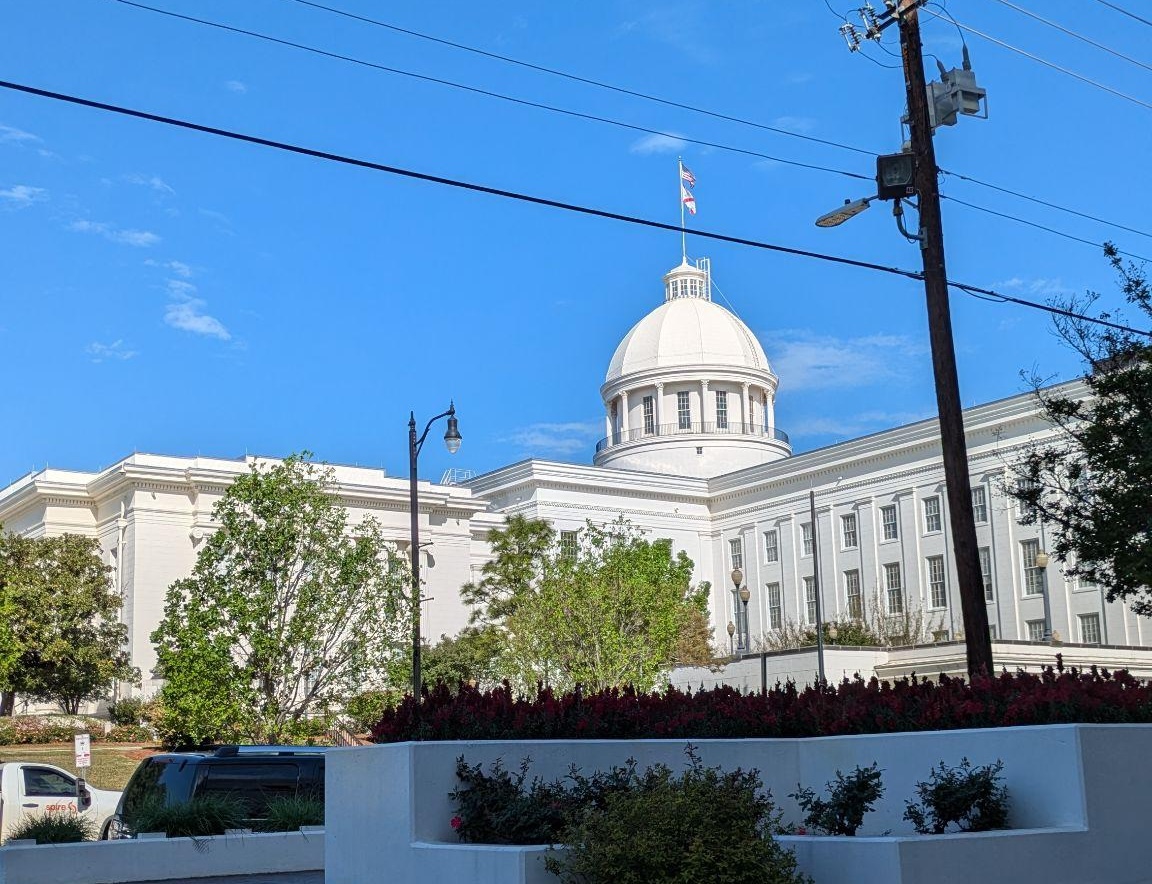
Photo of the Alabama State Capitol taken by Amanda Finn
I check the clock again. 4 AM. Another sleepless night thinking about what kind of advocacy my institution would find acceptable, if any.
On April 23rd, 2026, I will be speaking about my science policy experiences at a science advocacy webinar for the Society for the Advancement of Chicanos and Native Americans in Science (SACNAS).1 According to the society’s latest strategic plan [1], SACNAS is “the nation’s largest multicultural and multidisciplinary STEM diversity organization and has a 48-year history of network building, direct service, advocacy, and thought leadership.” Their mission is to support Chicano, Hispanic, and Native American students in obtaining advanced degrees, careers, and leadership positions, and achieving equality in STEM. I am honored to speak with SACNAS members as a proud Latina and the daughter of Central American immigrants.
When I shared this webinar with my school’s social media team, they told me that the university could not officially promote the event due to federal and state law, specifically SB 129 [2]. SB 129 defunded diversity, equity, and inclusion (DEI) programs and offices across public Alabama universities in 2024 and banned universities from advocating for “divisive concepts” that could be perceived as advancing DEI [3].
DEI can be defined in different ways, so I’ll describe what it means to me before we get into the Alabama law’s definition. Diversity in science means that leadership and other positions reflect the demographics of the population. When college presidents are predominantly older White men [4], this suggests there is room for greater diversity in university leadership, which may positively impact students’ educational experiences by bringing a range of lived experiences to the table. Equity refers to equal opportunities and treatment, although this is more than simply treating everyone as equals. Equity may include providing more resources to members of social groups who have been held back by discriminatory policies. Examples include travel awards for students from marginalized racial/ethnic/economic backgrounds who may not have the family resources to cover conference expenses. Lastly, inclusion refers to a welcoming place where people can belong. Organizations like SACNAS create a safe space for scientists to be their authentic selves, through multicultural celebrations and scientific conversations.
Last year, DEI became a collection of scarlet letters used to tag anything that represented an effort to give marginalized individuals a better chance at life and more visibility in society. Government programs [5–6], research grants [7], and historical information [8] labeled “DEI” were terminated, with some, but not all, being reinstated due to court orders or public backlash. While many students and academics around the country were shocked by these new rules, we had already feared the repercussions of being found with those three letters on our Alabama college campuses for half a year.
For example, one of the banned divisive (i.e. DEI) concepts in SB 129 is “That, by virtue of an individual’s race, color, religion, sex, ethnicity, or national origin, the individual is inherently racist, sexist, or oppressive, whether consciously or subconsciously.” [2]. This could be perceived as preventing bigotry against any group of individuals during university-sanctioned activities and courses. But when we consider that the bill’s supporters celebrated this as a ban on “far-left ideology” across Alabama campuses [3], instructors who teach subjects that may be deemed “left-wing” have to tread very carefully.
Could it be illegal to teach about the anti-Black bias embedded in countries across the globe?2 Or to assign reading about a Black woman’s experiences with medical racism?3 I’m sure most professors don’t want to be the first ones to find out.
While I was never explicitly told why the webinar violates the law, my gut says they fear that promoting it is synonymous with promoting a “DEI program”, given SACNAS’s focus on supporting Chicano, Hispanic, and Native American students.
DEI programs are defined in SB 129 as activities where participation is based on race, sex, gender identity, ethnicity, national origin, or sexual orientation [2]. While the law states that faculty or student organizations may host DEI programs as long as state funds are not used to sponsor the activity [2], it has essentially chilled free speech in classrooms and other university-affiliated operations around the state [9–10].
This is not the first time that I’ve personally witnessed the policy interfere with what should be mundane event promotions on university channels. In one case, a student was filmed wearing a university t-shirt printed in 2021 that listed DEI as a core value, and there was nail-biting about whether it was safe to post said video on social media. Another student organization leader felt uneasy about promoting one of my science policy webinars because my student group is funded by an outside organization, Research! America. Because my student group is not receiving state funding, we could technically promote “divisive concepts” at our events if we wanted to.4 It was not until the other student was reassured that neither our funders nor our webinar was focused on DEI that they shared the webinar information via personal — rather than organizational — channels.
In moments like these, lying awake at night, I feel both infuriated and embarrassed. While my fury is my own, the embarrassment is for the people committed to following unjust laws.
Martin Luther King Jr. wrote about such laws in his Letter from Birmingham Jail [11],
“Any law that uplifts human personality is just. Any law that degrades human personality is unjust. All segregation statutes are unjust because segregation distorts the soul and damages the personality. It gives the segregated a false sense of inferiority.”
The unjust laws against DEI are meant to make our work invisible and appear inferior. How else should it be interpreted if I have to dance around the organizations I’m proud to collaborate with? If the academic institutions see me as a legal liability for sharing science advocacy tips to students with similar ethnic backgrounds as myself?
I’m not asking the university president to give me an award; I’m begging the social media team for a crumb of exposure via an Instagram story or LinkedIn post. These anti-DEI policies are designed to wear us down. When we see, time and time again, that we can’t get even the barest recognition for our professional work, we start to question whether there is something wrong with us rather than with the system.
This suppression, in my opinion, is not only reserved for “DEI”. The “A” in advocacy can become another scarlet letter placed upon professors and students who challenge the status quo. Before “woke” became a pejorative, it referred to what MLK called “arousing the conscience” — having one’s eyes opened to the systemic injustices around them and feeling spurred into civil disobedience [11]. DEI initiatives often start from an aroused conscience, and may lead to programs, like the ones I’ve participated in, that aim to increase diversity in doctoral programs and the health sciences [12]. Likewise, science advocacy often arises from an aroused conscience, such as when scientists see government agencies turn away from scientific expertise in dangerous ways.
It’s not news to people involved in advocacy that the label can carry a charged connotation, depending on the institutional context. Maybe it is as simple as administrators fearing the financial repercussions of someone speaking truth to power. Maybe they realize how integral equity is to most advocacy work. For both of these reasons, professors and students who promote science advocacy, even in non-partisan ways, could be stained with the scarlet A, marking them as liabilities to their laboratory’s funding due to their candid, and often public, assessments of the research and academic landscape at state and federal levels.
I also worry that scrutiny against advocates could set up a double bind for people who belong to groups that benefit from DEI programs and are also science advocates [13]. If a Black woman speaks up against lost research funding opportunities, is her message viewed from an inherently “pro-DEI” perspective due to her race and gender?
Advocating for better science policy, scientific training programs, and improved academic incentive structures as a person of color (or someone of any other marginalized identity) will always be a threat to power. We sense the unjust laws before others and awaken consciences with our acts of resistance, whether large or small. But when policies are passed that redefine what scholarly activities are recognized and praised, many cannot afford to dedicate time to controversial or unprofessional work as they climb the academic ladder.
I’m a student for now, and am extremely grateful to all the unofficial university channels that spread the word for my events. But I can’t help but think, do I want to work for an institution that once used DEI as a marketing ploy and now bends over backward to over-comply with anti-DEI policy? Where complacency in the face of unjust laws is beneficial for my career and financial stability?
As my mentor once put it, make decisions that will allow you to sleep at night. I plan to heed his advice.
Recognition:
Amanda Finn is a Nutrition Sciences PhD candidate studying physiological and social determinants of insulin resistance in people with overweight/obesity.
Special thanks to fellow SNAP members who provided feedback on this article: Kassandra Fernandez, an engineering education researcher and PhD candidate with a background in medical microbiology; Mikayla Smith-Craven, who holds a doctorate in Pharmaceutical Chemistry from the University of Kansas where she focused on drug development and delivery of life-saving medications amphotericin B and zidovudine; and Shaurita D. Hutchins, a PhD candidate in Genetics, Genomics, and Bioinformatics focused on advancing rare disease diagnostics and ethical genomics data stewardship.
Footnotes:
- Here is the registration link for the SACNAS webinar if you’re interested!
- For further reading on anti-Blackness in Latine/Hispanic communities: Racial Innocence: Unmasking Latino Anti-Black Bias and the Struggle for Equality by Tanya Katerí Hernández
- Further reading about gender, race, and class: Thick: And Other Essays by Tressie McMillam Cottom.
- There are more rules we would have to consider beyond whether the student organization receives state funds, including how the event is marketed and where it is hosted. A “DEI” student org event would need to be completely separate from the university.
References:
- Mission and Strategic Plan. SACNAS. (n.d.).
- Senate Bill 129 (Act 2024–34), 2024 Regular Session (2024).
- Griesbach, R. (2024, March 20). Alabama gov. Kay Ivey signs dei bill into law: What the “divisive concepts” ban will do. AL.com.
- Melidona, D., Cecil, B. G., Cassell, A., & Chessman, H. M. (2023). The American College President 2023 Edition. Washington, D.C.: American Council on Education.
- The United States Government. (2025, January 21). Ending radical and wasteful government dei programs and preferencing. The White House.
- Brown, M. (2026, March 24). USDA cancels $300 million program to help farmers buy land amid anti-dei push. Politico.
- Kozlov, M., & Mallapaty, S. (2025, March 6). Exclusive: NIH to terminate hundreds of active research grants. Nature News.
- Crisp, E. (2025, March 7). 5 notable images flagged in Pentagon’s DEI purge. The Hill.
- Stephenson, J. (2024, August 27). University of Alabama closes spaces for Black Student Union and LGBTQ+ center. Alabama Reflector.
- Rocha, A. (2025, January 14). UAB students, UA Professors Sue Alabama over state law banning DEI programs. Alabama Reflector.
- King, M. L., Jr. (1963, April 16). Letter from Birmingham Jail.
- Building infrastructure leading to diversity. (2026, March 9). California State University Long Beach.
- Malcom, S. M., Hall, P. Q., & Brown, J. W. (1978). The Double Bind: The Price of Being a Minority Woman in Science. Washington, D.C.: American Association for the Advancement of Science.