Quantum Technology: A Double Edged Sword for Science Diplomacy
Written by SNAP members Andrew Mattson and Youssef El Gharably
Andrew and Youssef contributed equally to this blog post.
Disclaimer 1: One of the authors (Youssef) is a non-US citizen studying Quantum Engineering in the United States with active exclusion from national quantum research funding.
Disclaimer 2: This blog was posted on the World Quantum Day: 04/14, which resembles the rounded value of Planck’s Constant.
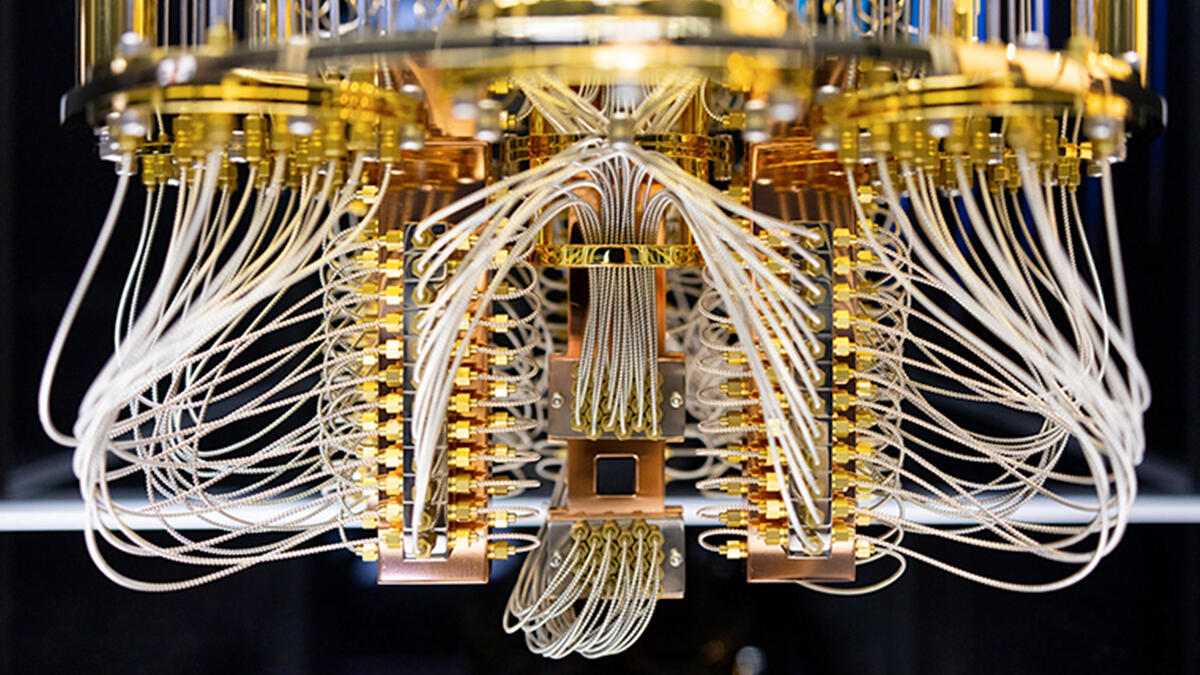
A dilution refrigerator — the workhorse of superconducting quantum computing. These devices cool quantum processors to temperatures near absolute zero, colder than outer space, to preserve the fragile quantum states that make computation possible. The dilution fridge has become one of the most recognizable symbols of the second quantum revolution. Credits to the University of California in Berkeley’s website.
In 1954, Europe’s nuclear research center (CERN) was founded with the explicit commitment to scientific openness across political divides. At the height of the cold war, this new research center included Americans, Europeans, and Soviets working together to push the frontiers of physics. However, perhaps CERN’s most underappreciated achievement was not scientific discovery, but diplomacy. Today, CERN has grown to over 16,000 scientists from 110 countries. [1] It has demonstrated that shared scientific infrastructure creates a new kind of international trust; nations develop a mutual stake in keeping the science running. The International Space Station successfully followed this same playbook of science diplomacy, using large collaborations to create and strengthen international partnerships.
On March 25th 2026, the U.S. Senate Commerce, Science, and Transportation Committee heard arguments for the National Quantum Initiative (NQI) Reauthorization Act of 2026. [2] This is the latest of many steps taken by governments around the world to position themselves as leaders in quantum technology. Quantum science and engineering have become some of the most important issues in science diplomacy, bringing physics back into the global spotlight in a way not seen since the nuclear arms race. As before, that attention brings both pressure and competition, creating the potential for opportunity or danger. Quantum physics could lead to groundbreaking technologies that improve quality of life across the globe and deepen our understanding of the universe. At the same time, these technologies could also be highly destructive. It is essential to act now to ensure this new era of innovation strengthens global science diplomacy and includes voices from many nations in the conversation.
What is quantum technology?
Pioneering work by physicists of the early 20th century (including Fermi and Einstein) led to the first quantum revolution in the 1920s. This burst of discovery led to technologies we now take for granted, including magnetic resonance imaging (MRI), nuclear energy, lasers, and maybe most importantly, semiconductor computer chips that we use every day in phones and computers. Much of this foundational research was done by scientists who were not U.S. citizens, many of whom contributed to science after immigrating to the U.S.
As our understanding of quantum physics has progressed, a second quantum revolution has begun. This revolution is centered around three main classes of new technology:
-
Quantum Sensing is the extremely precise measurement of particles as they respond to external electromagnetic fields or other particles. This field is well developed and has moved from laboratory curiosity to commercialization.
-
Quantum Computing uses quantum bits (qubits) that, unlike ordinary computer bits which are either 0 or 1, can be both at once. This is a property known as superposition. It makes quantum computers exponentially faster than classical computers in problems like drug discovery, materials simulation, and breaking encryption.
-
Quantum Communication exploits quantum properties like entanglement and superposition to transmit information in fundamentally new ways, which enables new and improved encryption but also introduces new vulnerabilities.
Why should we be concerned about it?
In 2024, NATO’s first “quantum strategy” identified quantum sensing, computing, and communication as priority military capabilities. [5] Other defense-oriented analyses list numerous applications of these technologies: submarine detection, GPS-free precision navigation, weapons design optimization, and strategic simulations on an unprecedented scale.
This has created an arms race, in which every country wants to be the first to wield these new weapons. Much like the nuclear arms race of WWII, the competition itself has become a threat; a direct consequence is the “harvest now, decrypt later” problem [6], in which countries store each other’s encrypted communications today and plan to decrypt them later.
Quantum computers could play a major role in this. It has been shown that these devices can theoretically break encryption protecting bank transactions, diplomatic communications, and medical records in seconds. [7] Quantum sensing could create additional military threats by detecting underground structures, submarine movements, and electronic devices. Prototype versions of these technologies exist right now. [8]
Quantum diplomacy right now
Standards: where diplomacy and geopolitics intersect
Technical standards are often dismissed as mere bureaucracy, but they are crucial agreements on how technologies are used and who can use them. For example, international trade and scientific collaboration require that meters, kilograms, and other quantities be universally defined; hence, the International System of Units (SI units) exists.
The current landscape of quantum communication provides a pertinent example of the importance of standards in diplomacy. The National Institute of Standards and Technology (NIST) held an international competition with submissions from researchers around the world to develop quantum versions of cryptographic algorithms for information processing and transmission. The winning algorithms came from international teams, through participation skewed toward certain geopolitical blocs. In parallel, the International Telecommunication Union (ITU) is developing its own algorithmic standards drawing from a different set of nations. [4] If ITU standards diverge from NIST standards, interoperability breaks down, and the fracture will run precisely along the geopolitical fault lines that science diplomacy was meant to bridge. Countries using one standard would not be able to securely communicate with those using the other standard.
This is an example of a negotiation happening right now, in working groups that most physicists are absent from. The focus, as always, lies on navigating the existing geopolitical tensions rather than the science itself. However, especially in the world of quantum communication, openness must be a deliberate diplomatic choice. It strengthens the chances of standardized international adoption of quantum cryptography, creating a common cryptographic foundation that improves security for every nation that uses it. A shared standard would lay the groundwork for secure communication and collaboration between nations, which is a diplomatic benefit beyond security.
Exclusion: another part of diplomacy
As international collaborations and diplomatic relationships develop, an implicit decision being made is who gets to do the science. Yet, in the world of quantum science and engineering, this is rarely mentioned.
The G7 endorsed a vision of the quantum future in June 2025 that explicitly commits to “STEM education and inclusion of underrepresented groups” as a pillar of the international framework [10], and the NATO quantum strategy talks about a transatlantic quantum community. The first quantum revolution succeeded because of international openness. Most of the major contributors to the principles of quantum theory were not American, but the U.S. provided refuge for many of them, despite significant barriers, even as immigration restrictions and religious discrimination created real obstacles.
The second quantum revolution has failed to continue this tradition, and instead treats quantum science as an export. The US Bureau of Industry and Security’s 2023 [11] interim rule imposed controls on quantum computers based on qubit thresholds. The Wassenaar Arrangement coordinates technology restrictions among 42 states. Across the U.S., international graduate students and postdocs are increasingly facing visa restrictions and being blocked from quantum research funding and programs. [12] Often, access is shaped more by nationality restrictions rather than by scientific merit. Other countries are following suit, each playing a role in accelerating a fragmentation that will ultimately cost every nation’s science. One of the authors of this essay is living this exclusion in real time as a non-US citizen studying quantum engineering at the University of Delaware. International students are excluded from the public funding that supports the very research they are advancing. The unfortunate truth is that the inclusive frameworks mentioned by G7 and NATO are being ignored in practice.
As a scientist or diplomat, what can you do?
The quantum policy and diplomacy infrastructure is being built today by scientific innovations, standards decisions, and international agreements that will shape research, collaboration, and security for decades. Scientists around the world will be greatly impacted, but are often not part of this process. Across many disciplines (physics, biology, chemistry, geology, archaeology, and more), people will either benefit from quantum technologies or suffer from their unsuccessful implementation. Beyond the lab, the world could be forever changed by the power of quantum science and engineering. To make sure these changes are for the better, there are a few things you can do:
-
Respond to requests for information. NIST, NSF, DOE, NIH, and BIS all issue RFIs when developing quantum-related rules. Most receive fewer than fifty substantive responses from experts. A single well-argued submission by a PhD student carries genuine weight.
-
Engage with standards bodies. IEEE Quantum, ITU Study Groups 13 and 17 [4], ISO/IEC JTC 1/SC 27 are actively writing the rules for quantum technology now. They need input from academics and researchers, not just industry representatives.
-
Advocate for open science. Scientists should be publicly advocating for protections of international academic collaboration, both domestically and abroad.
In the era of quantum technology, scientific knowledge is power. The expertise of scientists who understand these technologies is an invaluable resource for policymakers and diplomatic leaders. We must use that to ensure quantum science and engineering include all voices and create a better tomorrow for both those communities and the public that helped them get there.
Recognition:
Andrew Mattson is a physics PhD student developing quantum technologies for dark matter detection, gravitational wave observation, and life science/medical applications. He also serves as Science Diplomacy Coordinator for the Science Policy and Diplomacy Group at Johns Hopkins.
Youssef El Gharably is a Quantum Science and Engineering PhD Student at the University of Delaware studying quantum materials’ synthesis and thin-film growth optimization as applications for Quantum Computing hardware. He also serves as the Science Diplomacy Coordinator for the Science Policy Advocacy Coalition at the University of Delaware
We would also like to acknowledge the editors of this Blog: Bryce Wedig (a PhD candidate in physics studying dark matter in distant galaxies), Meredith Pritchard (a PhD student at the University of Texas at Austin studying particle physics), and Shaurita D. Hutchins (a PhD candidate in Genetics, Genomics, and Bioinformatics advancing rare disease diagnostics and ethical genomics data stewardship) for their feedback on this blog.
References:
- CERN. (2016). CERN Brochure: Facts and Figures.
- U.S. Senate. (2026). National Quantum Initiative Reauthorization Act of 2026, S.3597, 119th Congress.
- National Institute of Standards and Technology. (2024). NIST Releases First 3 Finalized Post-Quantum Encryption Standards.
- International Telecommunication Union. (2024). ITU-T Study Groups 13 and 17: Quantum Communication Standards.
- NATO. (2024, January 17). NATO Releases First-Ever Quantum Strategy.
- Mosca, M. (2018). Cybersecurity in an era with quantum computers: Will we be ready? IEEE Security & Privacy, 16(5), 38–41.
- Shor, P. W. (1994). Algorithms for quantum computation: Discrete logarithms and factoring. Proceedings of the 35th Annual Symposium on Foundations of Computer Science (FOCS), 124–134.
- Degen, C. L., Reinhard, F., & Cappellaro, P. (2017). Quantum sensing. Reviews of Modern Physics, 89(3), 035002.
- Ferrazzini, A. (2025). Quantum, Diplomacy, and Geopolitics: Strategic Imperatives for Defence and Security in the Emerging Quantum Era (v1.6). arXiv:2512.06052.
- G7. (2025, June). Kananaskis Common Vision for the Future of Quantum Technologies.
- Bureau of Industry and Security, U.S. Department of Commerce. (2023). Export Controls on Quantum Computing Items, FR Doc. 2023–22151. Federal Register.
- Wassenaar Arrangement. (2023). List of Dual-Use Goods and Technologies and Munitions List.