The Duel of Fates: FY2027 Budget vs. Science
Written by SNAP member Youssef El Gharably
Footnotes are denoted with superscript. References are denoted with brackets.
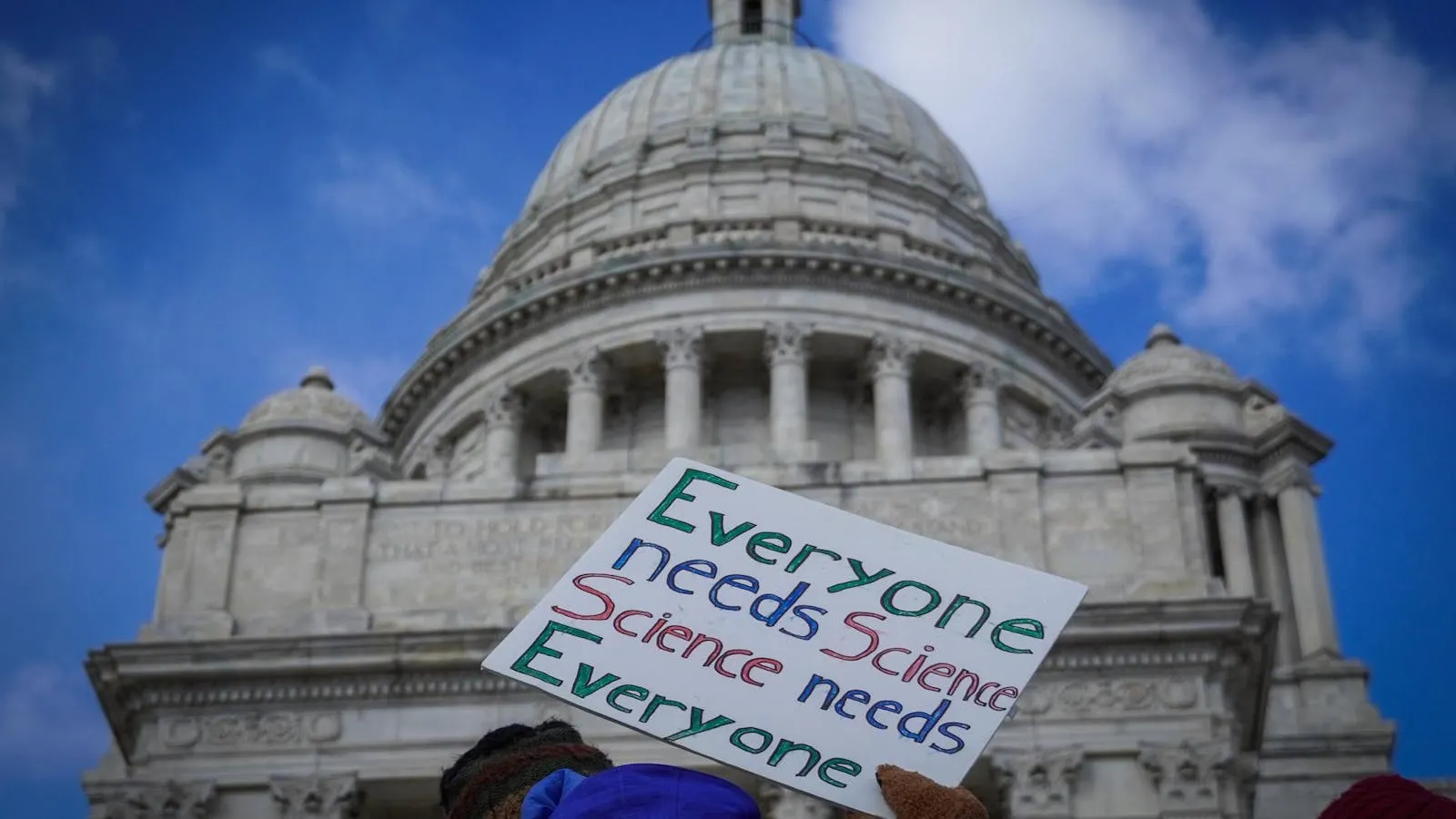
A demonstrator holds a sign outside the Rhode Island State House during a rally against federal cuts to research funding, Providence, March 2025.
TL; DR
The FY2027 federal budget proposes cutting the NSF by 55%, NASA’s science budget by 50%, NIH by 13%, NOAA by 26% [1] [2] , and DOE’s science by 15% for the second year running. Congress rejected nearly identical cuts in FY2026 because scientists and advocates pushed back. The budget is not law yet, and the window to act is now. Contact your representatives, respond to Requests For Information, and write to your local community.
The President’s Budget Request for the Fiscal Year 2027, released on April 3rd, 2026, is the administration’s formal statement of funding priorities to Congress. Congress ultimately decides how money is allocated, but this budget request informs future negotiations, so its numbers carry real weight.
The headline is a proposed $73 billion cut to non-defense discretionary spending, offset by a $1.5 trillion defense increase, which is 44% of the current FY2026 budget. Within this framework, science fares poorly across the board:
-
The National Science Foundation (NSF) has a proposed cut of $4.79 billion (55% of its current budget), which would bring the annual budget down to $4 billion. [1] Every research directorate would be reduced. Under the proposed budget, the Directorate for Social, Behavioral, and Economic Sciences (SBE), which currently funds research on human behavior, economic systems, and society, would be eliminated entirely. The administration is reportedly already moving to shutter SBE without waiting for congressional approval, [2] despite the Senate Appropriations Committee explicitly supporting its funding in FY2026.a Within the remaining budget, artificial intelligence (AI) and quantum technology would receive prioritized funding ($655 million and $231 million respectively). The rest of the research portfolio is reduced dramatically. [1]
-
The National Institutes of Health (NIH) has a proposed cut of $6 billion (13% of its current budget), bringing the total funding down to $41 billion. [1,3] The National Institute on Minority Health and Health Disparities, the Fogarty International Center (which supports global health research), and the National Center for Complementary and Integrative Health are all targeted for elimination. The budget also proposed capping indirect cost reimbursements (the overhead funding that keeps university labs operational) at 15% of total grants, an idea Congress rejected repeatedly in appropriations law. Federal courts also declared this cap unlawful in January 2026.b [4]
-
The National Aeronautics and Space Administration (NASA) has a proposed cut of $5.6 billion (23% of the current budget), bringing it down to $18.8 billion. [2] NASA’s Science Mission Directorate would be cut nearly in half, by $3.4 billion. This ends missions including the Mars Sample Return Mission and SERVIR.c [5]
-
The Department of Energy (DOE) Office of Science has a proposed cut of $1.1 billion (15% of its current budget), bringing it down to $7.14 billion [1,6]. The Biological and Environmental Research program (which funds atmospheric science, climate modeling, and ecosystem research) would be cut significantly. At the same time, the administration proposes a new Office of Artificial Intelligence and Quantum (AIQ) with a $1.2 billion budget, focused on AI supercomputers and quantum infrastructure at national labs. ARPA-E, an agency within DOE that funds early-stage clean energy R&D, would be cut by 43%, bringing it down to only $200 million. [6]
-
The National Oceanic and Atmospheric Administration (NOAA) has a proposed cut of $1.6 billion, bringing the agency down to $4 billion. [7] For the second consecutive year, the budget proposes eliminating NOAA’s office of Oceanic and Atmospheric Research, effectively shutting down the research infrastructure that supports the nation’s core weather forecasting and climate monitoring. Congress rejected this proposal for FY2026, yet it returns unchanged. [7,8] Independent analysis suggests that NOAA grant activity in early FY2026 has already collapsed to a fraction of historical norms: seven new grants were issued through March 2026 compared to 379 during the same period in 2025. [8] This suggests that cuts may already be underway through administrative actions before Congress has weighed in — witholding allocations to agencies, slowing or pausing grant approvals, and declining to spend funds appropriated by Congress.
-
The Centers for Disease Control and Prevention (CDC) has a proposed cut of approximately $4.6 billion (41% of its current budget), [9] with a significant portion being shifted to a new agency: the Administration for a Healthy America. Programs targeting minority health, occupational safety, and environmental health would see the deepest reductions with the cuts and shifts.
-
The Department of Education has a proposed cut of $2.3 billion (2.9% of its current budget). [1] The Institute of Education Science (which funds evidence-based education research) would be cut by 67%. The budget would also eliminate the Regional Education Laboratories and Statewide Longitudinal Data Systems programs.d
-
The budget also proposes a ban on using federal funds to pay for “expensive” academic journal subscriptions or publishing fees, unless specifically required by statute or approved by an agency. [1] The proposal does not define which journals would be affected or what “expensive” means.e Most early-career scientists are required to publish to graduate or remain competitive in academia, and they cannot afford standard journal fees even for the lesser-known journals. These fees (often referred to as Article Processing Charges or APC) vary between $1500 to as high as $15000, depending on journal prestige, with open-access (subscription-free) articles costing extra. Furthermore, most early-career scientists’ labs rely on open-access mandates, and their institutions alone depend on government-funded subscriptions. The ambiguity in this item alone is disruptive.
What these numbers mean in practice
Numbers at this scale are hard to internalize, so this is what they mean in practice. When the NSF loses half of its budget, grants don’t just get smaller–they disappear. Research programs end mid-project; graduate students lose funding; postdocs and PIs seek positions abroad; laboratory infrastructures get dismantled. [10] The researchers who could have made the next breakthrough in their field instead find that no funding exists for their work to continue.
When the NIH’s indirect cost recovery is capped at 15%, universities face a difficult choice: absorb the difference from other sources, or cut programs, facilities, and staff to make research possible. [11] For smaller institutions already operating on tight margins, the latter becomes the more likely outcome.
When NASA eliminates 40 space missions, they eliminate instruments already built, terminate data collection already underway, and slash international partnerships already established. The instruments will be faced with no choice but to collect dust in the lab while their builders seek other opportunities to stay in science.
When NOAA’s research office is eliminated, we lose the people who monitor the atmosphere, model extreme weather conditions, and analyze climate data that supports forecasts for families, farmers, emergency managers, and local governments. [7,8,12]
On the other hand, some programs received sustained or increased funding compared to last year’s budget proposal. AI and quantum computing research would be maintained and increased across DOE, NSF, and the Department of War. The Artemis moon program would receive $8.5 billion. Defense spending would reach $1.5 trillion. [1] Overall, the budget reflects a clear set of priorities: strategic technologies with near-term national security applications and military capabilities, with an unfortunate oversight of the fundamental science that makes these applications possible.
These investments are not necessarily misguided–AI and quantum computingf are genuinely transformative. However, a healthy research ecosystem is made up of more than its frontier technologies. It consists of the soil and air that nourish these new developments: the basic science that produces unexpected discoveries, the training pipelines that produce researchers, the social and behavioral sciences that tell us how technologies interact with societies, and the environmental science that tells us whether the Earth will live to see those technologies. One cannot indefinitely harvest the fruits of science while trimming the roots.
What you can do, and what Congress can do
The budget proposal is not law — the President proposes, but Congress ultimately decides how federal money is spent. Congress holds the power of the purse, and the FY2026 process demonstrated that there is bipartisan support for core science funding. [13] This dynamic has not changed. If you’re a researcher or someone concerned about cuts to science funding, here’s what you can do:
-
Contact your congressional representatives directly and tell them specifically what your research does, its impacts, what funding agency supports it, and what would happen if that support dissolves.
-
Write for your local community. SNAP’s McClintock letters campaign demonstrated that op-eds in hometown newspapers — not just in academic journals — move the needle. [14] Legislators read their local press. Explain to your neighbors what federally funded science means for their health, their weather, their water, and the generation their children will grow into.
-
Engage with professional societies. The American Association for the Advancement of Science (AAAS), the American Astronomical Society (AAS), and other societies are actively mobilizing now. Many professional societies also publish newsletters and policy alerts that keep members informed about developments in their fields — subscribing is an easy first step to stay engaged. They need member voices to amplify their advocacy!
-
Respond to Requests for Information (RFIs). When agencies like NIST, NSF, NIH, and BIS develop new science-related rules, they publish formal requests for public expert input. These RFIs appear several times a year and a well-argued submission from a PhD Candidate or PI carries genuine weight.
If you’re a policymaker or a policy staffer, the FY2027 budget request is asking you to make a losing bet that the United States can cut foundational science funding while maintaining technological leadership, and it can also dismantle PhD training pipelines while expecting a strong research workforce. The appropriations window is open now, and the 2027 fiscal year begins October 1, 2026. The window to act is now.
The United States has never built its future by betting against knowledge, and this is not the year to start.
Recognition:
Author: Youssef El Gharably is a Quantum Science and Engineering PhD Student at the University of Delaware studying quantum materials’ synthesis and thin-film growth optimization as applications for Quantum Computing hardware. He also serves as the Science Diplomacy Coordinator for the Science Policy Advocacy Coalition at the University of Delaware. Originally an Egyptian national, Youssef is trying to advocate for 3rd-world countries from within the U.S. as an international student.
Special thanks to fellow SNAP members who provided feedback on this article:
Amanda Finn is a Nutrition Sciences PhD candidate studying physiological and social determinants of insulin resistance in people with overweight/obesity.
Chad Small is a PhD candidate in Atmospheric and Climate Science at the University of Washington, where he researches how tropical phenomena can influence the severity of rainfall and flooding events in midlatitude regions.
Cael Dant is a botanist at Northwestern University and the Chicago Botanic Garden studying the physiology, ecological interactions, and genomics of North American carnivorous plants.
Emily Selland is an ecologist and public health scientist whose research focuses on sustainable and economically viable innovations for infectious disease control.
Jordan Williams is a pharmacology PhD candidate studying how to alter the lung’s innate immune responses to better treat chronic respiratory diseases.
Footnotes:
a. The Senate Appropriations Committee’s FY2026 Commerce, Justice, Science report (July 17, 2025) explicitly directed NSF to fund SBE at no less than the FY2024 enacted level, calling its research “fundamentally important” to public health, national security, education, and the interface between humans and technology.
b. NIH announced a 14% indirect cost gap on February 7, 2025. A federal district court in Massachusetts blocked it by March and permanently enjoined it in April 2025, and the 1st U.S. Circuit Court of Appeals unanimously upheld that ruling on January 5, 2026, declaring the policy unlawful. The White House administration subsequently declined to appeal further.
c. NASA’s Science Mission Directorate funds five science portfolios: Earth Science, Planetary Science, Heliophysics, Astrophysics, and Biological and Physical Sciences. Mars Sample Return is a joint NASA/European Space Agency (ESA) mission to retrieve surface samples already collected by the Perseverance rover. SERVIR is a joint NASA/USAID program that uses satellite data to help developing nations monitor and adapt to environmental hazards.
d. The Institute of Education Science (IES) is the federal government’s nonpartisan education research agency, best known for producing the “Nation’s Report Card.” The Regional Educational Laboratories translate that research into practical guidance for teachers and school districts across 10 federally designated regions. The Statewide Longitudinal Data Systems program funds infrastructures that all 50 states use to track student outcomes from early childhood through the workforce. It represents the data backbone behind evidence-based education policy. [16]
e. The budget request states verbatim: “The Budget prohibits the use of Federal funds for expensive subscriptions to academic journals and prohibitively high publishing costs unless required by Federal statute or approved in advance by a Federal agency.” It does not define “expensive” or “prohibitively high,” nor does it specify which journals would be affected.
f. See SNAP’s Blog on Quantum Technology as a Double Edged Sword for Science Diplomacy for further understanding of the potential of Quantum Computing in the future, by Andrew Mattson and Youssef El Gharably.
References:
- White House Office of Management and Budget. (April 3, 2026). FY2027 President’s Budget Request.
- Mosley, B. (April 8, 2026). President Trump Releases Another Potentially Disastrous Budget Framework for Fiscal Year 2027. Computing Research Association GovAffairs.
- FABBS. (April 11, 2026). FY27 President’s Budget Request Slashes Funding for Federal Science Agencies.
- Higher Ed Dive. (January 6, 2026). NIH cap on indirect research costs cap overhead rate on NIH grants to research universities appeals court rules
- Eos (AGU). (April 8, 2026). FY2027 Budget Request Slashes Billions in Science Funding.
- Federation of American Scientists. (April 9, 2026). Hot Takes: What the FY27 Presidential Budget Request Means for Climate and Energy.
- Balanced Weather (Substack). (April 3, 2026). White House releases FY27 budget proposal, continuing plan of massive cuts to Earth science, including elimination of NOAA Research.
- Balanced Weather (Substack). (April 3, 2026). White House releases FY27 budget proposal, continuing plan of massive cuts to Earth science, including elimination of NOAA Research.
- Voosen, P. (April 3, 2026). Slasher sequel: Trump again proposes major cuts to U.S. science spending. Science (AAAS).
- Garisto, D. (April 3, 2026). Massive budget cuts for US science proposed again by Trump administration. Nature.
- University of Washington Federal Relations Office. (April 3, 2026). Administration Releases FY2027 Budget Proposal.
- University of Georgia Extension. (March 2025). Budget cuts to NOAA and National Weather Service endanger us all.
- C&EN (January 6, 2026). Federal science agencies dodge big funding cuts for 2026.
- SNAP Coalition. (2025). McClintock Letters Initiative.
- Davis and Blyn, SNAP Coalition. (2026). The Appropriations Rollercoaster: Which Sciences Won and Lost?
- The Department of Education (2026)