Who is WHO? The World Health Organization is a Pillar of Science Policy Regulations
Written by SNAP members Becca Blyn, Sahana Kumar, & Emily Selland, who contributed equally to this piece.
Footnotes are denoted with superscript. References are denoted with brackets.
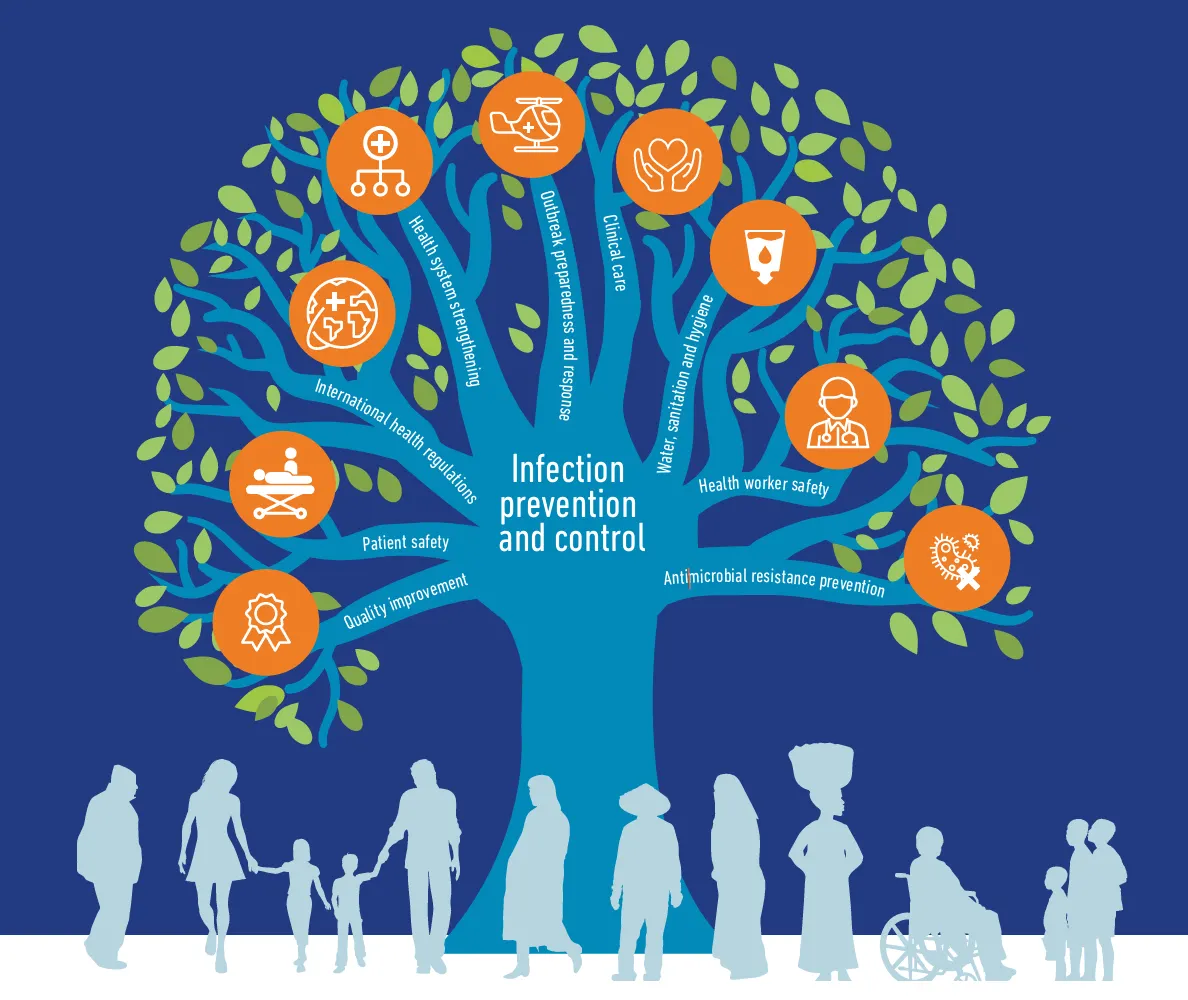
The branches of Infection Prevention and Control, as defined by the World Health Organization. This image is the cover art of WHO’s global report on infection prevention and control from 2022. source: “Global report on infection prevention and control. Geneva: World Health Organization; 2022.”
Due to the globalization of economies and travel, the spread of infectious diseases is a global crisis. The agents that cause these infectious diseases, called pathogens, do not respect country borders; we are seeing infectious diseases spread to regions of the world that were previously unimpacted [1,2]. As such, a global approach to disease prevention and elimination policies has become increasingly necessary in the past century.
The World Health Organization (WHO) was established in 1948, recognizing health as a global and fundamental human right. It’s Constitution confers various powers to WHO to ensure the highest attainable standard of health, authorizing the organization to adopt international agreements, regulations, and non-binding recommendations, to address global public health issues [3]. WHO develops health benchmarks for hospitals and public health systems in different countries, especially those that may lack the critical infrastructure necessary to develop their own guidelines, protocols, and technical briefs.
While WHO shapes global health policy through its guidance, it is fundamentally a regulating body, not a governing one, and cannot enforce direct legal or institutional consequences for member countries. International Health Regulations (IHR) are a body of international law, a byproduct of WHO’s authority, that is legally binding for the 196 member countries [4]. However, in practice, when countries fail to meet IHR obligations, they carry no formal penalties and are met with no enforcement mechanisms; furthermore, non-compliance is largely discovered through self-reporting and peer review [3]. WHO’s capacity to exercise its regulatory authority is weakened by its financing structure. Funding comes from two main sources: the countries’ membership dues and voluntary contributions1. Three-quarters of WHO’s funding comes from voluntary sources, making its priorities susceptible to influence by a few powerful donors.
Here, we examine the current capacity for science and policy by and with WHO to fight infectious diseases and prevent global spread. Given WHO’s central role in driving global health policy, we focus on its policies and guidance for three varied global diseases.
“Pandemic Preparedness” over time
In theory, developing guidance and regulations, and relying on the state’s capacity to invest in infrastructure and report on disease events, constitute effective pandemic preparedness and response. In the case of viral pandemics, however, voluntary compliance can drive major gaps and complications between the framework and reality of infectious disease control, especially when compliance has been chronically weak, and the same warnings have been issued repeatedly.
The first set of IHRs was established in 1969 to ensure maximum security against the international spread of diseases [5]. These regulations were revised after smallpox eradication in 1981 and refocused on controlling three infectious diseases: cholera, plague, and yellow fever. The global legal framework for pandemic response in the 20th century focused on the same three diseases as in the 19th century and did not account for newly emerging diseases [6].
Viruses are microscopic infectious agents that replicate in a host organism and can be transmitted through various routes, including direct contact with infected people, contaminated surfaces, or airborne particles released by infected people. In the 1930s, influenza (flu) was found to be caused by a virus. In the 1940s, the flu vaccine was developed from the inactivated virus of a single strain2. However, in 1947, researchers discovered that the flu virus changes its shape (in technical terms, its antigenic composition) each season. This scientific discovery established the need for continuous surveillance and characterization of the virus to support effective vaccine development. In 1948, WHO Influenza Centre was established, marking flu surveillance as one of WHO’s earliest priorities. The Centre was tasked with characterizing flu viruses seasonally, developing diagnostic methods, and disseminating data to support effective vaccine development [7].
In 2002, the framework for pandemic response failed to contain the impending SARS pandemic, caused by a novel coronavirus with a 10% mortality rate. The existing IHR framework required member countries to notify WHO only if cholera, plague, or yellow fever cases occurred. Without a legal obligation to report SARS cases, the disease spread to 28 countries before WHO was notified of the outbreak. WHO and GOARN (WHO’s Global Outbreak Alert and Response Network) coordinated the international response to the SARS outbreak, which involved partnerships with health services, academics, and institutions. It took them four months to control the outbreak, but earlier notification could have enabled a faster response and potentially saved more lives. [8].
The 2002–2004 SARS outbreak showed how rapidly public health crises can escalate globally, and it led to 2005 revisions to the IHR to demand that any potential public health crisis of international concern be reported. These revisions also empowered WHO Director-General to declare a state of public health emergency of international concern (PHEIC) and issue recommendations for its management and control, though individual countries were still responsible for building the necessary infrastructure to survey, detect, and respond to public health threats [9]. The first real test of these IHR revisions came in 2009 during the H1N1 flu pandemic, which was caused by another viral pathogen. The widespread response was rapid, but ineffective, as its excessive intensity caused unwarranted alarm, leading to critiques, budgetary cuts, and pandemic fatigue [10]. In 2010, the IHR review committee declared that the world was ill-prepared for another severe flu pandemic or public health crisis of that scale3.
Fast-forward to 2020, and this lack of preparation came back to bite the world on a global scale.
The Droplet vs Airborne controversy
Traditionally, infectious disease practitioners considered respiratory particles smaller than 5 μm capable of airborne transmission, and guidelines to prevent spread called for expensive precautions like hospital isolation and respirator masks [11]. Conversely, larger particles referred to as droplets called for maintaining distance and hoping for the best [11]. The WHO believed that viruses spread via large droplets rather than aerosols based on the above century-old doctrine.
In March 2020, WHO maintained that COVID-19 was transmitted via large respiratory droplets through direct contact with patients, not via the airborne route, despite the science saying otherwise. Calling it airborne was considered “misinformation” [12]. Scientists from around the world appealed to WHO to recognize that SARS-CoV-2 (the virus that causes COVID-19) is airborne, but they were disregarded. COVID-19 caused over 10 million deaths, and millions of others were left with chronic symptoms. It also cost the global economy over $14 trillion and drove millions of people into depression and anxiety, making it one of the most devastating pandemics.
After 6 months, WHO gradually changed its stance and promoted ventilation to control the spread of the virus they now recognized as airborne. This was one of the biggest blunders in the COVID-19 pandemic response, and it led to ineffective initial control strategies (mainly handwashing and surface cleaning) that resulted in devastating impacts. By the time COVID was identified in the United States, the general public and the United States government believed that WHO had “cried wolf,” and pandemic preparedness was not prioritized [10].
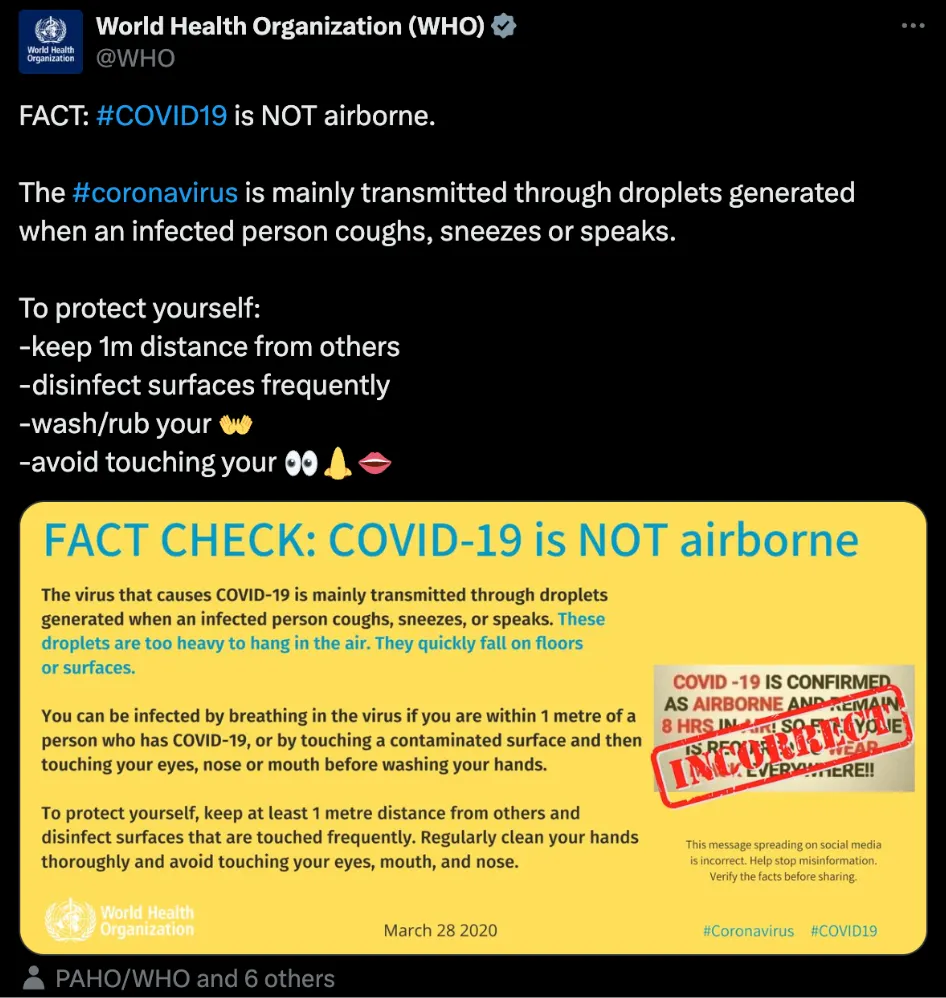
WHO tweeted in March 2020 that COVID-19 was not airborne due to droplet size, a stance it reversed 20 months later.
Viral preparedness today
WHO’s insistence that COVID-19 was not airborne stemmed from outdated scientific dogma that had gone unchallenged for a century and from the uncomfortable fact that admitting airborne spread would have required expensive respiratory protection (respirators and ventilators), potentially causing panic early in the pandemic.
Despite WHO’s slow catch-up to the science, the reckoning that followed produced some of the most significant reforms to global health in two decades. WHO published a landmark terminology reform in April 2024, declaring that infectious respiratory particles traveling through the air may be of any size and can travel any distance. Following this, IHRs were amended, introducing a new global framework for WHO to facilitate access to products, such as vaccines, and establishing a new governance infrastructure to ensure compliance by members.
This reform led to the 2025 Pandemic agreement, adopted by 124 countries, driven by the inequities and failures witnessed during COVID-19 [13]. Its core commitments address pandemic response failures: ensuring equitable access to diagnostics, vaccines, and therapeutics for low- and middle-income countries, and boosting investment in R&D infrastructure and data sharing. The agreement also recognizes the interconnections among human, animal, and environmental health, especially given the zoonotic origins of the COVID-19 and H5N1 viruses. Whether these reforms will break the cycle of ignored warnings remains to be seen. A viral pandemic is inevitable, but being unprepared doesn’t have to be.
The collaboration of WHO with local countries and experts
For all of the WHO reforms, formal documents, and agreements that shape health policy around the globe, local leaders, scientists, and governments are critical contributors and end-users. Preparation for the next viral pandemic will happen at the level of local leadership in the 124 countries that signed on to the 2025 agreement: this integration of science and governance across local-to-global scales represents WHO’s mechanism of action. While this structure is not foolproof and can be slow to follow novel scientific findings, as seen with COVID-19, it reflects the regions and countries it seeks to serve and is better for it.
This structure, as it relates to effective demonstration of science for policy4, is perhaps best demonstrated through the case of malaria, the most devastating parasitic disease that claims the lives of over half a million people each year [14]. Malaria is a vector-borne disease: it is transmitted through the bite of a female mosquito (the vector) that carries the parasite (Plasmodium spp.) from an infected person to an uninfected person. Infected individuals suffer fevers and chills, which can progress to organ failure, anemia, respiratory distress, and death [15]. Malaria’s transmission strategy defines the policies for its control and the science that supports them, from WHO policy development to regional actualization.
WHO’s position as a leader of global policy allows it to set high-level priorities and strategies; however, implementation of disease-relevant policies at the local level requires more on-the-ground coordination. This is done through partnerships between countries and WHO’s regional and country offices. Each country maintains an agreed-upon strategic priority set with WHO, which outlines the country’s health-related goals and the steps to be taken to reach those goals. These documents, called the Country Cooperative Strategy (CCS), are co-designed with local governments (often including Ministries of Health) and other stakeholders and tailored to unique local health challenges. Combined with the CCS, WHO’s country offices are positioned to support local governments for implementation, advocacy, and resource mobilization (e.g., for malaria, this includes mosquito control, preventative tools such as bednets, treatment delivery, education, and more). For example, Malawi’s CCS outlines one strategic priority to strengthen the health system capacity with direct goals to fortify malaria drug delivery. This, along with malaria incidence, will be measured across the years of the strategic plan through a partnership between WHO Country Office and the Government of Malawi5.
While the CCS outlines country-level strategies and goals, WHO develops global guidelines covering best practices and recommendations for clinical practice, policy, or both6. These guidelines evaluate evidence and recent scientific developments and successes, providing an action-oriented tool for countries and other stakeholders to utilize. The recent guidelines on malaria (released in August 2025) are contained in an almost 500-page document, outlining recommendations for prevention, case management, interventions for elimination, and surveillance of the disease, and they are accompanied by a global technical strategy [16,17]. Importantly, these documents were developed both by and for local governments, stakeholders, and other actors. While the process is well-developed for malaria, which may receive higher attention and funding compared to some other tropical diseases, given its outsized morbidity and mortality [18], the same underlying process applies for the development of guidelines for other diseases, even those which may be neglected in funding and attention7.
The malaria guidelines and strategies were developed by the Global Malaria Program (GMP), consisting of regional advisors based in endemic countries. Two advisory boards, the Malaria Policy Advisory Group (MPAG) and the Technical Advisory Group on Malaria Elimination and Certification (TAG-MEC), fall within the GMP. MPAG has 12 countries represented across the 16-person membership, comprised of medical doctors, independent researchers, and regional directors [19]. TAG-MEC has 9 countries represented in its 13-person membership8. But the 16 individuals on MPAG do not review evidence and develop guidelines alone. The GMP puts out a call for experts to assist in the development of these guidelines, calling for both “relevant technical experts” and “end-users… who will adopt, adapt, and implement the recommendation” [20]9. By ensuring diverse individuals from different backgrounds are involved in the translation of scientific evidence to recommendations, WHO enables the development of strong science-policy with robust, actionable, and evidence-based guidelines.
From science and policy into action
Of course, these recommendations and CCS have to be put into practice. In action, Malawi is deploying several interventions against malaria, made possible by collaborations and partnerships with WHO and other groups [21]. Atop preventative measures and mosquito control, including those targeting hard-to-reach rural areas, Malawi is one of the countries contributing to WHO evidence-based policy recommendations for a novel vaccine. In 2021, WHO determined that the vaccine (named the RTS,S vaccine) was successful in tests across three countries, including Malawi, and began recommending it for children living in endemic areas [22]. Malaria vaccines are now “strongly recommended” with a “high certainty [of] evidence” according to the most recent WHO guidelines for malaria [23]10. The local and international collaborations that enabled vaccine trials, scientific assessments, guidelines implementation, and, now, roll-out across more endemic countries cannot be understated. The trial itself was actualized “by WHO and supported by [numerous] ministries of health and partners, including PATH, UNICEF and GSK and financed by Gavi, the Vaccine Alliance, the Global Fund to Fight AIDS, Tuberculosis and Malaria, and Unitaid” [22]. The roll-out of the vaccine is truly localized, despite the large players and names contributing to its success. Malawian government employees are riding bikes with vaccines in tow to reach children across the nation [24]11. Not stopping there, WHO and Malawi local partners continue to collaborate for malaria prevention, with Malawi’s National Malaria Control Program now assessing seasonal prevention campaigns, which can be beneficial in some endemic areas due to weather driving seasonal patterns of mosquito prevalence [21].
The work of WHO is possible only because of its tight collaboration with local governments and actors in the places where the work needs to be done. This set-up maintains scientific rigor while recognizing that health policies are not a “one size fits all” approach. The international-local alliance for health progress, across malaria and other diseases, serves as an example for implementing science into policy and then into action across society.
The new normal in Global Health: U.S.’s un-collaboration
The United States has held a leading role in global health policy for decades, having joined WHO in 1948 as one of the first member countries and consistently contributing hundreds of millions of dollars to the organization each year for the past decade [25, 26]. As discussed, WHO relies on the involvement of its member countries for all components of its operation and success. Yet, on January 20, 2025, U.S. President Trump signed an executive order that began the process of withdrawing the United States from WHO. Because formal withdrawal requires a one-year notice, it was finalized early in 2026. In accordance with this decision, the U.S. stopped providing funds to WHO, withdrew American personnel who were deployed to WHO, and ended collaborative projects [27]12. This, along with the administration’s dismantling of the United States Agency for International Development (USAID) [28], has resulted in profound impacts on global health policy abroad, in countries that relied upon U.S. involvement with WHO as well as domestically within the U.S. Although there are massive ramifications of this decision on all aspects of global health policy, HIV/AIDS prevention and elimination took a particular hit.
As of 2024, there were over 40 million people globally living with HIV (human immunodeficiency virus) [29]. HIV is a virus that infects over a million people and results in over half a million deaths every year. The virus infects the body’s immune cells, which progressively causes the decline of an infected individual’s immunity and ability to fight new infections. Without treatment, this eventually results in the most advanced stage of HIV infection, called acquired immunodeficiency syndrome (AIDS). Unlike COVID-19 and flu viruses, HIV is not transmitted through airborne droplets; instead, it is transmitted through bodily fluids and typically spreads via needle sharing, sexual contact, or breastfeeding. WHO recommends a variety of infection prevention measures, the primary one being antiretroviral therapy (ART), which stops viral replication and is highly effective at preventing transmission [30]. Although HIV is preventable, there is no cure for the disease; it can only be managed through lifelong, daily treatment with ART.
The U.S. withdrawal is almost certain to negatively impact the maintenance and survival of ongoing HIV treatment and prevention programs. This is the result of the loss of significant financial contributions of the U.S. to WHO’s annual budget (~15%) and the American workers who previously supported WHO’s efforts [26]. However, it should be noted that the specific impact of the U.S. leaving WHO on HIV/AIDS prevention and control globally is difficult to separate from the sunsetting of USAID and delayed funding to associated programs [31], like the President’s Emergency Plan for AIDS Relief (PEPFAR)13. These changes in U.S. foreign aid policies on HIV control are likely to be especially devastating in regions with high HIV prevalence [32]. A recent report from Malawi’s Ministry of Health indicated that the U.S.’s decision to leave WHO would affect HIV/AIDS services, in addition to programs addressing tuberculosis, pediatric health, and emergency responses to disease outbreaks [33].
“Without U.S. support and funding for WHO leadership on [HIV/AIDS policy], countries may interpret evidence, plan for implementation and define access inconsistently, ultimately harming the global response.” — Executive Director of AIDS Vaccine Advocacy Coalition [34]
This will be especially important as novel HIV ART drugs which could improve disease treatment and prevention are developed and begin to undergo testing. Without strong global leadership and response coordination through partnerships between WHO and impacted countries, these novel drugs may end up being underutilized or unavailable to countries in need.
The U.S. withdrawal from the WHO will also have domestic impacts on public health. Michael Osterholm, director of the University of Minnesota’s Center for Infectious Disease Research and Policy, put it best: “Funding the WHO is about investing in our own health here in this country” [35]. The U.S. is currently privileged to have low transmission of most of the world’s leading infectious diseases (e.g., malaria, tuberculosis). However, a significant part of the U.S.’s low transmission comes from its previous support for WHO’s efforts to prevent those diseases in the countries in which they are most prominent [35]. Further, the decision to leave WHO means the U.S. will be less aware of emerging threats, uninvolved in key data sharing, and lacking multi-country coordination, all of which could impact the U.S. population, either through increasing pathogen spread to North America or through economic impacts due to more frequent outbreaks [36]. Critically, the U.S. has now lost access to WHO’s Global Influenza Surveillance and Response System, which tracks circulating influenza strains each year [37]. This information is essential for the development of flu vaccines by American manufacturers; we have yet to see how the recent loss of this database will impact this year’s vaccine pipeline.
Beyond domestic public health implications, there are also likely to be impacts of U.S. withdrawal on America’s role as a global leader in health. The U.S.’s major financial contributions to WHO and position as a leading member country previously allowed it to help determine WHO’s major priorities; now, other members may take on this role, resulting in the U.S. losing valuable “soft” power and diplomatic leverage [35, 38]. Additionally, as a member of WHO, the U.S. could participate in multilateral agreements and coordination with other countries, which can now only be replicated through the use of several bilateral agreements [39]. Although the U.S. has signed Memorandums of Understanding with 32 countries thus far to provide funding for a variety of diseases [40], this cannot fully replicate the connections with almost 200 countries provided by WHO membership.
U.S. States take charge
In response to the United States’ recent exit from WHO, several states have elected to join GOARN independently14. GOARN coordinates an extensive number of global technical institutions and centers, including university centers, laboratories, and government agencies. These groups work together primarily on emergency preparedness and response, ensuring that countries are prepared to identify and respond to emerging health threats. Thus far, six states have joined or announced plans to join GOARN: California, Colorado, Illinois, New York, Washington, and Wisconsin [41–44]. These states will have access to GOARN data, resources, training, and information that are currently withheld from the federal government and other non-member states, giving them unprecedented power over global health policy and decision-making. GOARN has supported the response to numerous outbreaks since its founding in 2000, including a 2025 HIV outbreak in Fiji. GOARN was able to coordinate assistance for Fiji, asking member institutions to deploy individuals to help Fiji’s HIV surveillance and epidemiological analyses [45]. Membership in GOARN may be especially relevant if the world were to face another pandemic-level threat from an emerging or existing pathogen.
Conclusion
Our health and responses to health threats are strongest when systems spanning international frameworks to local implementation are in place and enforced. While WHO sets norms and issues guidelines, countries are responsible for choosing to prioritize funding and infrastructure. Local health systems and hospitals decide what protocols are followed and disseminated to communities. When a major player withdraws from this system, like the United States, the entire architecture of global cooperation feels the strain. Yet, if we can reflect and learn from the successes (and failures) of global health and infectious disease policy, we can strive towards a truly healthy global society.
Recognition:
Sahana Kumar is a molecular biologist. Her research focuses on gene therapies for chronic respiratory diseases.
Becca Blyn is a Ph.D. candidate at the University of Washington studying the immune response to malaria in the liver and ways to improve malaria vaccine efficacy.
Emily Selland is an ecologist and public health scientist. Her research focuses on sustainable and economically viable innovations for infectious disease control.
Special thanks to fellow SNAP members who provided feedback on this article: Kassandra Fernandez, an engineering education researcher and PhD candidate with a background in medical microbiology; Disha Patel, a biochemist studying protein folding and secretion by leveraging high-throughput methodologies; and Mikayla Smith-Craven, who received her doctoral degree in Pharmaceutical Chemistry from the University of Kansas where she focused on drug development and delivery
Footnotes:
- Historically, the United States has been the largest single country funder of WHO through mandatory fees and voluntary contributions (like Bill and Melinda Gates Foundation; BMGF). After the US withdrawal from WHO, BMGF ranks as the largest overall donor to WHO.
- Inactivated viruses are rendered incapable of causing disease by using heat, radiation, or chemicals.
- We see the same pattern after the 2014–2016 Ebola outbreak, which exposed gaps in compliance and unheeded warnings.
- Science Policy is often split into 2 groups: Science for Policy and Policy for Science. Science for Policy here includes using research and scientific evidence to design better policies. Policy for Science is generally referred to as the policies that allow science to happen (such as funding opportunities).
- Additional collaborations will be critical for Malawi to achieve the goals set in its CCS, and the document notes that “development partners, NGOs, community-based organizations, traditional and religious leaders, (MoH) and other ministries and government departments and agencies” will be important for implementation. Additional partners named in the CCS are WHO Regional Office for Africa and WHO headquarters, and the United Nations (UN) country team.
- These guidelines can range drastically in topic, from creating healthy school food environments, to maternal health, to best practices for contact tracing a 500-page control of diseases such as malaria.
- Neglected tropical diseases are a group of ailments that receive disproportionately less research and control funding and attention than other diseases.
- The core responsibility of TAG-MEC is to decide which countries can be certified malaria-free. Most recently (2025), Timor-Leste was certified malaria-free. The group is not directly responsible for guideline development and evidence assessment for the guidelines.
- These expert groups may fall within more specified areas than just the disease. For example, with malaria, there was a call specifically for experts for guidelines development for malaria vector control.
- The malaria vaccine (specifically, the RTS,S/AS01 and R21/Matrix-M pre-erythrocytic vaccines) is currently only recommended for Plasmodium falciparum endemic areas. Plasmodium falciparum causes the largest number of malaria cases, dominantly in Africa, but is not the only Plasmodium spp. to cause malaria.
- The use of bikes to bring vaccines to children in hard-to-access localities is not new. The process has been used for cholera and rotavirus vaccines in Malawi in the past. Learn more [24]
- The U.S. decision to withdraw resulted in a significant cut to WHO’s budget (the U.S. contributed ~15% of the annual budget) and WHO has cut ~20% of its staff since the withdrawal. Further, U.S. staff previously provided critical technical support to WHO. Learn more [26]
- Learn more about the impact of the dissolution of USAID and disruption to PEPFAR funding [46]
- Many U.S. states have also chosen to create and join domestic public health alliances in order to form their public health policies at home. These include the Governor’s Public Health Alliance [47], the West Coast Health Alliance [48], and the Northeast Public Health Collaborative [49].
References:
- Frenk J, Gómez-Dantés O, Knaul FM. (2011). Globalization and infectious diseases. Infectious Disease Clinics of North America. 25(3):593–9, viii. doi: 10.1016/j.idc.2011.05.003.
- UK Health Security Agency. (2025, August 11). Emerging infections: how and why they arise.
- Gostin, L. O., Benjamin Mason Meier, Safura Abdool Karim, Bueno, J., Gian Luca Burci, Danwood Chirwa, Finch, A., Friedman, E. A., Habibi, R., Halabi, S., Lee, T.-L., Brigit Toebes, & Villarreal, P. (2024). The World Health Organization was born as a normative agency: Seventy-five years of global health law under WHO governance. PLOS Global Public Health, 4(4), e0002928–e0002928.
- WHO. (2024). International Health Regulations.
- World Health Assembly, 22 (1983). International Health Regulations (1969): adopted by the Twenty-second World Health Assembly in 1969 and amended by the Twenty-sixth World Health Assembly in 1973 and the Thirty-fourth World Health Assembly in 1981, 3rd annotated ed. World Health Organization.
- Wikipedia Contributors. (2019, September 23). International Health Regulations. Wikipedia; Wikimedia Foundation.
- Centers for Disease Control and Prevention. (2023, August 31). Influenza Historic Timeline 1930 and Beyond | Pandemic Influenza (Flu) | CDC.
- Rothstein, M. A., M Gabriela Alcalde, M P H Nanette, Elster, R., J D H Mary, Majumder, A., Larry, J. D., & Palmer, I. (2003). QUARANTINE AND ISOLATION: LESSONS LEARNED FROM SARS A Report to the Centers for Disease Control and Prevention.
- Merianos, A., & Peiris, M. (2005). International Health Regulations (2005). The Lancet, 366(9493), 1249–1251.
- Nerlich, B., & Koteyko, N. (2012). Crying wolf? Biosecurity and metacommunication in the context of the 2009 swine flu pandemic. Health & Place, 18(4), 710–717.
- Polianski, I. J. (2021). Airborne infection with Covid-19? A historical look at a current controversy. Microbes and Infection, 104851.
- Jimenez, J. L., Marr, L. C., Randall, K., Ewing, E. T., Tufekci, Z., Greenhalgh, T., Tellier, R., Tang, J. W., Li, Y., Morawska, L., Mesiano‐Crookston, J., Fisman, D., Hegarty, O., Dancer, S. J., Bluyssen, P. M., Buonanno, G., Loomans, M. G. L. C., Bahnfleth, W. P., Yao, M., & Sekhar, C. (2022). What were the historical reasons for the resistance to recognizing airborne transmission during the COVID‐19 pandemic? Indoor Air, 32(8).
- WHO Pandemic Agreement. (2025).
- World Health Organization. (2024, December 11). Malaria. World Health Organization.
- World Health Organization. (2023, March 27). Malaria.
- WHO. (2024b, November 30). WHO Guidelines for malaria.
- World Health Organization (2021). Global technical strategy for malaria 2016–2030, 2021 update.
- Liverpool School of Tropical Medicine (2004). Priorities on Dealing with the ‘Big Three’ Infectious Diseases: HIV/AIDS, Tuberculosis and Malaria. Infection Control Today.
- World Health Organization (n.d.) About Us: Malaria Policy Advisory Group.
- World Health Organization (2023, December 11). Call for Experts for the Guidelines Development Group on Malaria Vector Control.
- Chirwa, Meclina. (2025, July 24). Malawi Intensifies Malaria Fight with Vaccines, School Kits, and New Tools. Africa Brief.
- World Health Organization. (2024, December 11). Life-saving malaria vaccines reach children in 17 endemic countries in 2024.
- World Health Organization. (2025, August 13). WHO guidelines for malaria: 13 August 2025.
- Kalima, D. (2025, November 4). In rural Malawi, malaria might have wings but the malaria vaccine rides a bike. Vaccines Work.
- Park, A. (2026, January 22). The U.S. Has Pulled Out of the WHO. Here’s What That Means for Public Health. TIME.
- KFF. (2026, March 17). The U.S. Government and the World Health Organization.
- U.S. Department of Health and Human Services. (2026, January 22). United States Completes WHO Withdrawal. [Press Release].
- Tanis, F., & Fadel, L. (2025, July 1). USAID officially shuts down and merges remaining operations with State Department. NPR.
- UNAIDS. (n.d.). Global HIV & AIDS statistics — Fact sheet. Retrieved May 4, 2026.
- World Health Organization. (2025, July 15). HIV and AIDS.
- Kenny, C. (2026, February 24). Millions Lost Access to PEPFAR-Supported HIV Drugs During the US Foreign Assistance Pause. Center For Global Development.
- Cullinan, K. (2025, July 10). Millions At Risk Of HIV Infection And Death After US Funding Cuts, Warns UNAIDS. Health Policy Watch.
- Health sector hit hard as US withdraws from WHO. (2026, February 7). Nation Online.
- Warren, M. (2026, February 2). U.S. retreat from WHO harms global health and the HIV response. Positively Aware.
- Park, A. (2025, January 22). What Leaving the WHO Means for the U.S and the World. TIME.
- Hibbert, C. M. (101 C.E.). What the US exit from the WHO means for global health and pandemic preparedness. Northeastern Global News.
- Miller, J. (2026, January 31). US exit from the World Health Organization marks a new era in global health policy — here’s what the US, and world, will lose. The Conversation.
- Sokunbi, T. O., Umar, A. B., & Eyo, U. B. (2025). Implications of U.S. withdrawal from the World Health Organization on health financing in Africa. Health Policy OPEN, 9, 100142.
- Singer, P. (2026, January 21). The United States Leaves the WHO. Three Reforms Could Motivate Its Return. Think Global Health.
- KFF. (2026, April 27). KFF Tracker: America First MOU Bilateral Global Health Agreements.
- Chatlani, S. (2026, March 13). 3 states and New York City join global disease response network. Stateline.
- Lattof, S. (2026). Colorado’s Involvement in National and Global Public Health Networks. Legislative Council Staff.
- Washington State Nurses Association. (2026, April 14). Washington joins World Health Organization’s Global Outbreak Alert and Response Network.
- Press Release: Gov. Evers Announces Wisconsin to Join Growing Coalition of States in Joining World Health Organization Global Outbreak Alert Response Network. (2026, February 17). State of Wisconsin.
- Kirby Institute. (2025, November 3). Kirby Institute researchers respond to GOARN call for assistance in Fiji’s HIV response.
- UNAIDS. (n.d.). About the impact of US funding cuts on the global HIV response. Retrieved May 4, 2026.
- Governors Public Health Alliance. (n.d.). Retrieved May 4, 2026.
- Washington State Department of Health. (n.d.). West Coast Health Alliance. Retrieved May 4, 2026.
- Association for the Advancement of Blood & Biotherapies. (2025, September 23). Northeast States Announce Public Health Collaborative.