Member SNAPshot: May 2026
Our Member SNAPshot series shines a spotlight on the early-career researchers who make up the Scientist Network for Advancing Policy. Each post highlights the breadth of science or technology research, policy, and advocacy work our members are engaged in both within and outside of SNAP. We look forward to featuring these snapshots regularly to celebrate our community.
Member: Youssef El Gharably
University of Delaware
How did you first become involved in science policy and/or SNAP?
When walking to my office in Sharp Laboratory on campus in October 2025, I found a flyer calling for members in the University’s newly formed Science Policy group called SciPAC. I have always felt like I have a greater responsibility as a scientist outside of the lab. That flyer felt like a calling because I never felt like I could contribute to the infrastructure of Science Policy in the U.S. as an international student. That flyer also had SNAP’s logo on it as a partner of SciPAC, and then the club’s president (Emily Yao) introduced me to SNAP. I joined one of the general biweekly meetings, and I was strongly pulled in by all the energy of the SNAPers. From there, I felt like I had found a group of scientists with the same sense of purpose as the one I was seeking.
Tell us about your research!
I am part of an interdisciplinary program in the University of Delaware called Quantum Science and Engineering (QSE); it’s a research area sitting at the intersection of Physics, Material Science, Chemistry, Electrical, and Computer Engineering. The world had its First Quantum Revolution in the 20th century on the theoretical side, and now we’re at the Second Quantum Revolution after our technology has caught up to our theoretical breakthroughs. I work on improving the quality of the materials being used to build quantum computers, Molecular Beam Epitaxy, which is a materials growth technique that controls the material growth down to the individual atom. Improving the quality of the electronics in Quantum Computers opens the door for drug discoveries, computational solutions for curing diseases, and sensing fluctuations down to the atomic level for biomedical devices using quantum sensors. I am hoping my work will one day save someone’s life.
What are you involved with in SNAP?
At the moment, I am most involved in Stance on Science. I am the state lead of Delaware for Stance on Science, and I intend on being one of the SNAP organizing members for as long as I can. While I am not looking forward to something specific related to SNAP in the near future, I am excited for any in-person event where I meet SNAP members because their passionate, contagious energy at AAAS gave me a new sense of purpose as a scientist :)
Share a picture of you doing science and tell us about it.
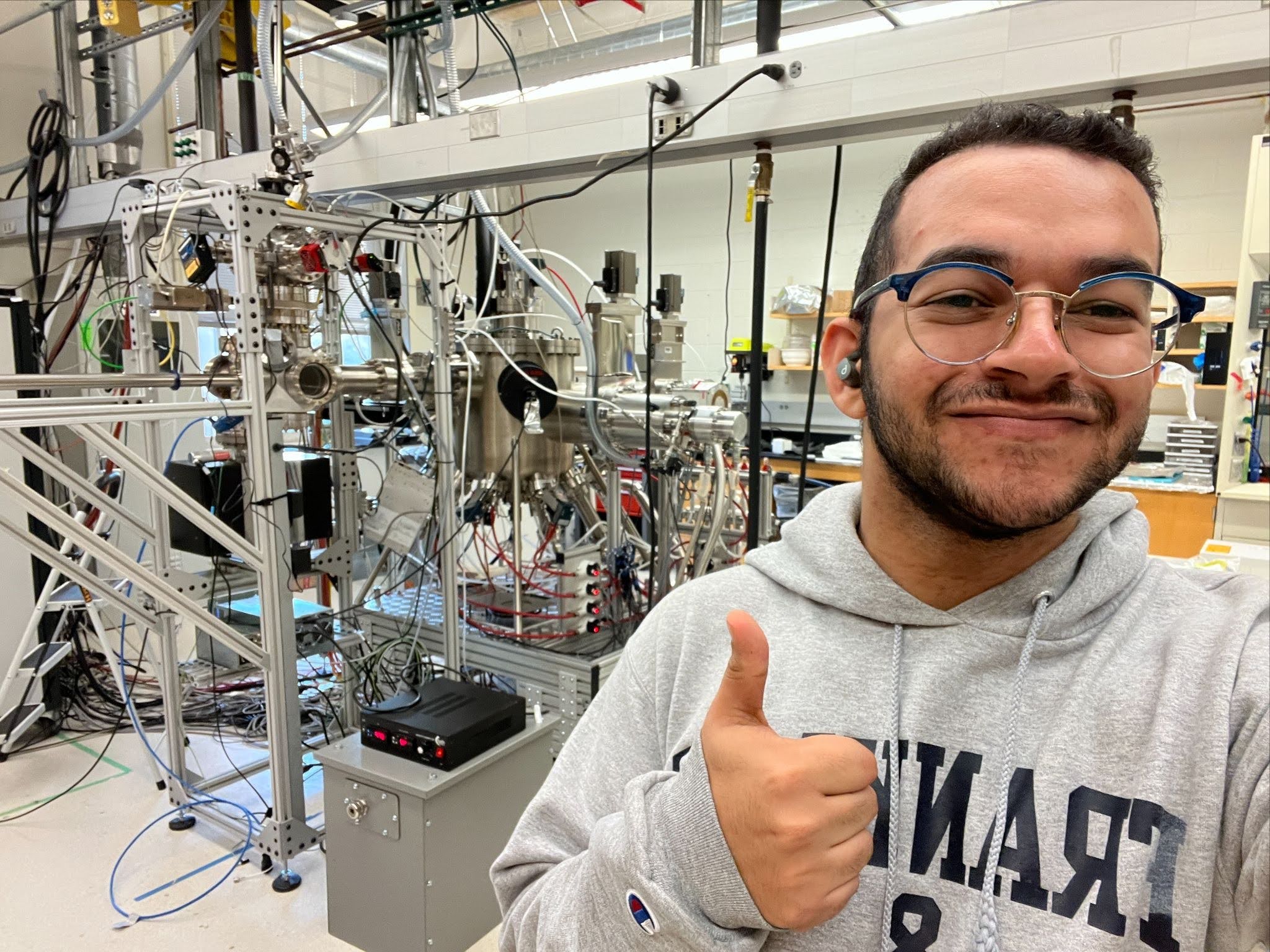
This is me with one of the Molecular Beam Epitaxy Machines that we have! This is the instrument I described in my answer of what I do for research :) I don’t have many pictures of me doing research because A. I am still a first-year PhD student, and B. Most of the work we do in the lab is Ultra-High-Vacuum machinery, so we are usually extra clean to avoid contamination.
Where can people learn more about your work?
You can certainly check out my LinkedIn for professional information, but if you want to learn more about who I am and how I think, then you should certainly read my writing series on my Medium account which I hope to turn into a book someday!
What’s a fun fact everyone should know about you?
My first language is Arabic since I grew up in Egypt and moved to the U.S. in 2022, and I actually learned most of my English through Minecraft videos on YouTube as a kid :D
Member: Sneha Rao
University of California, San Francisco
How did you first become involved in science policy and/or SNAP?
One of the first decisions (and probably the best decision) I’ve made in grad school so far was to join the Science Policy Group (SPG) at UCSF in my first month. At the time, SPG was co-organizing a 2-day hybrid Science Ethics and Policy Symposium with the Science Policy Group at UC Berkeley designed to examine the societal impacts of new technology in agriculture, gene editing, health, and privacy. After witnessing scientists tackle such complex science policy issues head-on, I was hooked. Fast forward a few years and dozens of SPG events and training workshops later, and I joined SNAP just before the 2025 AAAS CASE workshop, and I haven’t looked back. SNAP has exemplified what happens when you give a bunch of fired-up scientists in a room (on Slack) the space to dream big AND execute even bigger. I’ve been inspired by my fellow SNAPpers every single day, and I can’t wait to see where we go from here.
Tell us about your science!
Infertility is on the rise. According to the World Health Organization, 1 in 6 adults worldwide experience infertility. Reproductive therapies like IVF, or in vitro fertilization, can offer a solution, but unfortunately implantation success rates remain well below 50% even for women under age 35. While there are many possible causes of infertility, it’s estimated that over half of all embryos stop developing before they implant in the uterus (before a woman would even know she’s pregnant). Despite the growing prevalence of infertility and the critical importance of this pre-implantation stage of development, we still don’t fully understand how the embryo prepares for successful implantation.
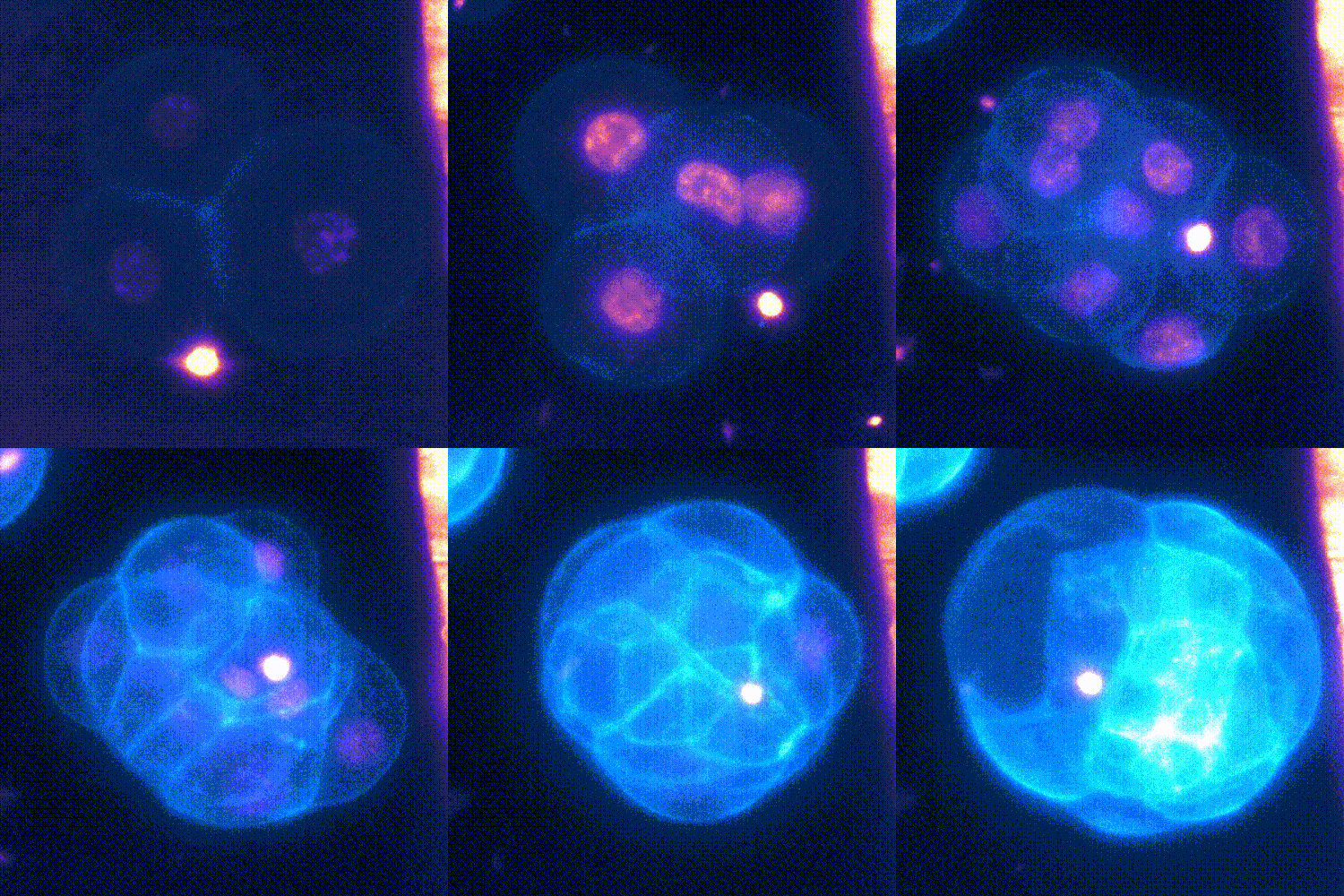
Using advanced microscopes, I can watch embryos develop in real time!
My thesis work in the Weiner Lab focuses on the first major event of embryo development, when cells must decide between two essential identities: the outer cells that will help the embryo implant in the uterus and form the placenta, or the inner cells that will develop into the fetus. To study this differentiation process, I’ve built tools to track key signaling proteins in live cells, and I use advanced microscopes that let me watch embryos develop in real time (see above). By visualizing the activity of these proteins as cells make their fate decisions, I’m working to disentangle the complex signaling logic that guides this early stage of embryo development. Ultimately, I hope my work will help inform much-needed advancements to reproductive therapies in the future.
What are you involved with in SNAP?
I’ve been involved with developing the multi-part Science Policy curriculum with several other SNAPpers, and I’m really excited for us to publish this as an open-access resource for scientists and science policy enthusiasts across the country! Science policy training for early-career researchers is close to my heart. I’ve spent the past 4+ years co-developing and running a science policy graduate mini-course at UCSF, and I’m grateful to have had the opportunity to participate in an active Science Policy Group and learn from an experienced network of advocates and science policy professionals. In a time when public engagement and advocacy is more important than ever, I want to share lessons I’ve learned and help support other trainees beginning their SciPol journeys. Stay tuned for the published SNAP science policy course soon!
Share a picture of you doing science policy, and tell us about it.
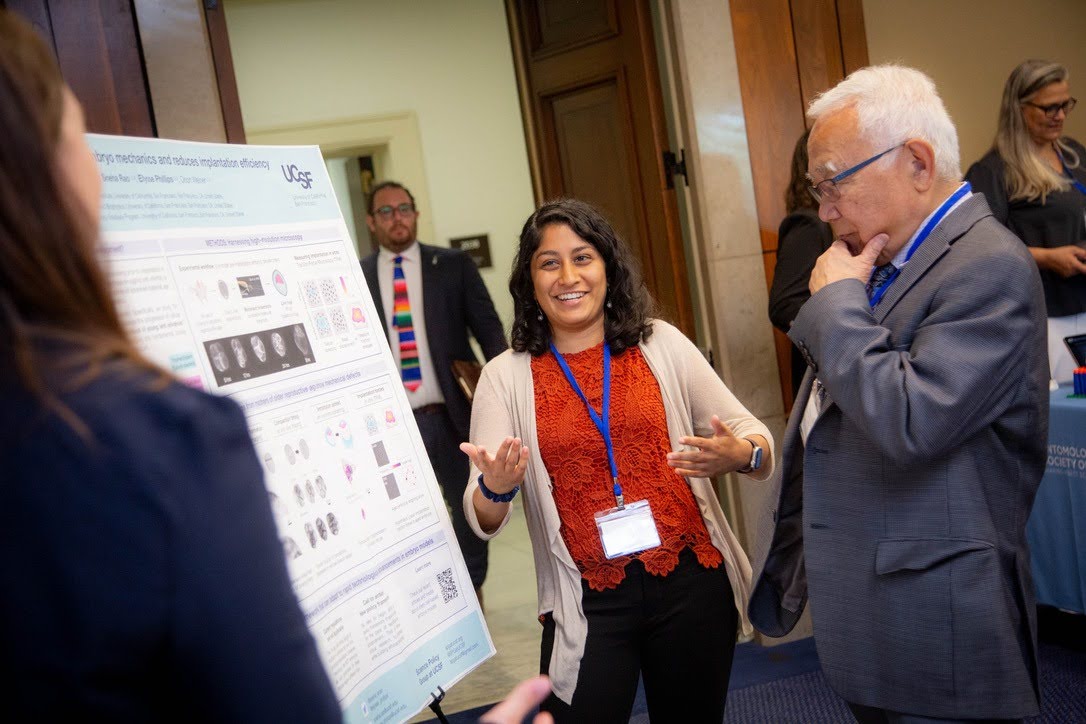
This photo was from my first advocacy trip to DC in 2023. After a packed day of back-to-back advocacy meetings on the Hill (13 total!) with our UCSF team of government relations staff, 3 of my fellow trainees and I presented posters at the Congressional Life Sciences Fair to share our research and related policy implications with legislative staff. Here, I’m presenting to Dr. Keith Yamamoto, a mentor to the Science Policy Group at UCSF and an experienced science advocate. It was an incredibly memorable experience that kickstarted much of my ongoing advocacy and science policy training efforts.
Explain your research using emojis only.
🥚➡️⁉️(🐁+🧬)
What’s a fun fact everyone should know about you?
Outside of lab (and sometimes in lab 👀), you will probably find me knitting. Also, I’m kind of obsessed with octopuses and have a growing collection of books about them!
Where can people learn more about your work?
Member: Doran Goldman
University of Wisconsin-Madison
How did you first become involved in SNAP?
I first heard about SNAP through the McClintock Letters initiative last summer, and writing one inspired me to get more involved with science policy in general! By coincidence, one of my classmates, who I convinced to also write a letter, met Emma Scales, one of the Letters organizers, at a conference shortly after and put us in touch. I was also able to meet Izzi Di Tomassi, the other organizer, at a conference in Madison a month later, and since then I have thrown myself into the (still very new to me) world of science policy work! Since then, I have also been involved in SNAP’s initiatives to organize congressional district visits in August 2025 and the ongoing Stance on Science project, and I have also become more involved in UW-Madison’s own student science policy group, Catalysts for Science Policy (CaSP).
Tell us about your research!
I am a second-year PhD student in Microbiology in the Mo Lab, and I work on the ecology and evolution of bacteria and their viruses, which are called bacteriophages (or just phages for short). Phages are really exciting right now because of their potential to be used to treat antibiotic-resistant bacterial infections, but there are still a lot of challenges involved in implementing this kind of phage therapy. One of these challenges is that bacteria can also quickly become resistant to phage treatment, and it’s difficult to predict when this kind of evolution will occur. I explore this in the lab using the bacterial pathogen methicillin-resistant Staphylococcus aureus (MRSA) as a model system.
What are you involved with in SNAP?
Right now, most of my energy is going into the Stance on Science initiative, where we ask candidates for public office about their positions on various science policy topics! I am acting as a state lead for Wisconsin and Alaska and participating as a volunteer for Washington, and I’m also helping to put together materials to help state leads run town halls to engage with candidates directly. It’s still a lot of logistics work right now to find candidate contact information and draft questions, but I’m looking forward to actually reaching out to candidates and starting to hear their answers in the future.
I’m also going to be serving as an external relations officer for CaSP at UW-Madison next year, which means that I’ll have a lot of leeway to design events and workshops where SNAP could potentially be involved, and I’m excited to explore these options, too!
Share a picture of you doing science/science policy/or something you are passionate about, and tell us about it.
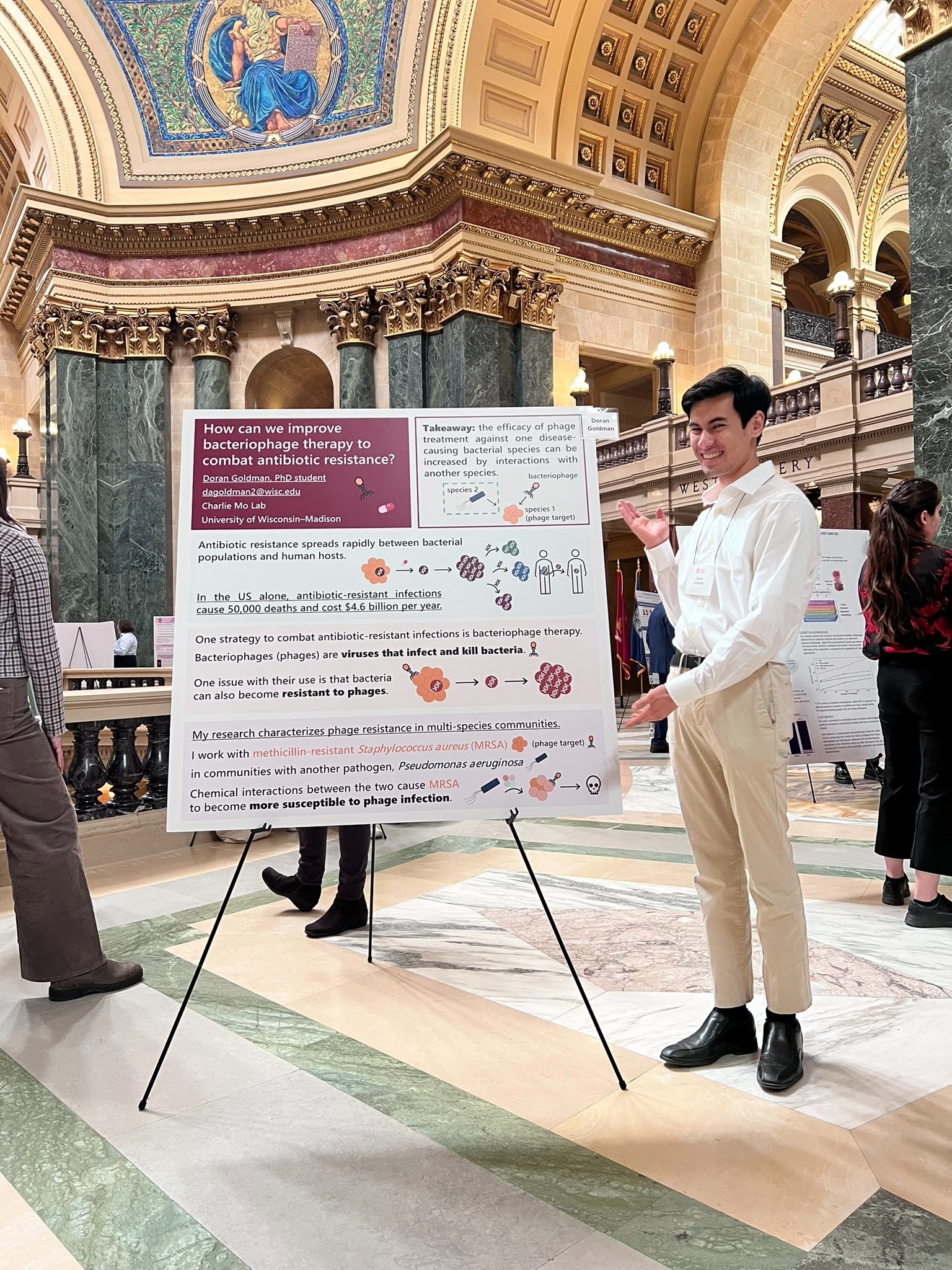
Here I am presenting my research to lawmakers at the UW Day at the Capitol just this past month! I, and about 40 other grad students, presented our research in the beautiful rotunda of the Wisconsin State Capitol building. Turns out lots of people have heard of the antibiotic resistance crisis (or even been personally impacted), but I got to tell several folks about phages for the first time!
What does your family think you do?
I used to study the effect of antibiotic perturbations on the gut microbiome, and I’m not sure my family has fully tracked my switch into phage and antibiotic-resistant pathogens in my PhD…so despite a few attempts at explaining my research, I think that all I’ve managed to do is accidentally convince my mom that antibiotics don’t work.
What’s a fun fact everyone should know about you?
Outside of science, I’m fascinated by existentialist and absurdist philosophy and related literature, especially the works of Samuel Beckett. I directed part of his famous play Waiting for Godot in high school and just this past winter had the pleasure of watching it on Broadway for its fifth revival (starring Keanu Reeves and Alex Winter!). I also wrote a series of column posts in undergrad detailing more of my thoughts on these works and how they have inspired me throughout my life!
Recognition:
Thanks to Youssef, Sneha, and Doran for their responses! This article was edited by Emily Selland.
Read more about SNAP and its members on our website.