Expertise as a pathway to accessibility
Written by SNAP member Liam Russell
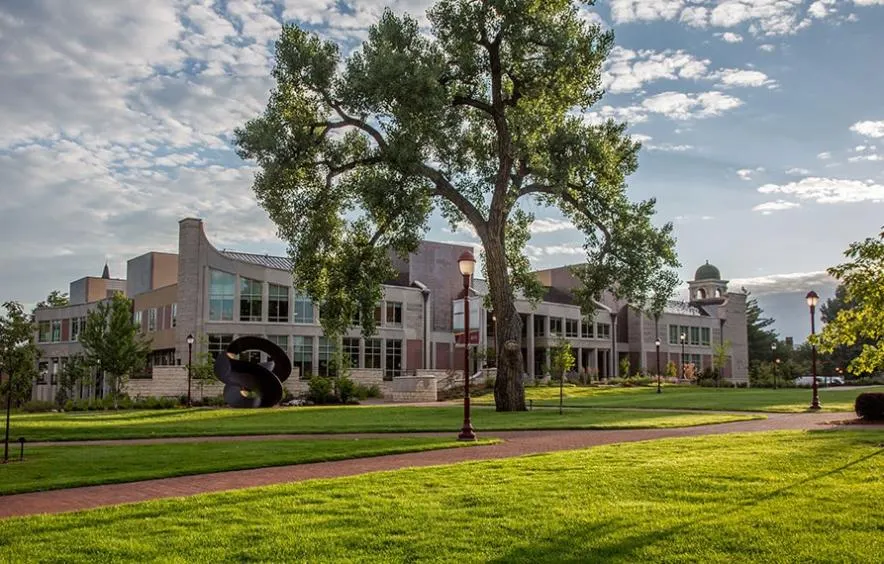
The University of Denver Anderson Academic Commons, home of the DU writing center.
Footnotes are denoted with superscript. References are denoted with brackets.
In many academic institutions, there is a distinctly felt ideological separation between the humanities and sciences. To a certain extent, this divide is understandable. Subject matter overlap between “unlike” fields of study, like chemistry and poetry1, is generally quite small. However, seemingly unlike scholars should have a common motivation: to communicate complex ideas within the genre conventions of their discipline. A truer distinction between the sciences and humanities, then, may be found in differing pedagogical frameworks regarding this necessary communication challenge. The humanities treat writing as a necessary skill worth training, so much so that in many fields, writing itself is thought of as the “doing” of that discipline. Many STEM fields, however, frame writing as a necessary evil, an item on a checklist to be completed as quickly as possible so practitioners can get back to the “real” work of science. This is, again, entirely understandable; with an exponentially growing body of scientific knowledge and equally rapid technological advancements, the experimental bar is constantly rising while institutional productivity and publication expectations remain largely the same.
As a result, those creating undergraduate STEM curricula are incentivized to maximally jam a semester full of content, often at the detriment of students’ development as communicators. There is typically very little writing required in a STEM degree program outside of lab reports, which bear minimal resemblance to any true science writing formats, including the research publication style they allegedly imitate2 [5]. Additionally, the few writing assignments given in an undergraduate STEM curriculum often receive little to no actionable feedback, since traditionalist academics especially view peer-review and revision as unhelpful, time-wasting efforts that detract from their class content goals3 [4, 7]. Many students will as a result never even think about their lab reports again once they’re submitted, and will therefore never critically examine their communication efficacy outside of the seemingly arbitrary letter grade they’re assigned. Thus, generation after generation of student researchers enter their grad school years with functionally no formalized training (or confidence) in their communication abilities. These students are mentored by senior scientists who were themselves shaped by this training paradigm, which leads to common, uncomfortable mentor-mentee conversations where a senior scientist doesn’t like what a student has written, but can’t articulate why. It may seem a better use of time, then, for an advisor to heavily edit or even rewrite a student’s work rather than attempt giving instructional feedback, leaving little room for trainees to develop their own authorial voices.
Students in these situations are often made to feel like they are uniquely bad at writing, or that writing is a skill people “cut out” for their field should somehow naturally possess. The vicious cycle preferentially disenfranchises minoritized, first-generation, international, and multi-lingual students, who must learn the same mountain of STEM content while navigating English language complexities. Importantly, the impact of such a paradigmatic cycle extends outside the confines of academia. Post-graduate scientists who leave the academy often occupy vitally important societal roles in sectors such as medicine, defense, policy, agriculture, and manufacturing, where they too find themselves with virtually no science communication training. In a time where societal distrust and devaluation of science are becoming more and more mainstream [6], scientists with communication confidence are vital for effectively reaching the public: if someone with prestigious academic training can’t explain why their work is meaningful, how important could it possibly be?
Despite centuries of academic tradition uplifting this self-perpetuating system, many principal investigators, especially those entering the field more recently, agree that focused communication training should be a required part of scientific practice [1, 7]. Because senior scientists have often not undergone systematic training in effective writing instruction, there is an exciting opportunity for collaboration with humanities disciplines, where pedagogical frameworks for teaching effective communication strategies are already well established. In this cross-disciplinary collaborative spirit, the writing center at the University of Denver (DU) launched its recent STEM Writing Support Initiative [10]. The DU writing center typically applies a pedagogical framework of generalist tutoring, leaning on non-evaluative feedback to model writing as an ongoing and conversational negotiation of possible communication strategies. While this generalist approach can powerfully provoke discovery-based learning through writing, for certain contexts disciplinary expertise allows for a new depth of conversation, especially in content-dense disciplines like the sciences [2]. The STEM initiative involves implementing an adapted version of the usual generalist approach that also allows for intentional integration of scientific expertise, structured in four main parts: (1) recruiting and training STEM majors, both graduate and undergraduate students, to work as peer writing consultants; (2) writing workshops for students, focusing on major genres and practices key to science writing; (3) pedagogical workshops for STEM faculty, aiming to help professors integrate writing-to-learn activities into their courses; and (4) an online repository of resources to offer STEM writing support asynchronously.
It’s been two years since the initiative started, and one year since I joined the team as a graduate STEM consultant. By leveraging the expertise of tutors who have both completed science coursework and formally trained in writing support strategies, the center represents a place for STEM students to come candidly navigate genre conventions, including those they’ve never been formally taught, with like-minded folks speaking the same scientific language. Out of the 84 writing consultants that have worked in the writing center since Fall 2023, 12 of them were dedicated STEM consultants from various disciplines, representing 14% of our tutors. With this increase in discipline-informed staff, we’ve seen a concomitant increase in STEM student engagement; from 2021 to 2026, the proportion of STEM majors using writing center resources increased from 8% to 13%. Importantly, a much higher number of STEM students specifically request disciplinary expertise, with 10% of STEM students requesting a STEM-informed consultant as compared to 1% of non-STEM writers. This confirms there is measurable student interest in these kinds of specialized resources when they are offered. We are hopeful these positive trends will continue helping us garner faculty-level support of the initiative. Anecdotally, many of the STEM students I’ve worked with cite encouragement from their professors as their primary reason for attending, asserting that faculty buy-in will be an important element of continuing initiative success.
Interestingly, STEM and non-STEM students seeking writing support often differ in their academic stage. Despite our attempts to equally advertise writing center offerings to students at all levels, 28% of STEM writers utilizing the writing center are graduate students, while the remaining 72% are undergrads. This is compared to non-STEM disciplines, where a near 50/50 split between undergrads and grad students more closely mirrors institutional enrollment trends. Since the STEM disciplines house a large proportion of the graduate students on our campus, this difference in attendance indicates we’re missing a population of students who could benefit from support. While many of our long term plans focus on integrating writing in undergraduate curricula, graduate level participation is an important parallel goal. The initiative can help fill any gaps left from a grad student’s potentially writing-sparse undergrad training, while simultaneously encouraging them to confidently identify as science communicators, benefiting both their future career prospects and our institution’s culture. So, we’re actively pursuing strategies for getting better grad student attendance– aside from our typical move of offering free coffee.
While the initiative is still fairly new, we have promising momentum. Since joining the STEM consultant team, I have seen firsthand how meaningful discipline-informed tutoring can be, and how impactful it is for students to see themselves represented in the writing support staff. My fellow science students are engaging in conversations about communication strategies more than I’ve ever seen previously, and the culture we are working to build in the writing center feels like a part of that shift. I’ve worked with many first-time writing center participants who’ve repeated some version of “I didn’t know this place was for science majors too!” To me, that’s what it’s all about — ensuring writers from all backgrounds feel confident identifying as contributors, and therefore communicators, within their field. We’ve demonstrated that students are interested in these kinds of writing resources, and that their confidence grows with resource accessibility. The next generation of scientists, if given the tools to thrive, are poised and ready to act as the vital science communicators our society desperately needs. I hope the work we’re putting in will inspire other academics to assess how their institutional status quo fits into this story, and to consider new ways they too can offer effective science communication support.
Recognition:
Liam Russell is a Molecular and Cellular Biophysics PhD candidate at the University of Denver, studying epithelial remodeling during embryonic development. He is also a current science communication intern for the Society of Developmental Biology, and a STEM writing consultant in the DU Writing Center.
Special thanks to fellow SNAP members who provided feedback on this article: Sneha Rao, leader of the Science Policy Group at UCSF and developmental biology PhD candidate studying how an embryo prepares for implantation in the uterus; Anna Rader Groves, who received her PhD in Neuroscience from Georgia State University where she studied visual development in adolescence and related neuropsychiatric vulnerabilities, now working in science communications and government relations; and Jordan Williams, a pharmacology PhD candidate studying how to alter the lung’s innate immune responses to better treat chronic respiratory diseases.
Footnotes:
- I chose chemistry and poetry sort of arbitrarily for the point I’m making here, but after researching I found this interesting work investigating poetry as an experiential reflection tool for undergraduate chemistry classrooms — how fun! [3]
- There is good evidence to the contrary, showing that writing-to-learn pedagogies demonstrably aid in students’ content mastery and construction of understanding in the sciences [8, 9].
- Lab reports as a format are so diluted that they function more like fill-in-the-blank style worksheets, which in reality doesn’t integrate the creative, content-solidifying parts of writing. People working on pedagogical frameworks for STEM writing know about this, and propose alternative structures; this and more is explored by Merkle & Heard in their recent book [5], which I highly recommend as extended reading on this topic.
References:
- Brownell, Sara E., et al. (2013). “Science Communication to the General Public: Why We Need to Teach Undergraduate and Graduate Students This Skill as Part of Their Formal Scientific Training.” Journal of Undergraduate Neuroscience Education: JUNE: A Publication of FUN, Faculty for Undergraduate Neuroscience, 12 (1), E6–10.
- Dinitz, S. and Harrington, S. (2014). The role of disciplinary expertise in shaping writing tutorials. Writing Center Journal, 33(2), 73–98.
- Illingworth, S., & Radhakrishnan, M. L. (2023). “I am here because I wanted to shine”: How poetry can be used to better understand undergraduate students’ first-year chemistry or related course experiences. Chemistry Education Research and Practice, 24(3), 868–881.
- Lane, S., Banuazizi, A., Effron, M., Roldan, L., Ruff, S., S_ckgold-Sarah, J., Trie, M., & Karatsolis, A. Mapping the relationship of disciplinary and writing concepts: Charting a path to deeper WAC/WID integration in STEM. (2022) Across the Disciplines, 19 (2).
- Merkle, B. G., & Heard, S. B. (2025). Teaching and mentoring writers in the sciences: An evidence-based approach. University of Chicago Press.
- Milkoreit, M., & Smith, E. K. (2024). Rapidly diverging public trust in science in the United States. Public Understanding of Science, 34(5), 616–627.
- Moon, A., Gere, A.R., & Shultz, G. B. (2018) Writing in the STEM classroom: Faculty conceptions of writing and its role in the undergraduate classroom. Science Studies and Science Education, 102 (5).
- Moskovitz C, Kellogg D. (2011) Inquiry-based writing in the laboratory course. Science, 332:919–920.
- Reynolds, J. A., Thaiss, C., Katkin, W., & Thompson, R. J. (2012). Writing-to-learn in undergraduate science education: A community-based, conceptually driven approach. CBE — Life Sciences Education, 11(1), 17–25.
- University of Denver. (2023). Clark Foundation STEM Writing Support Initiative. Writing Across the Curriculum | University Writing Program.