The Past Is Our Present: A History of America's Complicated Relationship with Science
Written by SNAP members Shreya Venkatesh, Daniel Affsprung, and Andrew Mattson, who all contributed equally to this piece.
Footnotes are denoted with superscript. References are denoted with brackets.
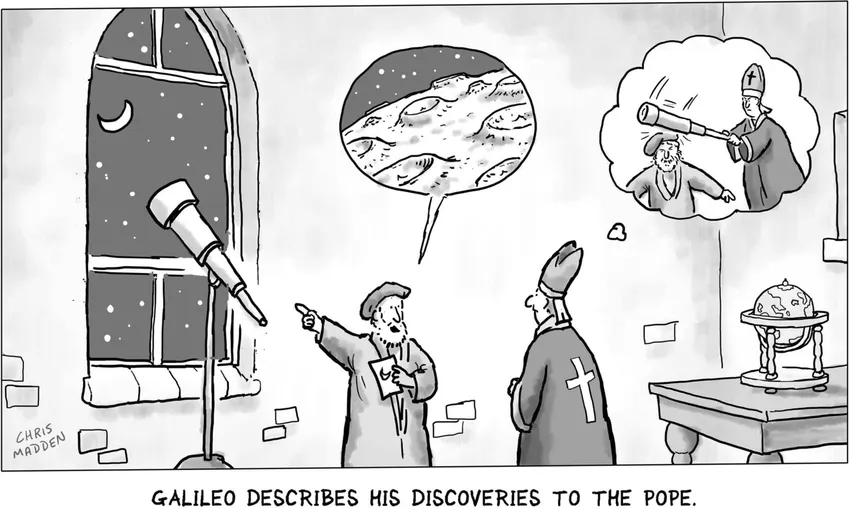
A cartoon originally drawn in 1996 depicting Galileo discussing his discoveries with the pope (source).
Science touches all aspects of our lives, whether we know it or not. Sitting in a moving car and you don’t lose signal? A fairly complicated problem that we hardly think about but scientists toiled away to solve it. Traveling somewhere with unfamiliar pathogens? There’s probably a vaccine to protect you. Drinking clean water out of the tap? Yup, scientists made that happen too. Yet, when something science has created in our daily lives becomes a hot topic of conversation, the discussion of the science involved is rarely neutral — there are strong opinions on all sides.
Public opinion of science and scientists has ebbed and flowed in waves. As history is only bound to repeat itself, there is something to learn from all the ways the public has confronted science when it enters our lives, whether through innocuous technological advancements or more complex ones that spark ethical or personal dilemmas. In the present day, we are seeing a fall in trust and general public opinion of scientists that is only worsening, but this phenomenon is not entirely unprecedented. Science is inevitably political, and the fact is that changing opinions of science have often followed controversy over a larger political issue where science is central.
But was it always this way? What did people think of Newton? Galileo? Today, we think of those people as pioneers who undoubtedly advanced our way of life. You may be surprised to learn, then, that amongst those who found them fascinating and their work important, there were still skeptics and those who thought scientists were just plain weird. In Galileo’s time, for example, despite being funded by the pope, he battled it out with him in the Holy Court and was even later accused of heresy for his idea that the world revolved around the sun [1,2]. It wasn’t until 300 years after Galileo’s death that the church officially cleared his name [1].
The United States’ modern relationship to science and technology took off after WWII as public spending on scientific research steadily grew with widespread support. But over the 20th century, science’s prominence in American society was double-edged: the nuclear bomb helped win WWII but brought new peril to the planet. The Cold War and the Space Race motivated spectacular technological developments, but the worldly problems of disease, poverty, and social unrest remained stubbornly untouched. The social and environmental consciousness of the 1960s extended to science and technology, leading to more regulation and efforts to direct applications of science towards social problems. Then, in the 1970s, the US economy faltered and, as a driver of growth, science regained importance and independence. In the 1980s, the biotech revolution and the Reagan revolution drew science and industry closer together, while the 90s and 2000s laid the groundwork for today’s Silicon Valley.
Amidst all of this, the American public has wrestled with the far-reaching impacts scientific advancement has had on all of our lives. Pessimism and distrust of emerging technologies have been high before: the 1960s included a distinct “anti-technology kick”, said then-NASA administrator James C. Fletcher [3]. For decades, public optimism and trust in science has waxed and waned on the tides of medical advancements [4], entanglements with military might and global risks, fears over out-of-control technology and pollution, and scientists’ roles in shaping government decisions. Perhaps you’ll remember all the buzz around stem cell research in the 70s and 80s. Hot off the heels of the Roe v. Wade Supreme Court decision in 1973, research on embryos was thrust unwillingly into the abortion debate, and the end result? A major decline in governmental support of any kind of research that mentioned the terms “fetal” or “embryonic” from 1988 all the way up to 1993 [5]. Sound familiar? We’re living through something incredibly similar now.
We can see, then, that the decline in public confidence of science and scientists in the US today is a distrust that has been brewing for quite some time, and mixed opinions on science and scientists are not new. Still, polling from the 1980s through the present day consistently suggests the public agrees that the benefits of science, medicine, and technology outweigh the harms [6]. However, in numerous examples throughout history (most recently the COVID-19 pandemic), the public has been skeptical of the intentions and impacts of scientists and researchers.
This skepticism is not entirely unwarranted. It is important to recognize that public apprehension often stems from failings on the part of the scientific community, rather than failings of the general public. In the 18th century, science was used as a tool to perpetuate racist ideologies and implement racist policies. These bad actors claimed that this discriminatory legislation was “evidence-based” using flawed pseudoscientific reasoning. There are further examples of science taking advantage of marginalized communities: the Tuskegee Syphilis Study, stolen cells from Henrietta Lacks, the women who are now acknowledged as the Mothers of Gynecology for undergoing forced gynecological experimentation, and sadly, much more. To this day, there is research that suggests patients who are members of a minority group receive less empathy and attention from medical providers in comparison to white patients [7]. Rather than being members of the public who use their science to give back, there have been far too many examples of scientists who exploit their communities.
The public’s relationship with science and scientists is and has always been complicated. With all we’ve seen over this brief history of perspectives on science, it’s fair to say scientists have taken a back seat in actively engaging with public opinions of their work and have only recently taken back a real role in bringing their discoveries to their communities. This rings true especially when we acknowledge that making strides towards effective science communication is not unique to modern scientists. Say what you will about Galileo’s mockery of the pope as a simple-minded caricature in his book on heliocentrism, but he wrote in colloquial Italian instead of Latin or Greek, as was common with academics. Instead of getting lost in jargon, he used these easy-to-understand characters to bring the debate to his neighbors’ doors. As scientists have taken to social media, we have a responsibility to not only educate but make ourselves part of our communities once more and accept that our discoveries and our opinions of them are not infallible. To invite the public into the conversation is difficult but necessary.
Yet, this issue is far more complex than just more education and community involvement. As we’ve seen, distrust in scientific work is not always unwarranted, and putting pressure on science to be the ultimate dispenser of truth and decision-making in our daily lives is a weight it may not be able to withstand. Such a system is too powerful and too fragile, depending on both high trust in science and scientists while moving the general public closer to a state of disenfranchisement. The next few decades will be era-defining in this sense: will a more engaged scientific community improve trust or only push the public further away? And what impact will that have on the important scientific and technological advancements that are yet to come?
Recognition:
Shreya Venkatesh received her PhD in Mechanical Engineering from the University of Colorado Boulder where she developed tissue engineered and computational models of the breast cancer bone metastatic vicious cycle. Andrew Mattson is a physics PhD student developing quantum technologies for dark matter detection, gravitational wave observation, and life science/medical applications. He also serves as President of the Science Policy and Diplomacy Group at Johns Hopkins. Daniel Affsprung is a PhD candidate in History and Philosophy of Science at Arizona State University. He researches the history of Congressional efforts to make science and technology more responsive to societal needs.
Special thanks to fellow SNAP members who provided feedback on this article:
Alex Byrne, who received his PhD in Chemistry from the Massachusetts Institute of Technology where he studied the formation of organic molecules in interstellar environments; Nadiia Hutchinson, who is a software engineer and a computer science graduate student at Johns Hopkins University specializing in bioinformatics.
References:
- P. J. Casey, “Misleading Narratives: The Galileo Affair’s Lessons,” heterodoxacademy.org, Dec. 15, 2021.
- Galileo Galilei, Dialogue Concerning The Two Chief World Systems, Ptolemaic &. Berkeley, Ca: University Of California Press, 1970.
- McCray, W. Patrick, ‘California Dreaming’, The Visioneers: How a Group of Elite Scientists Pursued Space Colonies, Nanotechnologies, and a Limitless Future (Princeton, NJ, 2017; online edn, Princeton Scholarship Online, 24 May 2018).
- K. E. Kang, A. Vedlitz, C. L. Goldsmith, and I. Seavey, “Optimism and pessimism toward science: A new way to look at the public’s evaluations of science and technology discoveries and recommendations,” Politics and the Life Sciences, pp. 1–20 and Appendix B, Jun. 2023.
- H. Gottweis, “The Endless hESC Controversy in the United States: History, Context, and Prospects,” Cell Stem Cell, vol. 7, no. 5, pp. 555–558, Nov. 2010.
- J. Lloyd, “What We Don’t Know About Public Perceptions of Science,” Issues in Science and Technology, Jul. 23, 2025.
- E. G. Bergeron, “The Historical Roots of Mistrust in Science,” Americanbar.org, 2021.