Why build a $4B space telescope?
Written by SNAP members Bryce Wedig, Andrew Mattson, Yanbo Pan (Yanbopanpi), & Rishika Porandla.
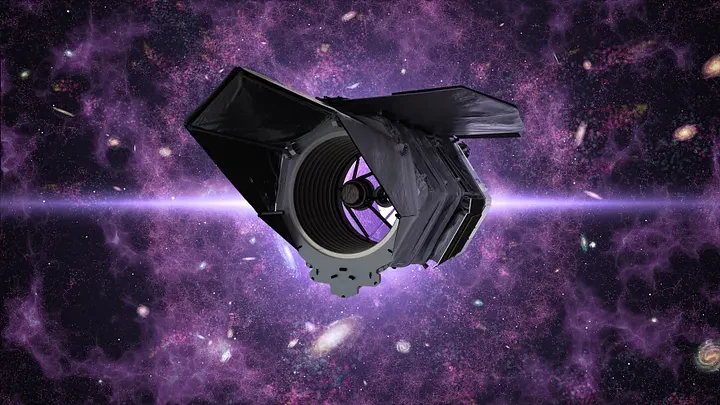
Credit: NASA’s Goddard Space Flight Center.
Footnotes are denoted with superscript numbers. References are denoted with brackets.
On August 30th, 2026 at 7:20 AM ET, the National Aeronautics and Space Administration (NASA) will launch the Nancy Grace Roman Space Telescope. This colossal feat of engineering is over 40 feet long and weighs around 18,000 pounds, with the same resolution as the previous Hubble Space Telescope over a viewing range that is 100x bigger [1, 2]. It will discover 100,000 planets outside of our Solar System, measure dark energy and dark matter to tell the story of the birth and growth of the Universe, and do much more [3, 4].
However, it comes with a price tag of roughly $4B. Many would ask, for what? A shiny mirror for astrophysicists that’ll add facts to science textbooks and make NASA social media content? Let’s put this number into context: for the lifetime cost of Roman, you could get half of a submarine1, fund the National Park Service for a year and a half2, or offset the cost of a nine-day government shutdown3.
Why send a telescope into space in the first place? Telescopes on the ground are roughly 100 times cheaper to build4. However, obtaining clear pictures from the ground can be difficult due to the turbulent atmosphere, cloudy days, and humidity. This is why many telescopes are in high-elevation deserts like Arizona and the Atacama desert in Chile: this minimizes the effects of weather and the amount of atmosphere to look through. The blurring effect of the turbulent atmosphere (which is what makes stars twinkle) is especially problematic for Roman, which needs to see especially clearly to precisely measure distant planets and galaxies. Also, the atmosphere also blocks certain kinds of light, so there are parts of the Universe that we simply cannot see without sending telescopes into space.
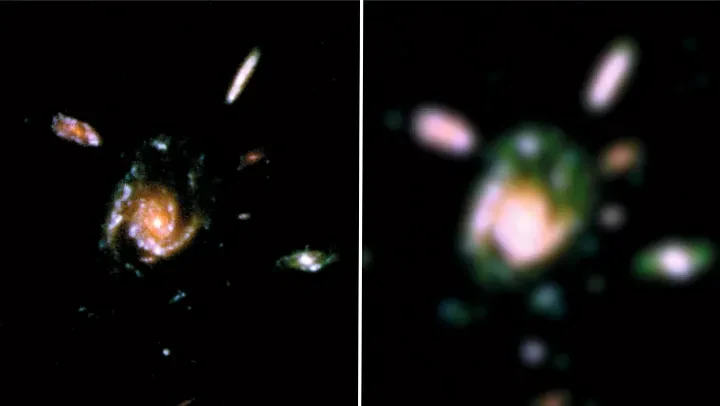
Left: a distant galaxy imaged by the Hubble Space Telescope. Right: a simulated image of the same scene as seen by a state-of-the-art ground-based facility, the Rubin Observatory in Chile. Credit: B.E. Robertson, et al. 2019, Nat Rev Phys, 1, 450.
There are good scientific reasons to go to space, but why does it cost so much? The space shuttle Discovery, which gave Hubble a ride, cost approximately $54,000 per kilogram — that’s ~$4.4M for a person weighing 180 lb [5]. The SpaceX Falcon Heavy, which will be taking Roman up into space, is a relative deal at $1520/kg or $123k for the average person [ibid]. Once in space, the telescope will be subjected to harsh radiation and dramatic temperature changes. Space also makes maintenance hard (or impossible, in Roman’s case). For all of these reasons, space telescopes are a significant engineering challenge.
Humanity has overcome this challenge before. Back in 1968, before even landing on the Moon, NASA launched the first ever space telescope: the Orbiting Astronomical Observatory 2 (OAO-2). OAO-2 was only in space for a month, but it had an impact on astronomy stretching across decades through its ultraviolet observations of stars [6]. NASA’s Chief of Astronomy, Nancy Grace Roman, spent the following years leading the creation of an ambitious new space-based telescope. Over two decades, she worked to advance telescope technology, secure funding, and gain congressional support. This laid the groundwork for the eventual launch of the Hubble Space Telescope, which became one of the most valuable tools ever made for understanding our universe [7]. Roman builds on Hubble by surveying the sky over 1000 times faster and seeing much older and fainter light [8]. With this efficiency, Roman will observe many rare objects and events and build enormous samples for robust statistics.
Roman represents nearly seventy years of scientific vision stretching from Nancy Grace Roman’s early advocacy for space astronomy to one of NASA’s most ambitious observatories. But the question remains: do missions like Hubble, Webb, and now Roman actually return scientific value commensurate with their cost?
The Politics of Space Telescopes
As in the case of Hubble, space science has found bi-partisan support throughout America’s history. NASA was initially created from an agreement between a Republican administration and Democrat-controlled Congress, and several Congressional committees have been filled with members from both sides of the aisle to advance space science and technology priorities [9]. This built trust over decades between the astronomy community and the government, allowing the field to flourish.
This begs the question, how is this trust maintained? The answer begins with how NASA decides to build its flagship missions. Every ten years, the National Academies ask the astronomy community to identify the scientific questions that matter most through a Decadal Survey. In the 2010 report, New Worlds, New Horizons in Astronomy and Astrophysics, astronomers selected the Wide-Field Infrared Survey Telescope (WFIRST) — later renamed the Nancy Grace Roman Space Telescope — as the decade’s highest-priority large space mission [10, 11]. Since the Decadal Survey is important for both lawmakers setting funding levels and astronomers setting their scientific agendas, this signified the community’s excitement for the new telescope. Their goal was ambitious: measure the mysterious dark energy accelerating the expansion of the Universe, map the distribution of invisible dark matter, conduct enormous infrared sky surveys, and discover thousands of planets through gravitational microlensing [12, 13]. Those science goals required a telescope unlike any that had come before.
However, these lofty aims were also the reason Roman repeatedly became a target during the federal budget process. In both 2019 and 2021, presidential budget proposals recommended canceling the mission to redirect funding toward other agency priorities but Congress overrode the executive branch and fully restored funding [14]. This was due to the fact that projects like Roman are broadly seen by lawmakers as critical national investments in advanced manufacturing, aerospace engineering, precision optics, and the highly skilled workforce required to support them.
The Development of the Roman Space Telescope
In 2012, the National Reconnaissance Office (NRO) happened to have two 2.4-meter mirrors lying around originally intended for spy satellites and offered them to NASA. These mirrors were the same size as Hubble’s, but since they were designed for pointing towards Earth, they had much shorter focal lengths. But this also means that the field of view can be much larger. One of these became Roman’s mirror, saving NASA an estimated $250M [15].
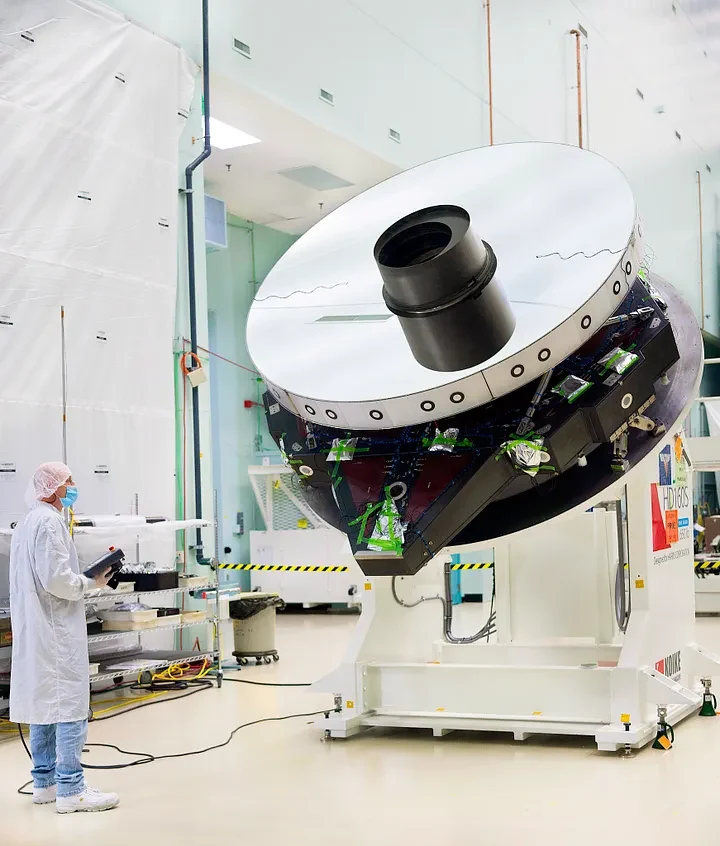
Roman’s 2.4 meter primary mirror. Credit: NASA/Chris Gunn.
NASA built a flagship mission around it: a spacecraft capable of operating for years in deep space, a 300-megapixel camera, the first high-performance space coronagraph ever flown, precision pointing systems capable of holding the telescope nearly motionless, sophisticated flight software, and hardware qualified to survive launch, radiation exposure, and years of extreme thermal cycling [16].
Perhaps the most impressive feat was achieving these technological advances while navigating labor disruptions and supply-chain issues during the COVID-19 pandemic. In 2021, NASA established a revised mission baseline that capped Roman’s lifecycle cost at $4.3 billion and set a formal launch commitment of May 2027 [17]. Since then, independent assessments by both the Government Accountability Office and NASA’s Office of Inspector General have consistently found the project operating within its approved cost cap while completing integration and environmental testing ahead of schedule [18, 19]. Roman is now targeting an August 30, 2026 launch, which is eight months earlier than planned [20].
The Case for Spending $4 Billion
Every flagship space telescope has faced criticism before launch over its cost, complexity, and technical risk. Yet every telescope has fundamentally changed our understanding of the Universe in ways that were impossible to predict beforehand. The Hubble Space Telescope helped determine the age of the Universe with unprecedented precision, refined measurements of cosmic expansion, and provided compelling evidence that nearly every massive galaxy hosts a supermassive black hole at its center [21, 22]. Its iconic images — from the Pillars of Creation to the Hubble Ultra Deep Field — reshaped both astronomy and the public’s view of the cosmos [23]. More recently, the James Webb Space Telescope has detected carbon dioxide and water vapor in distant exoplanet atmospheres, discovered galaxies that existed less than 300 million years after the Big Bang, and challenged theories of how quickly the first galaxies formed [24]. Both telescopes transformed science in ways that exceeded their original expectations.
The return on investment for taxpayers extends well beyond astronomy. Building space telescopes advances precision optics, detectors, aerospace engineering, and scientific software, while training thousands of scientists and engineers whose expertise spreads throughout academia, government, and industry. Solutions developed for space often find unexpected applications on Earth: for example, technologies originally developed for Hubble later improved digital mammography [25]. All science data from Roman will also be released immediately with no proprietary period, allowing researchers, students, and citizen scientists around the world to explore the observations [26].
Data from Roman’s two instruments have the potential to shine light on solutions to some of the biggest mysteries in astronomy [11]. Roman’s Wide Field Instrument will allow astronomers to map enormous regions of the sky with unprecedented efficiency [27], which could reveal how dark matter shapes the Universe, place new constraints on dark energy, and discover thousands of planets [28]. Roman’s other instrument, the Coronagraph Instrument, will be the first high-performance coronagraph flown in space, demonstrating technologies needed for NASA’s planned Habitable Worlds Observatory. This is a mission designed to directly image Earth-like planets around nearby stars and search their atmospheres for potential signs of life [29]. In that sense, Roman is a technology pathfinder for the next generation of space telescopes.
Hubble was once criticized as an expensive mistake before becoming one of humanity’s greatest scientific instruments. Webb is already rewriting astronomy. Roman builds on those legacies, and if history is any guide, its greatest discoveries still lie beyond our imagination.
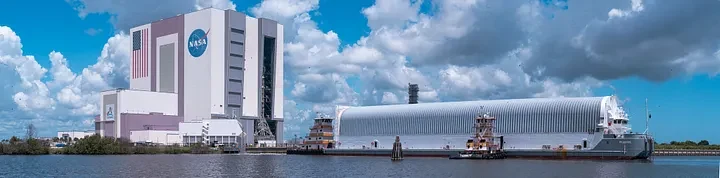
Taken June 21st, 2026: Roman on its way from the NASA Goddard Space Flight Center outside of Washington D.C. to the Kennedy Space Center in Florida. Its transport container is named “Chariot” and its barge is named “Pegasus.” Credit: Sydney Rohde.
Recognition
Bryce Wedig is a PhD candidate in physics studying dark matter in distant galaxies.
Andrew Mattson is a physics PhD student developing quantum technologies for dark matter detection, gravitational wave observation, and life science/medical applications. He also serves as President of the Science Policy and Diplomacy Group at Johns Hopkins.
Yanbo Pan (Yanbopanpi) is a PhD student in Astronomy studying stars and galaxies.
Rishika Porandla is an undergraduate at Princeton University studying Astrophysics and researching detector materials and diagnostic probes for space plasma instrumentation.
Special thanks to the following SNAP members who provided feedback on this article:
Andrew Ramirez, a postdoctoral researcher at Rutgers University-New Brunswick investigating immunotherapy response for melanoma patients. He received his PhD from UCLA developing machine learning models to analyze multi-sample single-cell gene expression data; Sari Terrazas, a molecular biology PhD candidate studying double-stranded (dsRNA) localization and dynamics in paraspeckles at UCLA; and Breelyn Karno, a PhD candidate at Vanderbilt University studying the metabolic determinants of breast cancer bone metastasis.
Footnotes:
-
The Congressional Research Service tracks the cost of 12 Columbia-class nuclear-powered ballistic missile submarines at $132 billion [30].
-
The National Park Service annual operations budget hovers around $2 billion [31].
-
A standard month-long government shutdown costs the U.S. economy up to $14 billion in total economic losses according to the Congressional Budget Office [32].
-
The Automated Planet Finder (APF) at the Lick Observatory in California is a 2.4 meter optical telescope that cost just over $12M back in the early 2010s [33]. The Sloan Digital Sky Survey (SDSS) 2.5 meter telescope at the Apache Point Observatory in New Mexico, a more sophisticated instrument, came out to at least $55M in the early 2000s [34].
References:
[1] https://svs.gsfc.nasa.gov/14856/
[2] https://www.stsci.edu/files/live/sites/www/files/home/roman/_documents/roman-science-sheet.pdf
[3] https://www.nasa.gov/missions/roman-space-telescope/nasas-roman-mission-preps-to-unveil-new-populations-of-faraway-worlds/
[4] https://science.nasa.gov/mission/roman-space-telescope/science/
[5] https://spacenexus.us/guide/space-launch-cost-comparison
[6] https://www.historyoftelescope.com/telescope-facts/facts-about-space-telescopes/
[7] https://science.nasa.gov/people/nancy-roman/
[8] https://science.nasa.gov/mission/roman-space-telescope/why-the-roman-space-telescope/
[9] https://www.nasa.gov/history/65-years-ago-the-national-aeronautics-and-space-act-of-1958-creates-nasa/
[10] https://www.eoportal.org/satellite-missions/rst#roman-space-telescope–former-wfirst-wide-field-infrared-survey-telescope
[11] https://www.nationalacademies.org/read/12951
[12] https://www.nationalacademies.org/read/12982/chapter/1#ii
[13] https://ui.adsabs.harvard.edu/abs/2015arXiv150303757S/abstract
[14] https://aas.org/posts/advocacy/2020/11/senate-appropriations-fy-2021
[15] https://spacepolicyonline.com/news/nro-gifts-nasa-two-leftover-space-telescopes-euclid-to-cost-nasa-40-50-million-gems-not-confirmed/
[16] https://www.eoportal.org/satellite-missions/rst#science-objectives
[17] https://www.nasa.gov/missions/roman-space-telescope/nasa-confirms-roman-missions-flight-design-in-milestone-review/
[18] https://www.space.com/astronomy/its-going-to-do-things-that-currently-are-impossible-the-roman-space-telescope-nasas-next-great-observatory-is-ready-to-launch-aug-30
[19] https://www.oversight.gov/reports/audit/audit-nancy-grace-roman-space-telescope/recommendations/rec-2
[20] https://svs.gsfc.nasa.gov/15004/
[21] https://phys.org/news/2024-03-webb-hubble-telescopes-affirm-universe.html
[22] https://ui.adsabs.harvard.edu/abs/2001ApJ…553…47F/abstract
[23] https://ui.adsabs.harvard.edu/abs/1996AJ….111.2349H/abstract
[24] https://www.researchgate.net/lab/The-JWST-Transiting-Exoplanet-Community-Early-Release-Science-Team-The-JWST-Transiting-Exoplanet-Community-Early-Release-Science-Team
[25] https://spinoff.nasa.gov/pdf/Hubble_Flyer.pdf
[26] https://www.stsci.edu/contents/newsletters/2026-volume-43-issue-01/roman-delivering-data-that-unlocks-discovery
[27] https://www.stsci.edu/files/live/sites/www/files/home/roman/_documents/WFIRST-AFTA-SDT-Report-2015.pdf
[28] https://www.nasa.gov/missions/roman-space-telescope/new-study-reveals-nasas-roman-could-find-400-earth-mass-rogue-planets/
[29] https://www.spiedigitallibrary.org/journals/Journal-of-Astronomical-Telescopes-Instruments-and-Systems/volume-11/issue-03/031511/Overview-of-Roman-Coronagraph-Instrument-requirements-test-campaign-and-results/10.1117/1.JATIS.11.3.031511.full
[30] https://portal.ct.gov/oma/in-the-news/2025-news/the-navys-columbia-class-submarines-will-cost-132-billion
[31] https://www.doi.gov/sites/default/files/documents/2025-06/fy26bibnps508.pdf
[32] https://www.cbo.gov/publication/61823
[33] https://arxiv.org/abs/1402.6684
[34] https://www.desy.de/f/seminar/Jester.pdf