Science on Tap🍻: Serving up Science to Community Members in Miami
Written by SNAP member Brandon Emanuel León
Footnotes are denoted with superscript numbers. References are denoted with brackets.
Welcome to Miami
In the three years I’ve lived here, I’ve come to appreciate Miami for more than its palm trees, beaches, and luxurious restaurants. Miami offers more than that. I’ve come to appreciate the stories of Caribbean diasporas seeking a better life, potent morning coladas, and the city’s endearing Art Deco architecture style. Most vacationers likely don’t spend much time thinking about the 490,000 people who call the 305 home. However, Miami comes with its own struggles for the people that do live here: hurricanes and other climatic events drive insurance premiums sky high and seaweed increasingly overwhelms our beaches. And like any other city, people try to take care of their families and well-being.
Miamians have a phrase for these everyday struggles, La Lucha, which represents opportunities for scientists to align the goals of their work as solutions to the needs of their local communities. Science probably is not the first thing that comes to mind when you think about the Magic City, but as a PhD candidate that studies cancer biology at the University of Miami, I have thought a great deal about the role scientists play in society beyond the laboratory and out in the Miami community.
Scientists at the University of Miami are doing great work that have wonderful implications for Miamians. Researchers at the Rosentstiel School are investigating how to more accurately predict weather events like hurricanes [1] and rid our beaches of seaweed [2]. Furthermore, as Miami exhibits one of the nation’s highest HIV incidence rates [3], scientists at the Miller School of Medicine are investigating how to reduce infections and improve the quality of life of infected individuals.
Unfortunately, community members rarely interact with us or hear about the work we do. Without these interactions, Miamians are left in the dark about how our progress can address the issues they deal with on a daily basis. Scientific communication is a critical skill for any scientist, but scientific training usually focuses on communicating with other scientists. This is important for peer-review and to collaborate on projects, but what we miss in this training is the chance to connect with our local community and collaborate to address our problems.
Who is science for?
Over time, I believe that this disconnect has contributed to the skepticism and distrust about who benefits from scientific progress. It becomes unclear whose interests science is serving when communities are excluded from shaping how research is done. Artificial intelligence (AI), for example, is poised to affect every aspect of life including healthcare, social media, and the global economy; however, concerns about environmental impacts, job displacement, and the concentration of benefits have made it a contentious technology [4,5]. Similarly, political polarization has driven growing vaccine skepticism [6] despite the rigorous efficacy, safety, and quality control standards these life-saving medicines adhere to [7]. These examples demonstrate that public trust does not depend only on whether advances can increase economic productivity or are safe and effective, but if people’s concerns and needs are considered in the decisions of how these advances affect their lives.
Most scientists feel an ethical obligation to share their work and connect with the general public [8], but often there aren’t opportunities to relate with their local community. Establishing relationships is important because public trust is not built solely by providing information and facts. When scientists develop relationships with their local communities, they empower people to be more active stakeholders and shape more equitable implementation of discoveries. When people can ask questions, voice concerns, and understand how science happens, science becomes less of an abstract institution and more of a process in which they can trust. These interactions can also give scientists a better understanding of the priorities, concerns, and lived experiences of the communities their work is ultimately intended to benefit. Creating spaces for these conversations drove me to get involved in science communication in Miami.
Relationships with community
To begin fostering these relationships between graduate students and community members in Miami, I established the Science Policy and Communication Committee with the Biomedical Graduate Student Government (BGSG) at the University of Miami. Together, my colleagues Oriana Teran Puma, PhD, and Piera Grisolia, PhD, and I collaborated to host our first initiative, Science on Tap.
The goal of Science on Tap is to provide a space for researchers to share their work in a fun, accessible, and entertaining format with community members in a non-academic setting. We wanted to go out into Miami to reach community members in spaces where they have fun rather than host our event in a cold academic auditorium. Our former BGSG president, Maddison Marshall, connected us with a local brewery, Unseen Creatures Brewing & Blending, who graciously provided their space to us. Their credo, “We constantly strive to create beers that are inherently Miami — expressing terroir and telling the story of our environment and culture through time and place” embodies the exact environment we wanted to launch Science on Tap in. We recruited three speakers, Marla Marquez, Dr. Ana Rosario Santos, and Dr. Paulo Roberto Del Valle to present their work.
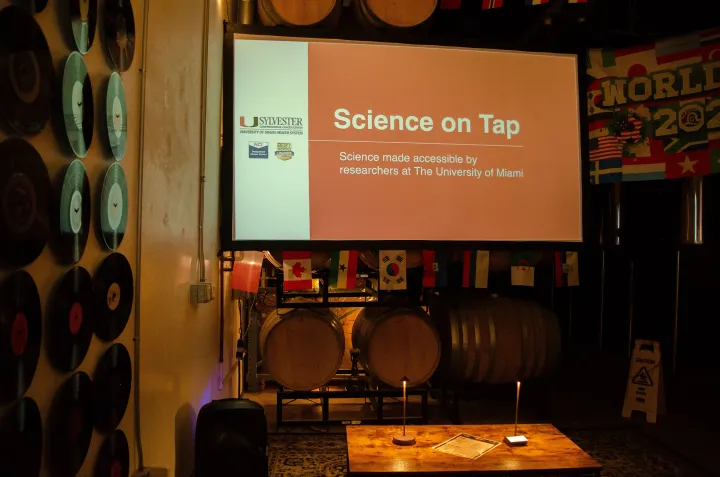
Setting the stage for our event, Science on Tap. Photo credits: Piera Grisolia
The event and speakers
I opened up the event with a quick introduction to Science on Tap. I gave thanks to our speakers, Unseen Creatures Brewing & Blending, and community members for attending the event. I spoke about our motivations for hosting Science on Tap and then introduced our first speaker, Marla Marquez.
Marla, our current BGSG president, is a PhD candidate in neuroscience in the Liebl Lab at the University of Miami, which focuses on understanding how the brain responds to traumatic injury and neurodegenerative disorders. She presented her thesis project, “Brain Injuries and Alzheimer’s: Two Conditions, One Broken Connection” connecting the molecular mechanisms underlying Alzheimer’s disease (AD) and brain injuries, relevant for the increasingly aging population in Miami. Nearly 600,000 people are diagnosed with AD in Florida [9]. There are limited treatment options for AD and brain injuries and even these only slow disease progression. Her work could yield new treatments that reverse disease progression years before symptoms arise.
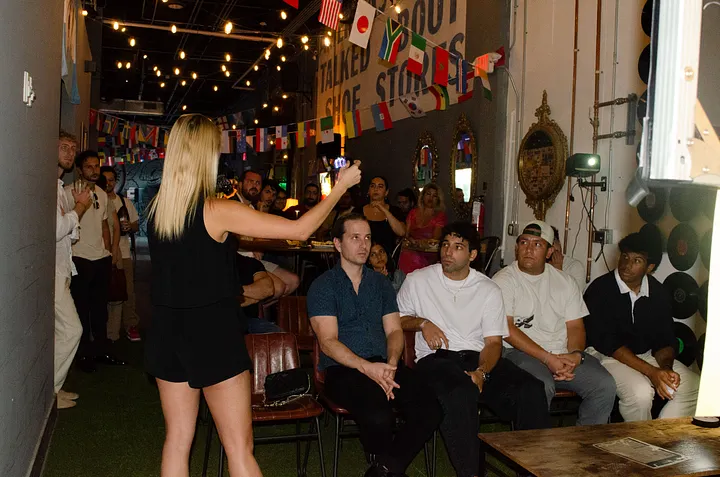
Marla Marquez presents “Brain Injuries and Alzheimer’s: Two Conditions, One Broken Connection”. Photo Credit: Piera Grisolia
Next was Dr. Rosario Santos, who is an Obstetrics and Gynecology physician and Gynecological Oncology Fellow at the University of Miami. She spoke about her work, “Microbial Conversations in the Vagina: What They Can Teach Us About Uterine Cancer”. She aims to find a new and less invasive way to diagnose uterine cancer in women by measuring changes in the vaginal microbiome. Uterine cancer is the most commonly diagnosed gynecological cancer in Florida with nearly 5,000 newly diagnosed cases annually [10]. But unlike cervical cancer, routine pap smears cannot definitely diagnose uterine cancer. Instead, clinicians must remove a piece of tissue which is painful for the patient. She is probing how uterine cancer changes the composition of molecules secreted by the vaginal microbiome. By identifying a distinct molecular signature between women with and without uterine cancer, her work may provide a minimally invasive diagnostic tool to diagnose uterine cancer.
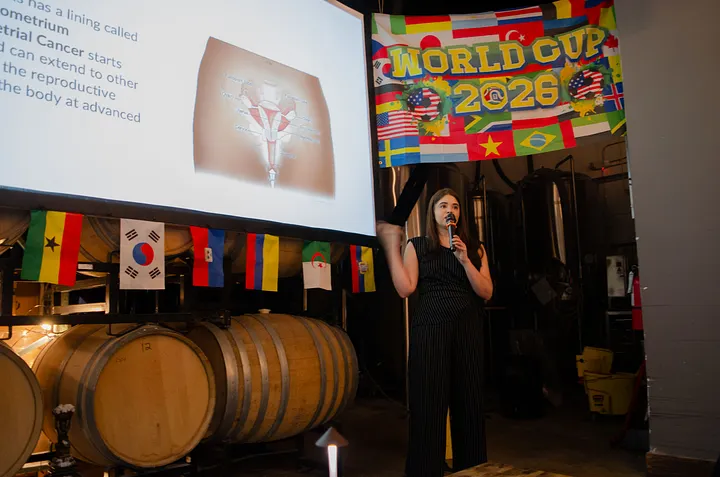
Dr. Ana Rosario Santos presenting her work, “Microbial Conversations in the Vagina: What They Can Teach Us About Uterine Cancer”. Photo credit: Piera Grisolia
Our final speaker of the night was Dr. Paulo Roberto Del Valle. He is a Postdoctoral Fellow in the Welford lab, which investigates hypoxia and redox biology of cancer. He presented his work, “Stranger fields: Using electromagnetism to improve cancer treatment”, seeking to understand how electromagnetic waves disrupt the proliferation of glioblastoma cells (GBM), a particularly deadly form of brain cancer. The standard of care for GBM has not changed in 21 years and patients still exhibit poor clinical outcomes. Tumor treating fields are an experimental treatment that use electromagnetic waves continuously administered 24/7 through pads attached to a patient’s head. Tumor treating fields can extend patient survival by ~3–5 months, but generate heat and are uncomfortable to wear [11]. No one understands exactly how EM waves kill GBM cells. Dr. Del Valle’s goal is to elucidate this exciting mechanism and develop a new treatment regime of tumor treating fields with a shorter duration that doesn’t require sticky pads to be worn 24/7.
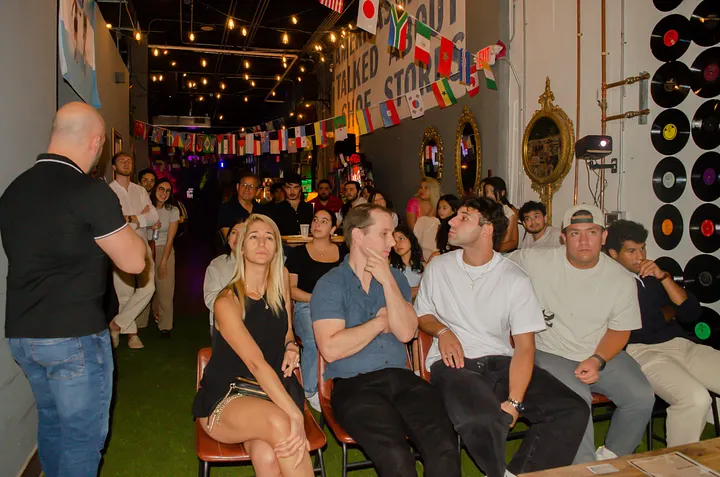
Dr. Paulo Roberto De Valle presents his work, “Stranger fields: Using electromagnetism to improve cancer treatment”. Photo Credit: Piera Grisolia
Future directions and reflections
Science on Tap is the first step in our goal of fostering stronger relationships between scientist and non-scientist community members in Miami, and we are looking to expand our impact. All of our speakers were biomedical scientists, and we would like to expand our speakers to include different disciplines such as climatologists, oceanographers, computer scientists, and more for future events. Additionally, Miami is an international city. 66% of residents speak Spanish, and Little Haiti is the central hub of the Haitian diaspora. To better reach these communities, I believe it is important to present our work in their language. We will have our speakers present in Spanish for our next event, Ciencias y Cervezas, and a future iteration will feature presentations in Haitian Creole. Finally, we would like to invite members of community organizations such as Healthy Little Havana to develop relationships with local leaders to learn about the concerns and lived experiences of community members here in Miami.
For us researchers, Science on Tap was special. Research is arduous work. Reviewer comments, grant rejections, and failed experiments test a scientist’s adversity. It is easy to lose sight of the broader impact of research, but in sharing their work, our presenters felt a recognition that is not often provided in academic settings. One of our speakers recalled,
“I was surprised [at] how people [were] interested and engaged. I think it is very important to let people [be] aware of the kind of research we’re doing… and it is motivating to see their engagement and attention”.
Events like Science on Tap remind researchers that their work matters beyond new findings, publications, and grants. Seeing their fellow community members appreciate their work can reconnect scientists with a deeper purpose for their work and provide a renewed motivation to continue it.
That sense of connection was not limited to our speakers. Our attendees were fully engaged with the cutting-edge science happening in their backyard. After each presentation, I was happy to see them asking insightful questions and seeing how the projects could relate to their lives. A number of women were interested in Dr. Rosario Santos’ work, for example, and asked about early signs of uterine cancer they should look out for. In the post-event survey, we found that 80% of attendees saw biomedical research as more important than before. Even more importantly, we had scientists and community members share drinks and laughs afterwards. These informal interactions were exactly what we hoped for. We created a space where scientists and community members were not separated by a lectern, but could sit across a table and share a conversation.
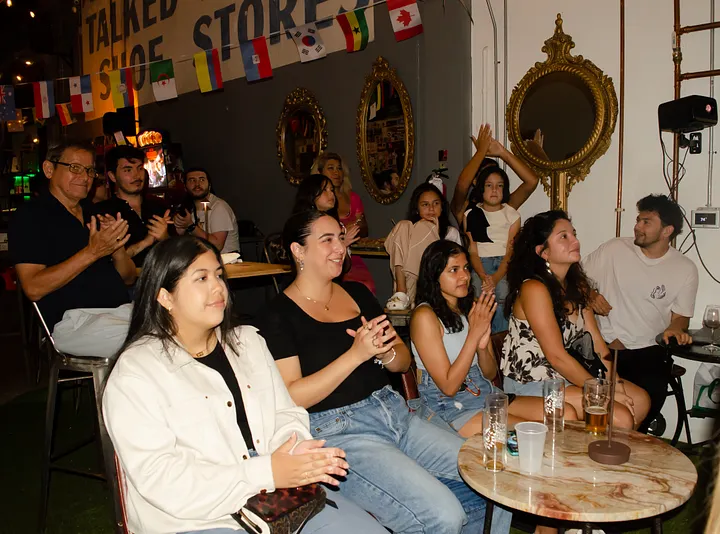
A round of applause from community members in attendance at Science on Tap. Photo Credit: Piera Grisolia
Recognition
Brandon Emanuel León is a member of Scientist Network For Advancing Policy (SNAP) and a PhD candidate in Cancer Biology at the University of Miami Miller School of Medicine. He is the founder of the Science Policy and Communication Committee of the Biomedical Graduate Student Government at the University of Miami Miller School of Medicine.
Piera Grisolia is a postdoctoral fellow at the Sylvester Comprehensive Cancer Center at the University of Miami. Her work focuses on mapping methylation patterns of circulating cell-free tumor DNA. In her free time, she enjoys photography and graciously photographed Science on Tap.
Special thanks to the following SNAP members who provided feedback on this article:
Andrew Mattson is a member of Scientist Network For Advancing Policy (SNAP) and a physics PhD student developing quantum technologies for dark matter detection, gravitational wave observation, and life science/medical applications. He also serves as President of the Science Policy and Diplomacy Group at Johns Hopkins.
Andrew Ramirez is a member of Scientist Network For Advancing Policy (SNAP) and a postdoctoral researcher at Rutgers University-New Brunswick investigating immunotherapy response for melanoma patients. He received his PhD from UCLA developing machine learning models to analyze multi-sample single-cell gene expression data.
Jordan Williams is a member of Scientist Network For Advancing Policy (SNAP) and a pharmacology PhD candidate studying how to alter the lung’s innate immune responses to better treat chronic respiratory diseases.
References:
- University of Miami Rosenstiel School of Marine, Atmospheric, and Earth Science. (2026, August). Hurricane Hunter data reveal early signs of strengthening tropical cyclones.
- University of Miami Rosenstiel School of Marine, Atmospheric, and Earth Science. (2026, August). Scientists turn to nature’s recycling insects to solve Florida’s seaweed problem.
- U.S. Department of Health and Human Services. (2019, August 18). America’s HIV Epidemic Analysis Dashboard (AHEAD): Miami-Dade County, FL. Retrieved August 16, 2026, from
- Capraro, V., Lentsch, A., Acemoglu, D., Akgun, S., Akhmedova, A., Bilancini, E., Bonnefon, J.-F., Brañas-Garza, P., Butera, L., Douglas, K. M., Everett, J. A. C., Gigerenzer, G., Greenhow, C., Hashimoto, D. A., Holt-Lunstad, J., Jetten, J., Johnson, S., Kunz, W. H., Longoni, C., Lunn, P., Natale, S., Paluch, S., Rahwan, I., Selwyn, N., Singh, V., Suri, S., Sutcliffe, J., Tomlinson, J., van der Linden, S., van Lange, P. A. M., Wall, F., van Bavel, J. J., & Viale, R. (2024). The impact of generative artificial intelligence on socioeconomic inequalities and policy making. PNAS Nexus, 3(6), pgae191.
- United Nations Environment Programme. (2025, November 13). AI has an environmental problem. Here’s what the world can do about that.
- Gardner, L. (2026, April 14). More Americans doubt vaccine safety than trust it, POLITICO Poll finds. POLITICO.
- Research!America. (2022, November 8). First-of-its-kind report: U.S. researchers most concerned about misinformation and public trust in science. Research!America.
- Centers for Disease Control and Prevention. (2024, August 10). How vaccines are developed and approved for use.
- Alzheimer’s Association. (n.d.). Alzheimer’s and public health action in Florida.
- National Cancer Institute & Centers for Disease Control and Prevention. (n.d.). State Cancer Profiles: Incidence rates table — Uterus (corpus & uterus, NOS), late stage, Florida by county, 2017–2021. Retrieved August 16, 2026, from
- Rominiyi, O., Vanderlinden, A., Clenton, S. J., Bridgewater, C., Al-Tamimi, Y., & Collis, S. J. (2021). Tumour treating fields therapy for glioblastoma: Current advances and future directions. British Journal of Cancer, 124, 697–709.