Pesticides: History, Alternatives, and the Untapped World of Fungi
Written by SNAP member Alex Lando
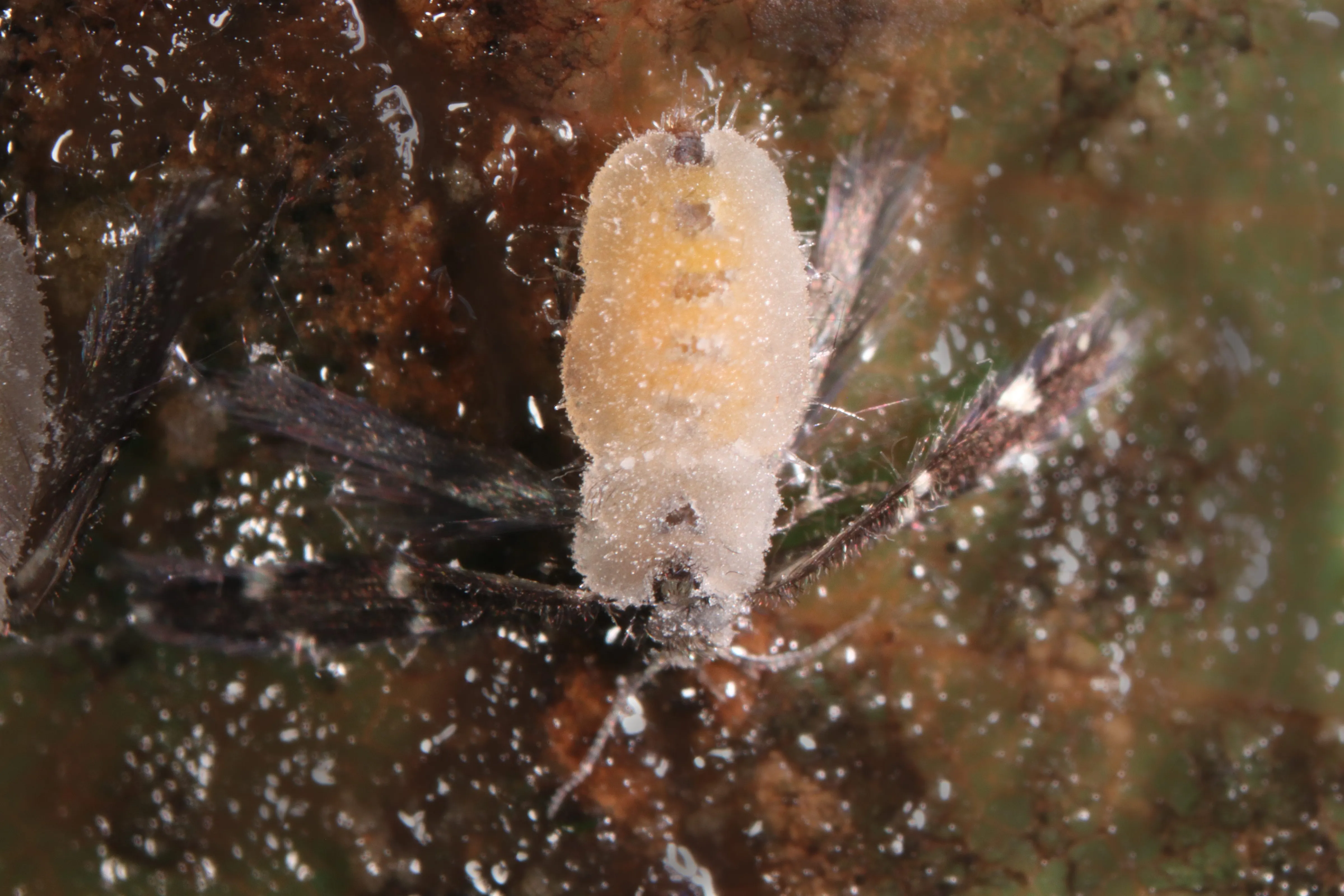
A caddisfly infected with Erynia curvispora near Cascadilla Gorge in Ithaca, NY. Photo by Kathie Hodge.
Footnotes are denoted with superscript numbers. References are denoted with brackets.
In today’s day and age, the term “pesticide” often carries a negative connotation. Though used on the vast majority of American farmland, it is inherently associated with harmful chemicals, environmental consequences, and risks to human health. Not long ago, however, pesticides were viewed in a very different light. Industrial agriculture expanded dramatically post-World War II, and the rapid development of pesticides both during and after the war was widely viewed as a technological marvel. As chemical pesticides became the default in this era, FIFRA, the Federal Insecticide, Fungicide, and Rodenticide Act [1], was passed in 1947 to regulate their use across industrial farmland. While there has been much discussion around the usage and regulation of chemical pesticides in the United States, I turn here to the story of alternatives to chemical pesticides, more specifically biological controls, in the untapped world of fungi. Why on Earth should we care about fungi, you may ask? Because your world, your medicine, and your food quietly revolve around them.
Fungi have a longstanding history in scientific research, be it pharmaceutical, pathological, or agricultural, but are understudied compared to their plant and animal counterparts. There are some exceptions, and fungal strains of critical importance have gathered repertoires of research-backed data over centuries. Saccharomyces cerevisiae, the yeast used for bread and beer, is the most well-studied fungal species [15]. Other model organisms include plant pathogenic fungi like Aspergillus fumigatus, human pathogens like Candida albicans, and the black mold that infects our bathrooms, Stachbotrys chartarum. Though there has been a longstanding cohort of mycologists (fungal researchers), fungi were not even distinguished from plants and recognized as their own kingdom of life until 1969 [14]! Interest in fungal products and their role in environmental conservation and sustainability [4] exploded due to the combined efforts of “magical” mushrooms of the Woodstock era, the synthesis of the psychedelic drug LSD from the fungus Claviceps purpurea, and then President Nixon’s War on Drugs [2,3].
A Brief History of Pesticides
Pesticides fell out of public favor around the same time, due largely to the popularity of Rachel Carson’s work Silent Spring1 in 1962. This book exposed the harmful health effects of dichlorodiphenyltrichloroethane (DDT), turning the tide against one of the most heavily used and environmentally destructive pesticides at the time. Silent Spring not only reshaped public opinion around the technological marvel of pesticides, but spurred a series of policy changes that restructured their use. Laws surrounding pesticide approvals and regulations strengthened, and integrated pest management was born [5, 6]. This process combines all facets of crop disease management, including chemical and biological defenses, to create a unified system that takes into consideration cost, labor, and efficacy alongside environmental effects. The formation of the Environmental Protection Agency (EPA) also occurred in the aftermath of Silent Spring, creating a formal government entity to oversee the effects of agricultural and forestry land management on the surrounding environment [7].
As consumers grew increasingly more aware of the harmful side effects of chemical pesticides, alternatives were continuously being developed, using bacteria, viruses, and predatory insects. This research was relatively poorly funded and not often successful, in large part due to the complications involving using a living, infective organism. Expensive shipments, trouble with storage, and uncontrollable environmental effects created many gaps in the preparation of farm-ready products [10]. Biological control (or biocontrol) products, the term used for these living pesticides, often have unfavorable trade-offs; while more target-specific towards an individual pest, these alternatives are slower-acting and require multiple applications. Convincing long standing family farms with large scale operations to switch to expensive and occasionally unreliable biocontrols was, and continues to be, a formidable challenge that further slows data collection on efficacy.
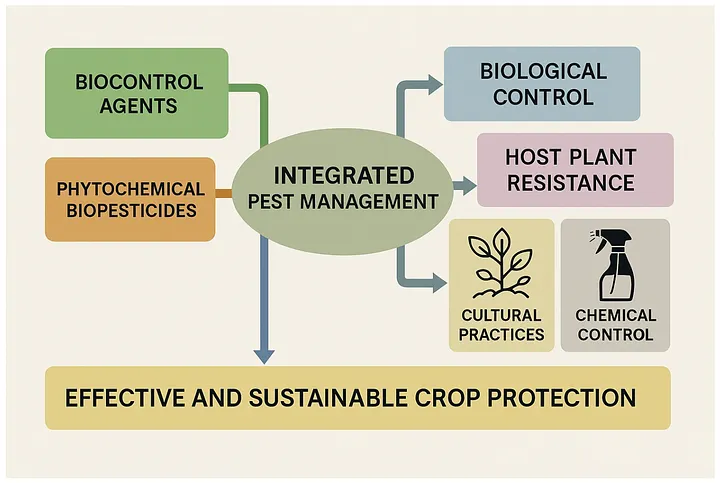
Workflow of Integrated Pest Management (IPM) strategies, including biological control agents such as fungi alongside chemical control using pesticides. From Danesh et al. [5].
Modern Challenges and Successes of Pesticide Alternatives
Modern agriculture is still challenged to meet the demands of the American consumer, as many crops are not grown off-season or at all in the United States. Shipment of living organisms across borders carries with it significant risk of uncontrollable invasive pests and pathogens [10]. This can come in the form of a non-native insect with no local predators, or a formidable disease American trees cannot withstand. Historically, the most famous example is Phytophthora infestans, the microbial disease that caused much of the Irish Potato Famine [18]. Some more recent well-known examples may include the spongy moth (formerly known as the gypsy moth), the emerald ash borer, or even more recently, the spotted lantern fly [20]. Wine grapes are plagued by the powdery mildew fungal disease [21], and chestnut trees with chestnut blight [22].
There are, however, some success stories, both in agriculture and forestry [16]. Entomophthora maimaiga is a fungus that kills the larvae of the invasive spongy moth, which has devastated hundreds of tree species across American forests for nearly a hundred years [8]. There have been successful small-scale inoculative releases of this fungus into the wild to wreak havoc on moth populations [8]. Beauveria bassiana is a popularized fungal pathogen of insects that has been turned into a successful biopesticide in use on farms worldwide [9], decreasing pest populations in some cases up to 90% [19].
Modern agricultural policy centralizes a more integrative approach, and attempts to more thoroughly bridge academia and farming communities through extension and outreach. Agriculture-related sciences are funded heavily through the United States Department of Agriculture National Institute of Food and Agriculture. Government incentives around sustainability, much like those for farms and industry that adopt solar or wind energy, exist for biological pest management systems [11].
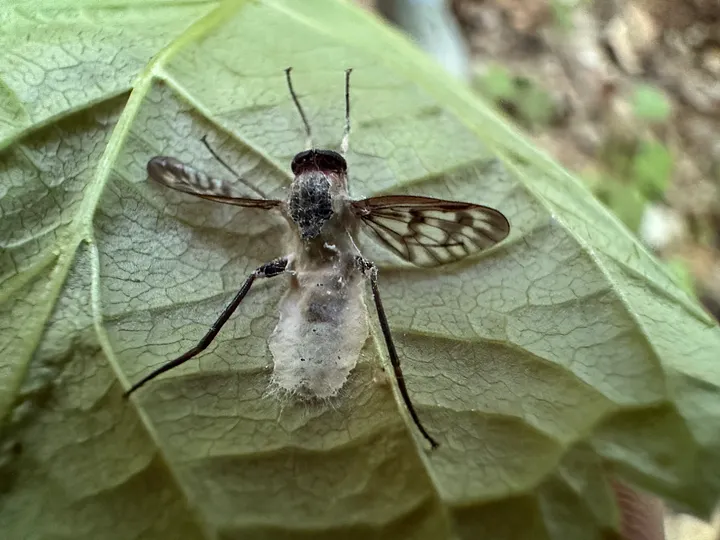
A snipe fly infected with Furia ithacensis, a fungus named after its discovery in Ithaca, NY. Photo by Brian Lovett.
Future Avenues and Policy for Pesticide Alternatives
Inconsistent policy between administrations and research funding shifts are only some of the challenges involved in developing sustainable agricultural practices. Commercialization costs, manufacturing difficulty, and shelf life of living products are significant deterrents for industrial development [10]. The high costs also eliminate adoption by smaller farms. The “valley of death”, the gap in information passing from academia and industry, slows development of commercially available products to a crawl. Many of the challenges in the realm of biological control lie far beyond the lab bench, as field trials are unreliable and costly, and policy changes with the tide.
Today, using terminology around biological control such as “non-chemical”, “environmentally friendly”, “sustainable”, “alternative”, or even “natural” can carry a lot of societal weight [12]. The scientific community has increasingly incorporated more traditional agricultural practices from Native American communities, such as companion planting and decoy crops to confuse pests [17], within the framework of peer reviewed research. Biological control of disease is nearly as old as agriculture itself, but the process of its development and testing is continuous [13]. Careful framing of biological control to increase usage must include the environmental and public health benefits alongside acknowledgement of traditional practices, while being careful not to play into the fear mongering of “trendy” pseudoscientific claims around natural alternatives. While there may be mixed opinions on whether to market biological controls under this framework, the fact remains that this avenue of research is only getting stronger with modern genetic advancements, and may be the change in crop protection that our farmers, and our environment, so desperately needs.
Opportunities for policy development around fungal biocontrol are unsurprisingly abundant. Universities that have received federal government land grants often include agricultural extension components to research professorship roles, which involve input from local farms as well as community outreach in return [23]. Increasing these extension positions and funding for academic institutions, specifically those with land grants, can strengthen the flow of research in biological control. Further emphasizing integrative pest management strategies and incentives while strengthening public-private partnerships can target downstream application of these tools and narrow that “valley of death”. The development of biological controls sits firmly among a wide swath of broader policy goals, such as biodiversity and conservation, pollinator protection, climate resistance, food security, and sustainability. Fungal biocontrol successes are a case study in how academia, agriculture, environment, and policy spheres can coalesce into actionable change and the progression of science-forward policy.
Recognition
Alex Lando is a PhD Candidate in Plant Pathology at Cornell University currently researching methods for developing insect-killing fungi as biological controls for agricultural pests.
Special thanks to the following SNAP members who provided feedback on this blog:
Andrew Ramirez, a postdoctoral researcher at Rutgers University-New Brunswick investigating immunotherapy response for melanoma patients. He received his PhD from UCLA developing machine learning models to analyze multi-sample single-cell gene expression data.
Jordan Williams, a pharmacology PhD candidate studying how to alter the lung’s innate immune responses to better treat chronic respiratory diseases.
Further Reading
There is a significant history to pesticide usage in the United States, its correlations outside of agriculture and into environmental advocacy, public health, drug discovery, even chemical weapons manufacturing. Below, we recommend additional resources for further reading on this topic:
1 Carson, Rachel. (1962). Silent Spring. Houghton Mifflin.
[2] The Joe Gardener Show, Episode 281 https://joegardener.com/podcast/chemical-age-how-tools-of-war-became-agricultural-chemicals/
[3] von Hippel, F. (2020). The Chemical Age: How Chemists Fought Famine and Disease, Killed Millions, and Changed Our Relationship with the Earth. University of Chicago Press.
[4] Aktar, Md Wasim et al. (2009). “Impact of pesticides use in agriculture: their benefits and hazards.” Interdisciplinary toxicology vol. 2,1: 1–12. doi:10.2478/v10102–009–0001–7
References:
- U.S. Environmental Protection Agency. (2026, February 23). Summary of the Federal Insecticide, Fungicide, and Rodenticide Act.
- Tucker, J. B., & Mahan, E. R. (2009, October 1). President Nixon’s decision to renounce the U.S. offensive biological weapons program. Center for the Study of Weapons of Mass Destruction, National Defense University.
- Microdose Pro. (n.d.). Nixon’s ban of psychedelics.
- Tucker, J. B. (2002). A farewell to germs: The U.S. renunciation of biological and toxin warfare, 1969–70. International Security, 27(1), 107–148.
- Rezaee Danesh, Y., Mulet, J. M., & Porcel, R. (2025). Bridging microbial biocontrol and phytochemical biopesticides: Synergistic approaches for sustainable crop protection. Plants, 14(22), 3453.
- U.S. Department of Agriculture. (n.d.). Integrated pest management.
- U.S. Environmental Protection Agency. (n.d.). Origins of EPA.
- Hajek, A. E. (1996). Entomophaga maimaiga: A fungal pathogen of gypsy moth in the limelight. In Proceedings of the Cornell Community Conference on Biological Control.
- U.S. Environmental Protection Agency. (1999, November 1). Beauveria bassiana [Fact sheet].
- Hajek, A. E., & Eilenberg, J. (2018). Natural enemies: An introduction to biological control (2nd ed.). Cambridge University Press.
- National Institute of Food and Agriculture. (n.d.). NIFA awards $92M to support pests, beneficial species in agricultural production. U.S. Department of Agriculture.
- Pew Research Center. (2026, April 3). Americans’ shifting views on energy issues.
- Umetsu, N., & Shirai, Y. (2020). Development of novel pesticides in the 21st century. Journal of Pesticide Science, 45(2), 54–74.
- Whittaker, R. H. (1969). New concepts of kingdoms of organisms. Science, 163(3863), 150–160.
- Heitman, J. (2025). The fungal kingdom as a Rosetta stone for biological discovery. Current Biology, 35(11), R427–R433.
- Nature. (n.d.). Biological control of weeds using fungal pathogens. Nature Index.
- Native Pest Control. (n.d.). Native American pest control. Baron Services.
- Goss, E. M., Tabima, J. F., Cooke, D. E. L., Restrepo, S., Fry, W. E., Forbes, G. A., Fieland, V. J., Cardenas, M., & Grünwald, N. J. (2014). The Irish potato famine pathogen Phytophthora infestans originated in central Mexico rather than the Andes. Proceedings of the National Academy of Sciences of the United States of America, 111(24), 8791–8796.
- Sufyan, M., Abbasi, A., Gogi, R. M., Arshad, M., Nawaz, A., & Neuhoff, D. (2017). Efficacy of Beauveria bassiana for the management of economically important wireworm species (Coleoptera: Elateridae) in organic farming. Gesunde Pflanzen, 69.
- Cornell Integrated Pest Management. (n.d.). Spotted lanternfly management. Cornell University College of Agriculture and Life Sciences.
- University of California Agriculture and Natural Resources. (n.d.). Powdery mildew. UC Integrated Pest Management.
- Forest Pathology. (n.d.). Chestnut blight.
- Association of Public and Land-grant Universities. (n.d.). What is a land-grant university?