It's a Wonderful Life
Written by SNAP member Sneha Rao
References are denoted with brackets.
Tiny little rocket ships are swimming around in the water, some tumbling, others gently drifting, occasionally bumping into each other along their paths. These little rockets are sea stars, though in their current larval stage they look more like Darth Vader’s helmet. Watching them through the microscope, they seem content and carefree, oblivious to my encroachment on their privacy. Just a few days ago, I started watching them grow up from single cells, dividing and dividing in an almost synchronized dance, taking shape first into hollow spheres and then free-swimming larvae. I couldn’t tear my eyes away.
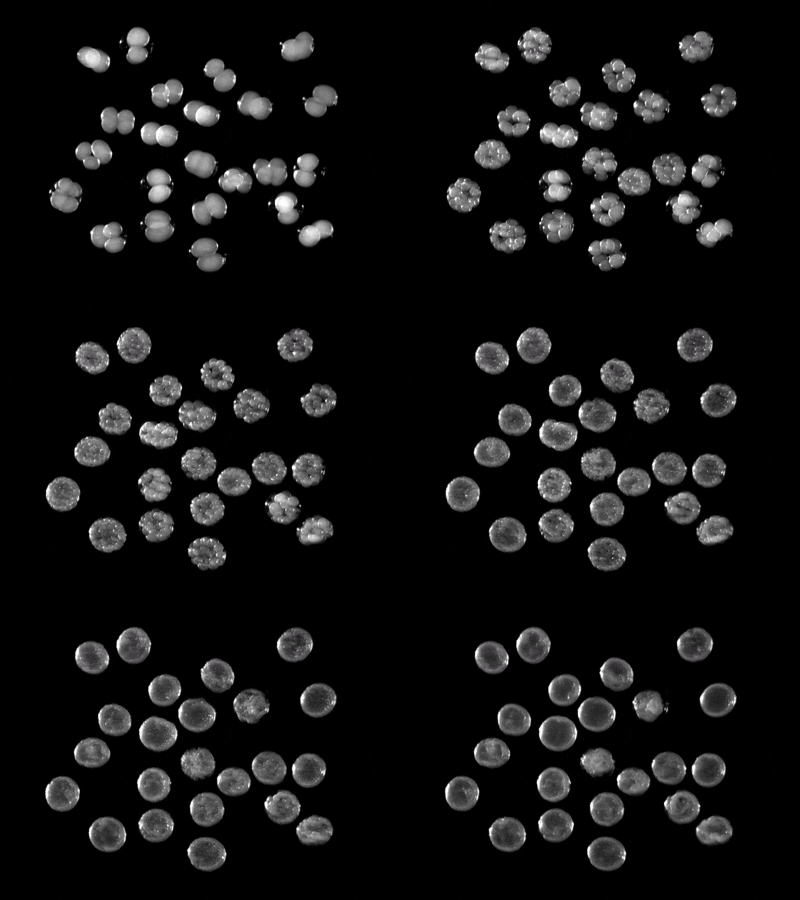
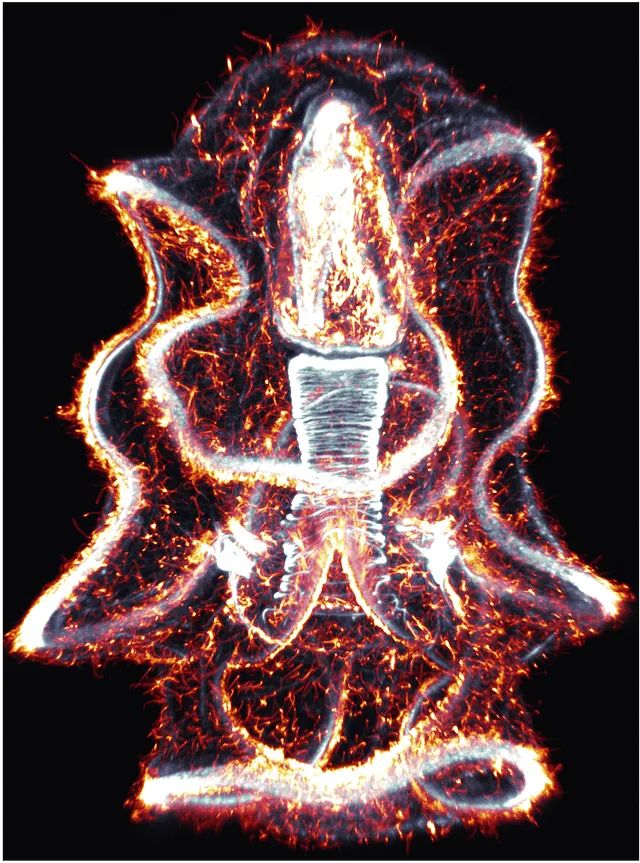
Left: Sea star embryos developing over several hours. Right: A preserved sea star larva with structural proteins labeled in white (actin) and orange (tubulin).
Wonder
This summer, I spent many days (and nights) peering at embryos through microscopes while the world around me faded away, utterly transfixed at the beautiful transformations I got to witness. As a student in the 6-week Embryology course at the Marine Biological Laboratory (MBL), I studied the embryo development of over two dozen animals including sea urchins, worms, squids, snails, tardigrades (the cute little water bears that can famously survive outer space and other extreme conditions), and more.
Embryology, the study of how a single cell develops into an adult organism, has captivated society for millennia. In the 300s BCE, Aristotle dissected chicken eggs at different stages of development to study how body parts arise [1]. In the early first millennium, an ancient Buddhist text from India describes the weeks of human gestation with striking accuracy [2]. Today, our understanding of how life forms has increased exponentially thanks to technological advancements in genetics, microscopy, bioengineering, and computing [3], yet every time I watch an embryo develop, I remain in awe of just how much there is still to discover. This sense of wonder and curiosity about the fundamental processes that shape life is what motivates me every day.
At the MBL, I felt like a child in a scientific playground, free to explore the world with all the technological toys at my fingertips. After my course ended, I wanted to bottle up the child-like sense of wonder and culture of open-ended exploration that makes the MBL such a fertile ground for discovery. I recognize how privileged I am to be able to observe the world and study the questions that interest me as a PhD student, pursuing philosophia, the “love of wisdom” that the degree is named after. As much as I wish this curiosity alone could justify pursuing any research question, funding agencies and political leaders expect scientists to justify their research with its relevance to human health and society, not simply wonder or awe.
Investment in basic science
STEM research spans from deeply fundamental or theoretical research, known as ‘basic science’, to highly applied work that directly impacts society. This distinction is not black and white, and many research projects fall along a sliding scale somewhere in between. Which end of this spectrum merits more funding has been hotly debated for decades in the United States.
Before World War II, federal involvement in science was modest, but the rapid advancements made with the wartime Manhattan Project and radar program showed how powerful government-funded science could be. After the war, Vannevar Bush, Director of the Office of Scientific Research and Development, wrote the landmark report, Science: the Endless Frontier, calling for the creation of a National Science Foundation (NSF) to expand federally funded basic science research that he argued was essential to the security and progress of the nation [4]. In the process of creating the NSF, however, there were strong debates about whether the agency should prioritize basic or applied research, and whether scientists or the public should have influence over what research gets funded. The structure of the NSF ended up being a compromise from both sides, with a focus on basic science, grant review by scientific peers, and a politically appointed director. While the creation of the NSF in 1950 was followed by the formation of new science agencies such as NASA and DARPA and the expansion of the NIH, the debates over research and investment priorities for federal science agencies continued.
Over the past year and a half, I’ve watched support for basic science in the US dwindle. Under the current administration, federal agencies that fund basic research face massive cuts, canceled grants based on restricted keywords, and are being redirected to focus on technological advancement at the cost of other areas of research. Funding to train the next generation of the workforce in basic sciences has taken a massive hit as well, with cuts to graduate programs and fellowships in most STEM fields. Just this summer, Michael Kratsios, Director of the White House Office of Science and Technology Policy, released a report, Science: A New Golden Age, outlining a vision for the US scientific enterprise focused on funneling investments into current tech priorities.
While there are valid arguments to prioritize this area of research, as an early-career graduate researcher trying to find my footing in the shifting sands of the federal funding landscape, I am left to grapple with a more personal, existential question. If society no longer places much value on knowledge for knowledge’s sake, what contributions can I make to society by pursuing my interests in basic science research?
“Scientific progress on a broad front results from the free play of free intellects, working on subjects of their own choice, in the manner dictated by their curiosity for exploration of the unknown.” — Vannevar Bush, Science: The Endless Frontier, 1945
What value does basic science bring?
Some of the strangest, most impractical-sounding research has ended up laying the groundwork for major advances in medicine, technology, and engineering. Research into microwave amplification in the 1950s eventually led to the generation of lasers that allow many ubiquitous modern technologies like the internet to exist. The study of lizard venom in the early 1990s led to the production of GLP1 drugs whose production for diabetes and obesity treatment has skyrocketed in the past few years. The study of yogurt cultures in the early 2000s led to the discovery of the bacterial immune system, CRISPR, which has revolutionized gene editing therapies. (If you’re interested in learning about more such stories, be sure to follow the annual Golden Goose Award, which celebrates federally funded research that sounded silly but turned out to be transformative for society.) These examples highlight how long-term, sustained investment in basic science research is required for an initial discovery to mature into usable applications.
It’s a bit like the 1946 film, It’s a Wonderful Life. In the movie, George Bailey, the main character, contributes to his community with no expectation of reward in return, spending most of the movie unaware of how much his good deeds and very existence have shaped the people and town around him. In the end, he reaps the benefits of this community he always supported. Similarly, basic science research consistently contributes to a body of knowledge without expectation of short-term results; with enough time and investment, the impact of this research can be felt in our everyday lives.
It is incredible when a long-studied basic science question leads to a transformative application in society. But, does that mean we always have to be working towards an application as the end point of a research project? What about the research that deepens our understanding of the world, but might never result in a therapy or a technology? How does that kind of knowledge serve society indirectly? What value do we place, individually and collectively, on simply knowing more about the world we live in?
Looking ahead
I believe it is reasonable to support basic science purely for the sake of knowledge, independent of whether it serves a named strategic priority or promises short-term products. That being said, I also believe we need to reimagine how we fund basic science and view its contribution to society.
With cultural tides swaying against increased federal investment and towards industry funding of scientific research, we should focus on creating new infrastructure within industry to support basic science research. At the moment, federally funded research and industry research largely fulfill different functions, with basic science research primarily funded by the government. However, we could envision a world where industry is incentivized to include fundamental research as part of their pipeline, generating new basic science tracks for open-ended discovery rather than R&D in only existing products areas. Recent proposals from the NSF and Congress also show support for increasing industry-focused graduate training. These new training programs and partnerships between industry and academia could protect funding for exploratory research and help share the cost of training the next generation of scientists.
I also propose a more cultural shift: a democratization of science that returns the power of inquiry to everyone, not just specialized researchers. After all, my research to understand embryo development builds on centuries of observations from ordinary people paying close attention to the world around them. As AI takes over data analysis and robots automate lab work, it’s worth remembering that our inherent human curiosity is still what generates new ideas in the first place. We need to better engage communities in identifying questions worth studying, openly sharing what the answers teach us, and reconnecting people to the curiosity they already feel about the world. If we could incorporate more dialogue in the research process, especially around basic science, we could build more trust and lasting public support for it.
The road ahead will be messy as we explore new ways to support basic science research, but through all the hard work, I invite you to remember something simple. The world is full of wonderful, strange things that merit our attention. Whatever your version of an embryo under a microscope is, I hope you take some time to let yourself be transfixed by it.
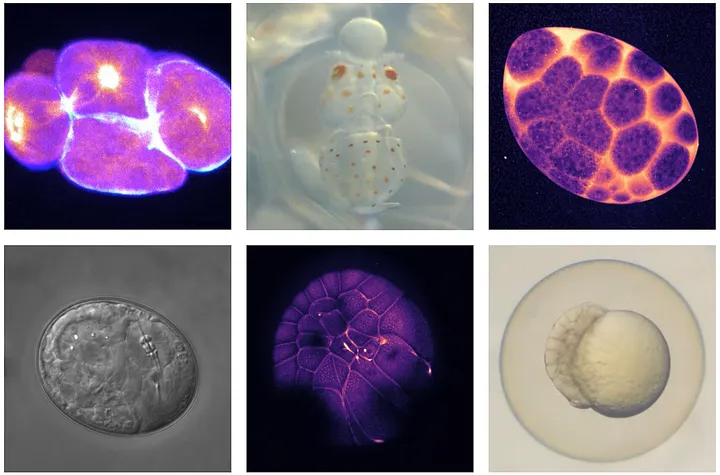
Embryos of various animals. Top: Nematode worm, Longfin inshore squid, Beach hopper. Bottom: Tardigrade, Longfin inshore squid, Zebrafish. (Images taken at the Marine Biological Laboratory by Sneha Rao)
Recognition:
Sneha Rao is a leader of the Science Policy Group at UCSF and a developmental biology PhD candidate studying how cells talk to each other during embryo development.
Special thanks to the following SNAP members who provided feedback on this article:
Alex Lando is a Plant Pathology PhD candidate at Cornell University and co-president of the Cornell Advancing Science and Policy Club studying the use of insect-killing “zombie” fungi in agriculture, Breelyn Karno is a PhD candidate at Vanderbilt University studying the metabolic determinants of breast cancer bone metastasis, Daniel Affsprung is a PhD candidate in History and Philosophy of Science at Arizona State University. He researches the history of Congressional efforts to make science and technology more responsive to societal needs, and Emily Selland is an ecologist and public health scientist whose research focuses on sustainable and economically viable innovations for disease control.
References:
- Needham, J. (1934). The History of Embryology.
- Wallingford, J. (2021). Aristotle, Buddhist scripture and embryology in ancient Mexico: building inclusion by re-thinking what counts as the history of developmental biology. Development, 148(3).
- Liberali, P., Schier, A. F. (2024). The evolution of developmental biology through conceptual and technological revolutions. Cell, 187(14), 3461–3495.
- The National Science Foundation: A Brief History.
- Bush, V. (1945). Science: The Endless Frontier. United States Office of Scientific Research and Development.
- Kratsios, M. (2026). Science: A New Golden Age. White House Office of Science and Technology Policy.