A Trip Down Memory Lane: Psychedelics & Their Complicated Status Throughout United States Health Policy
Written by SNAP member Jessa Burling
Footnotes are denoted with superscript numbers. References are denoted with brackets.
{Source: https://medicine.washu.edu/news/podcast-can-psychedelic-drugs-help-treat-mental-illness/}
It is no secret that the word ‘psychedelics’ invokes a multitude of different feelings, thoughts, or expectations. Whether it be people in tie-dye experiencing mind-altering hallucinations or the government conducting experiments to weaponize a compound for ‘mind-control,’ psychedelics have long been a polarizing topic of conversation in society. Earlier this year, their presence once again came to the forefront of health policy in the United States after Donald Trump signed an executive order directing federal agencies to loosen restrictions on psychedelic compounds and invest at least 50 million dollars in researching psychedelics as potential treatments for psychiatric illnesses [1]. At the April 18th announcement, Secretary of Health and Human Services, Robert F. Kennedy Jr., explained, “We are accelerating the research, approval, and responsible access to promising mental health treatments, including psychedelic therapies like ibogaine, to confront our nation’s mental health crisis head-on, especially for our veterans.” [2] He went on to say that, “The FDA will prioritize therapies with Breakthrough Therapy designation, where early evidence shows meaningful improvement over existing options for serious mental illness.” [2] Specifically, the FDA issued national priority vouchers to three companies that are researching psilocybin, another psychedelic, for treatment-resistant depression and major depressive disorder, and methylone for post-traumatic stress disorder. They also approved a new early-phase clinical study investigating ibogaine as a potential treatment for alcohol use disorder [1, 2].
Considering the plethora of budget cuts within the National Institutes of Health (NIH) and National Science Foundation (NSF) over the last year [3], it may be easy to view expansion of research funding for psychedelics and investment in clinical trials as a positive. Indeed, Dr. Mason Marks, a senior fellow at the Project on Psychedelics Law and Regulation at Harvard Medical School, mentions that “the order could have a substantial impact on the research and development of psychedelic treatments” [4]. But he also alludes to the fact that the executive order may be more symbolic in nature, mentioning complicated mechanisms of the FDA approval process and the Right to Try Act, which was signed in 2018 and provides avenues to access experimental drugs without approval from the FDA for specific patient populations [4, 5]. Similar conversations of hesitancy have questioned why ibogaine was chosen for the clinical trial despite its cardiotoxicity [6], what the order means for the future of psychedelic research and implementation into mainstream treatment [7], and whether the FDA is capable of delivering the promises detailed in the order [8]. To understand both the excitement and skepticism towards the deliverables of this recent executive order, one must look towards the history of psychedelics.
A brief history of psychedelics
Medicinal and religious practices using psychedelic plants date back to prehistoric times. The peyote cactus, containing mescaline (a psychedelic compound), the teonanácatl mushroom, containing psilocybin, and the caapi plant, containing ayahuasca (a psychedelic compound), were used by Indigenous cultures around the world to induce inebriation, cure illnesses, and for sacred religious purposes [9]. Despite their prominence in Indigenous traditions for a multitude of years, scientific exploration of these compounds and their psychoactive properties began around 1897 when Arthur Heffter, a German pharmacologist and chemist, isolated mescaline from peyote and noted its psychoactive effects [10]. Psychedelic research remained few and far between until 1938, when Albert Hoffman synthesized lysergic acid diethylamide, commonly known as LSD, from the ergot fungus and ingested the compound before embarking on his bicycle ride home. On the journey, he experienced the psychoactive properties of LSD, including dreamlike hallucinations. In the subsequent years, he conducted research examining the hallucinogenic effects of LSD and its potential to treat psychiatric disorders [11]. To this day, his bike ride home is known as the ‘first LSD trip’. Further information about the psychoactive properties of these compounds was detailed when R. Gordon Wasson published his experience with ‘magic mushrooms’ in Life magazine in 1957 after participating in an Indigenous healing ceremony in central Mexico [12]. This public introduction to psychedelics coincided with hundreds of preclinical and clinical studies already underway from the 1940s to the 1960s, examining the effects psychedelics produced in humans and how they could be harnessed to improve mental health [9].
The positive effects occurring in these studies (despite their questionable methodologies, including lack of informed consent [10]) and the published first-hand experiences on these substances captivated public interest in psychedelics. Consequently, recreational use of psychedelics increased in the 1960s and ultimately became associated with the counterculture movement, which came to carry a negative connotation, seen by mainstream society as embodying inherently ‘deviant’ morals [13]. As a response to this ill-perceived movement and the psychedelic drugs that had become so intertwined with it, the Controlled Substances Act (CSA) of 1970, which established federal control over possession of drugs, was signed by Ronald Reagan and subsequently enforced through the formation of the Drug Enforcement Agency (DEA) [14]. Before this bill, psychedelics were not controlled or considered ‘illegal’ by the federal government (though individual states started passing laws to criminalize psychedelics starting in the mid-1960s [15]. The CSA classified psychedelics as a Schedule I substance, listing them as having ‘no currently accepted medical use’, a ‘lack of accepted safety for use under medical supervision’, and ‘at least some potential for abuse’ [16]. As such, from the 1970s to the turn of the 20th century, scientific investigation into psychedelics was significantly curtailed, and the potential treatment effects of psychedelics remained elusive.
{Source: Adobe Stock Images}
Where are we now?
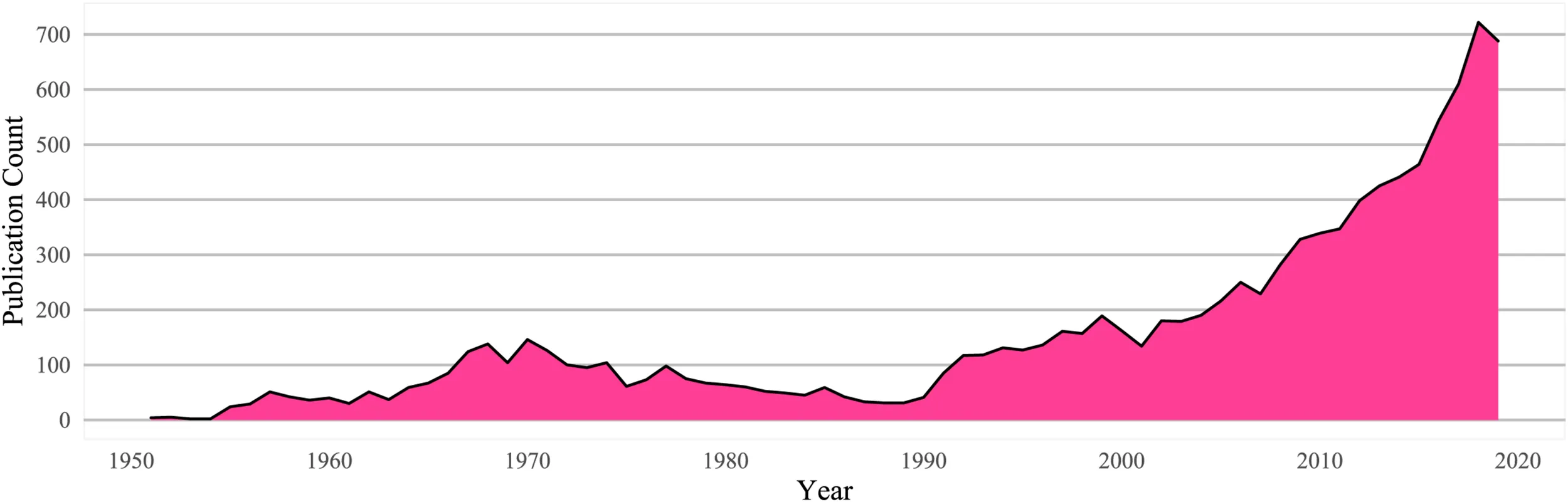
Despite their restrictive status and the 20th-century tough-on-drugs policies, the tireless lobbying work of researchers, companies, and organizations created the ability to secure legal pathways for psychedelic research, leading to a plethora of new information about their potential as treatments (see publication counts in image below) [16, 17]. Work over the last 20 years has indicated that psychedelics like psilocybin, LSD, and 3,4-methylenedioxymethamphetamine, also known as MDMA, have positive treatment impacts on alcohol use disorder, opioid use disorder, end-of-life anxiety, major depressive disorder, and post-traumatic stress disorder [7, 18]. These studies have brought about a resurgence of acceptance and encouragement for the use of psychedelics to improve psychiatric conditions by the general public. These sentiments have also reached state governments; a 2023 review found that the number of psychedelic reform bills introduced each year steadily increased from 2019 to 2022, with 25 states considering 74 bills [19]. Though psychedelics uphold their Schedule I federal status, state laws have different restrictions, varying from inactive legislation to state-regulated medical access. One collaboration between Psychedelic Alpha, Calyx Law, and the UC Berkeley Center for the Science of Psychedelics has created the US Psychedelic Law & Policy Tracker, which allows users to utilize an interactive map and view legislation/reforms at the local and state levels. Additionally, the executive order signed earlier this year creates a rescheduling pathway, instructing the US Attorney General to move psychedelics to a lower status upon completion of a successful Phase 3 clinical trial.
{Source: DOI:10.3389/fpsyg.2020.01681, reference [16]}
What may the future hold?
So where does that leave us? The status of psychedelics throughout history within federal law, but also in the societal zeitgeist, may feel like a pendulum that swings back and forth from radical acceptance to outright abolition. Initial discovery led to an initial surge of recreational and academic use of psychedelic compounds. Association with counterculture and the rise of conservatism led to broad-sweeping legislation and the explicit prohibition of these substances. And now? What might the increased spending and fast-track approvals in this executive order lead to? It may well be that the executive order leads to little or no practical impact on the psychedelic research being done due to the fickle nature of government regulation. On the other hand, it may provide psychedelic researchers with the tools and support they need to build more rigorous trials, increase sample sizes, and improve replicability. One thing is for sure, though: this executive order demonstrates that the federal government favors using psychedelics as potential treatments.
Being a scientist requires skepticism, and the executive order demands such critical examination. As someone who researches psychedelics, I have worried that the executive order could be viewed in a negative light by the general public. After all, what does it say that a government that slashes research funding in other areas and propagates mistrust in scientists is simultaneously putting forth support for research on psychedelics? However, I also believe that it is important to have optimism as a scientist. As such, I am choosing to view the order in such a light: a beacon of hope that there is the potential for science to prosper, even under the current constraints.
{Source: Adobe Stock Images}
Recognition:
Jessa Burling obtained her BS from the University of Wisconsin-Madison and is currently a PhD Candidate at Dartmouth College. Her work focuses on modifying the neural correlates and specific behaviors after trauma exposure using brain stimulation and psychedelics.
Special thanks to the following SNAP members who provided feedback on this article:
Aislinn Gilmour is a PhD student studying environmental epidemiology at Dartmouth, with a focus on how environmental chemicals impact maternal and child health.
Andrew Ramirez is an adjunct professor at The College of New Jersey and Middlesex College. He received his PhD from UCLA, developing machine learning models to analyze multi-sample single-cell gene expression data.
Jordan Williams is a pharmacology PhD candidate studying how to alter the lung’s innate immune responses to better treat chronic respiratory diseases
Sarah Berretta is a PhD student in Psychology at the University of Texas at Dallas, where her research focuses on self-awareness and social cognition in paranoia and serious mental illness.
References:
- O’Neil, G. (2026, April 18). Accelerating Medical Treatments for Serious Mental Illness. The White House.
- Office. (2026). FDA Accelerates Action on Treatments for Serious Mental Illness Following Executive Order. U.S. Food and Drug Administration.
- 11791, & 135. (2026, March 31). The Cost of the Trump Administration’s Attacks on Research Funding. Brennan Center for Justice.
- Reddick, R. (2026). Trump’s psychedelic executive order: president expands access to psychoactive drugs. BMJ, 393, s794.
- An Act. (n.d.). Retrieved September 8, 2026.
- Perrone, M., & Kim, S. M. (2026, April 18). Trump signs order to speed review of psychedelics, including ibogaine. AP News.
- Afrah Howlader. (2026, July 22). Trump Order Gives Psychedelic Therapy a Boost — Penn LDI. Penn LDI.
- Scott, E. (2026, April 18). A New Executive Order on Psychedelics: Q & A with I. Glenn Cohen and Mason Marks — Petrie-Flom Center. Petrie-Flom Center — The Blog of the Petrie-Flom Center at Harvard Law School.
- Geyer, M. A. (2023). A brief historical overview of psychedelic research. Biological Psychiatry. Cognitive Neuroscience and Neuroimaging, 9(5), S2451–9022(23)00314–2.
- Nichols, D. E. (2004). Hallucinogens. Pharmacology & Therapeutics, 101(2), 131–181.
- Pallardy, R. (2019). Albert Hofmann | Swiss chemist. In Encyclopædia Britannica.
- National Academies of Sciences, E., Division, H. M., Policy, B. H. S., Disorders, F. N. N. S., Stroud, C., Norris, S. M. P., Matney, C., & Bain, L. (2022). History and Current Status of Psychedelics and Entactogens for the Treatment of Psychiatric Disorders. In www.ncbi.nlm.nih.gov. National Academies Press (US).
- Beyond Counterculture: Towards a People’s History of Psychedelic Networks | Center for the Study of World Religions. (2016). Harvard.Edu.
- Lampe, J. R. (2025, January 22). The Controlled Substances Act (CSA): A Legal Overview for the 119th Congress. Congress.Gov.
- Marks, M. (2024). State Drug Laws. Scholarship Repository.
- Petranker, R., Anderson, T., & Farb, N. (2020). Psychedelic Research and the Need for Transparency: Polishing Alice’s Looking Glass. Frontiers in Psychology, 11.
- UC Berkeley Center for the Science of Psychedelics. (n.d.). Psychedelics, the Law and Politics — UC Berkeley BCSP. UC Berkeley Center for the Science of Psychedelics. Retrieved September 8, 2026.
- dos Santos, R. G., Bouso, J. C., Alcázar-Córcoles, M. Á., & Hallak, J. E. C. (2018). Efficacy, tolerability, and safety of serotonergic psychedelics for the management of mood, anxiety, and substance-use disorders: a systematic review of systematic reviews. Expert Review of Clinical Pharmacology, 11(9), 889–902.
- Siegel, J. S., Daily, J. E., Perry, D. A., & Nicol, G. E. (2023). Psychedelic Drug Legislative Reform and Legalization in the US. JAMA Psychiatry, 80(1), 77.