Combating the antimicrobial resistance public health crisis with next-generation tools
Written by Disha Patel and Ashley Eng
Thoughts and views written in this blog post reflect those of the author(s) only, and not necessarily those of every SNAP member or the SNAP coalition as a whole.
References are denoted with brackets.
Antimicrobial resistance (AMR) is a public health crisis
If you are infected with a pathogen, small organisms (i.e., bacteria, viruses, fungi) that cause disease, then those medicines help your body fight the pathogen and make you feel better [1]. However, there are pathogens for which medications do not work because the germs have developed resistance to them [1,2]. This is known as antimicrobial resistance (AMR). AMR is a global public health crisis. Resistance has increased by over 40% since 2018, and current methods to stop resistant pathogens are not working [3]. According to the Centers for Disease Control, 2.8+ resistant infections occur in the United States per year [4]. Specifically, bacterial AMR was estimated to lead to more than 4.7 million deaths in 2021 [5]. Doctors are often left with few treatment options that can be harsh for patients and prolong recovery time. Illnesses that take longer to clear also often strain hospitals and increase risk in medical treatments that use antibiotics (i.e., chemotherapy and transplants) [1]. Thus, it is important to understand resistance and improve methods to detect resistant pathogens.
Pathogens become resistant by either acquiring mutations in their genes or by a resistant pathogen transferring its resistant genes to a non-resistant pathogen. What happens when pathogens become resistant? Let’s take bacteria as an example. Antibiotics were developed to kill bacteria or make it difficult for them to grow and spread [1]. However, bacteria have cleverly evolved to evade antibiotics, as shown in Figure 1 [6]. For example, a bacterium that develops resistance to an antibiotic can modify the antibiotic, reject the antibiotic, or destroy the antibiotic.
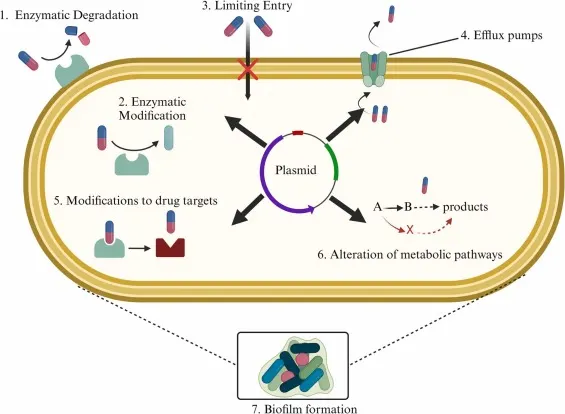
Figure 1. Example of an antibiotic-resistant bacterium. Pathogens can be resistant to an antibiotic in a multitude of ways. [6]
There are a myriad of reasons why pathogens have grown resistant to antimicrobials. Many factors are human-related. For example, overprescription or underprescription of medications or a patient not fully finishing a course enables even the few microbes with antibiotic resistance genes in the population to live on and spread, eventually outcompeting the vast majority of microbes without these genes [7]. Waste from facilities (e.g., industrial plants and hospitals) and agricultural practices introduce pathogens and antimicrobials into the environment [8]. Low levels of antimicrobials kill the non-resistant pathogens, while allowing the resistant ones to live on. Waste conditions can also allow pathogens to transfer resistant traits to non-resistant ones. Eventually, the resistant pathogens can pass into water sources and agriculture, reaching humans. While such microbes and antimicrobials are often found in low levels, this movement of microbes and antimicrobials between humans and the environment can create opportunities for humans to develop antimicrobial-resistant infections.
Traditional antimicrobials have worked well over the years, but their efficacy has waned over time as microbes have grown resistant to them. There are a multitude of scientific, socioeconomic, and environmental factors that are being targeted and redirected to combat AMR, making the fight against antimicrobial resistance a multifaceted approach. In this piece, we focus on emerging methods to detect antimicrobial resistance, often citing bacteria as examples, and conclude with a future outlook on how these new tools are being used.
Gold standard methods for antimicrobial resistance detection and diagnostics
Historically, the priority of AMR detection has been for diagnostic capabilities in clinical settings, allowing clinicians to determine what antimicrobials to administer and at what dosage. In 1929, antimicrobial susceptibility testing (AST) [9] was developed to establish standardized workflows for clinicians to grow bacteria and test their susceptibility to various drugs in order to determine appropriate treatment regimens for patients. However, in order to do so, laboratory technicians must first isolate the infectious agent (e.g., bacteria) from a patient sample. This can be challenging to do, as patient samples will also contain non-disease-causing microbes. However, common pathogenic bacteria have been established, so laboratory technicians know what to look for when they grow bacteria from patient samples.
Two common techniques used in medical laboratories to assess the susceptibility of the isolated pathogens are disk diffusion [10] and broth dilution assays [11]. For both of these techniques, clinicians collect patient samples and isolate the bacterium as a pure culture according to established standards in the field. Once a pure culture is obtained, clinicians perform a series of tests to determine the bacterium’s susceptibility to various drugs and at what concentrations. In a disk diffusion assay, organisms are grown on agar plates containing antibiotic disks, where the area surrounding the disk is the highest in concentration. Clinicians measure the area where there is no microbial growth (i.e., the zone of inhibition); a larger zone of inhibition means that the microbe is more susceptible to a given antibiotic. In a broth dilution assay, a fixed amount of microbes is grown in liquid media containing various levels of antibiotic. Following an incubation period, the growth of the microbe in the liquid media is measured.
Both of these methods allow clinicians to determine the required antimicrobial dosage for a patient. While these assays are designed to be simple and are standard practice, they can be a slow process, as growing bacteria from the environment in the laboratory can be challenging and unpredictable. This can lead to possible delays in patient diagnoses, which thus beckons the need for more rapid diagnostic tools. While these tools were designed for diagnostics, the results of these tests may discover drug-resistant microbes if certain microbes appear to grow across all or very high concentrations of any given drug. Despite being effective tools at diagnosing microbial infections and determining treatment regimens, the process of microbial isolation and growth can create a bottleneck, delaying diagnoses and AMR detection. Emerging tools enable more rapid identification of resistant microbes.
Next-generation tools for AMR detection
To overcome the bottleneck that growing microbes presents, more modern tools for AMR detection and diagnostics have moved away from phenotypic tests and moved towards genotypic tests. This means that scientists no longer have to grow organisms in the laboratory in order to characterize them, which was what made such assays lengthy and laborious. With the advancement of sequencing-based technologies, scientists can now use sequencing based tools, such as polymerase chain reaction (PCR) and quantitative PCR (qPCR) [12]. In addition to simply identifying pathogens, decades of research have enabled scientists to identify common DNA sequences that encode antibiotic resistance genes. The knowledge of these DNA sequences enables clinicians to look for these genes in patient samples using sequencing-based technologies. Tools like PCR and qPCR simply require scientists to know the specific DNA sequence they are interested in identifying (i.e., AMR genes). This allows researchers to use PCR or qPCR to determine the presence and amount of the gene in whatever microbe is isolated from patient samples. While this circumvents the need to grow the microbe, these techniques can require specialized instrumentation and technical skills.
Although both PCR and qPCR can be performed on samples with multiple species of microbes, their efficacy is enhanced in pure cultures. Next-generation sequencing has enabled rapid development of low-cost, efficient diagnostic tools, such as metagenomic sequencing [13]. Metagenomic sequencing enables researchers to profile microbial communities directly from environmental samples, thus circumventing the need to isolate bacteria at all. Similar to PCR and qPCR, researchers using metagenomic sequencing are still looking for DNA sequences known to encode antimicrobial resistance genes. Metagenomic sequencing can reveal what microbes are in the sample, their relative abundances, and potentially what they do. However, as with any tool, there exist several limitations to metagenomic tools. Analyzing the large amounts of data generated by these tools can require intensive computation and bioinformatic expertise. Additionally, there may be trade-offs between cost and output for using metagenomic sequencing in a clinically applied setting, as metagenomic sequencing can be expensive and the amount of data produced may be far more than what is needed in a clinical setting.
While sequencing tools can circumvent the lengthy process of growing microbes in the lab, they can struggle to capture the low levels of AMR genes/DNA sequences found in patient samples. Clustered Regularly Interspaced Short Palindromic Repeats (CRISPR) methods offer a workaround to this issue due to their highly programmable and targeted nature [14]. CRISPR tools co-opt an adaptive immune system found in bacteria. Here, enzymes that act as DNA or RNA “scissors” have been developed into tools that can generate signals when a target DNA or RNA is cut. These enzymes are versatile diagnostic tools, as researchers can program them to recognize various forms of DNA or RNA and generate a signal upon recognition. Therefore, researchers can program them to recognize known AMR gene sequences. This allows clinicians to start with a patient sample, extract the pathogen’s DNA, and apply the CRISPR tools to detect the presence of AMR genes. Two existing diagnostic tools that utilize this technology are SHERLOCK [15] and DETECTR [16].
Finally, the advancement of high-performance computing has led to the development of AMR prediction using computational tools [17]. Advances in sequencing technologies have unlocked a massive database of bacterial genomes for analysis. Combining sequencing DNA data with measurements of microbial RNA, proteins, and metabolites has enabled the development of predictive computational models for AMR. AMR modeling can be generally categorized into three groups: (1) Machine learning (ML) techniques, (2) Protein modeling, and (3) advanced large language models (LLM) frameworks that integrate multiple data types. Early ML models are less computationally intensive to run but struggle to capture higher-order data structures; for example, how proteins interact. Deep-genomic and structure-informed models incorporate structural awareness into early ML models that are largely based solely on sequencing. Advanced LLM frameworks go even further than sequence-based models and structure, as they can incorporate additional metadata such as epidemiological information detailing the observed spread of a disease. While computational tools are primarily used for research purposes to better understand the fundamental biology of a system, continuous advancement of these models may ultimately have applications in clinical settings. For example, a well-trained model may be able to assist clinicians in deciding what treatment regimen to prescribe or help researchers design novel antibiotics [18]. However, while computational tools are rapidly progressing, it is critical that they are designed thoughtfully and safely, as poorly designed models may lead to incorrect understanding of clinical challenges, like AMR, and misdiagnosis of diseases in patients
Conclusions and future outlook
Emerging technology enables researchers, public health officials, and other stakeholders to track resistant pathogens faster, helping to mitigate the spread of infection and protect entire communities. Implementing such technologies in low-resource areas offers a groundbreaking opportunity for containing the spread of pathogens and infectious outbreaks. For example, a portable Oxford Nanopre ® Technology sequencing platform was used to detect multidrug-resistant Enterobacter cloacae isolated from dairy farms in Sri Lanka [19]. Tools like these circumvent traditional detection methods to avoid infectious outbreaks and overwhelm clinics. As exemplified in the piece, emerging tools for AMR detection are fundamentally changing the status quo and shaping the future of AMR treatment. These new tools not only offer greater throughput but can reduce the time it takes to perform laborious experiments, delivering results in the matter of hours, instead of days. Though challenges like data privacy, cost, and implementation still remain, the tools are a step forward from traditional methods.
Recognition
Disha Patel is a Ph.D. Candidate in Biochemistry at the University of Notre Dame.
Ashley Y. Eng is a Ph.D. candidate in Microbiology at UC Berkeley studying the role of micronutrient sharing among bacteria in soil.
Special thanks to the following SNAP members who provided feedback on this article:
Shaurita D. Hutchins is a PhD candidate in Genetics, Genomics, and Bioinformatics advancing rare disease diagnostics and ethical genomics data stewardship.
Sneha Rao is a leader of the Science Policy Group at UCSF and a developmental biology PhD candidate studying how cells talk to each other during embryo development.
Sol Taylor-Brill is a PhD candidate in Molecular, Cellular, Developmental Biology, and Genetics at the University of Minnesota with a focus on statistical and population genetics.
References
- Centers for Disease Control and Prevention (2025) About Antimicrobial Resistance.
- Aslam, B., Wang, W., Arshad, M. I., Khurshid, M., Muzammil, S., Rasool, M. H., Nisar, M. A., Alvi, R. F., Aslam, M. A., Qamar, M. U., Salamat, M. K. F., & Baloch, Z. (2018). Antibiotic resistance: a rundown of a global crisis. Infection and drug resistance, 11, 1645–1658.
- Zavaleta-Monestel, E., Arguedas-Chacón, S., Rojas-Chinchilla, C., & Díaz-Madriz, J. P. (2025). Antimicrobial Resistance: An Emerging Global Threat to Modern Medicine. Cureus, 17(11), e97668.
- Centers for Disease Control and Prevention (2025) 2019 Antibiotic Resistance Threats Report.
- GBD 2021 Antimicrobial Resistance Collaborators (2024). Global burden of bacterial antimicrobial resistance 1990–2021: a systematic analysis with forecasts to 2050. Lancet (London, England), 404(10459), 1199–1226.
- Ahmed, S. K., Hussein, S., Qurbani, K., Ibrahim, R. H., Fareeq, A., Mahmood, K. A., & Mohamed, M. G. (2024) Antimicrobial resistance: Impacts, challenges, and future prospects Journal of Medicine, Surgery, and Public Health, 2.
- Centers For Disease Control and Prevention (2019) Antibiotic Resistance Threats in the United States, 2019.
- Endale, H., Mathewos, M., & Abdeta, D. (2023). Potential Causes of Spread of Antimicrobial Resistance and Preventive Measures in One Health Perspective-A Review. Infection and drug resistance, 16, 7515–7545.
- Alem, K., Dagnew, M., Gizachew, M., Gelaw, B., & Moges, F. (2025). Environmental Antimicrobial Resistance: Key Drivers, Hotspots, Innovative Strategies, and Challenges in the Fight Against Superbugs. MicrobiologyOpen, 14(5), e70067.
- Disk Diffusion
- Bayot, M. & Bragg, B. (2024) Antimicrobial Susceptibility Testing StatPearls
- Broth Dilution
- Salam, M. A., Al-Amin, M. Y., Pawar, J. S., Akhter, N., & Lucy, I. B. (2023). Conventional methods and future trends in antimicrobial susceptibility testing. Saudi journal of biological sciences, 30(3), 103582.
- Tang, W., Yang, N., & Shi, M. (2026). Applications and Challenges of CRISPR-Cas Technology for the Detection of Antimicrobial Resistance Genes. Infection and Drug Resistance, 19.
- Kellner, M. J., Koob, J. G., Gootenberg, J. S., Abudayyeh, O. O., & Zhang, F. (2019). SHERLOCK: nucleic acid detection with CRISPR nucleases. Nature protocols, 14(10), 2986–3012.
- Chen, J. S., Ma, E., Harrington, L. B., Da Costa, M., Tian, X., Palefsky, J. M., & Doudna, J. A. (2018). CRISPR-Cas12a target binding unleashes indiscriminate single-stranded DNase activity. Science (New York, N.Y.), 360(6387), 436–439.
- Hossain, E., & Yousefi, N. (2026). Computational paradigms for antimicrobial resistance prediction: integrating multi-omics, structural modeling, and foundation artificial intelligence systems. Briefings in bioinformatics, 27(3), bbag219.
- Bilal, H., Khan, M. N., Khan, S., Shafiq, M., Fang, W., Khan, R. U., Rahman, M. U., Li, X., Lv, Q. L., & Xu, B. (2025). The role of artificial intelligence and machine learning in predicting and combating antimicrobial resistance. Computational and structural biotechnology journal, 27, 423–439.
- Kumari, L. S., Siriwardhana, D. M., Liyanapathirana, V., Jinadasa, R., & Wijesinghe, P. (2025). Rapid whole genome sequencing for AMR surveillance in low- and middle-income countries: Oxford Nanopore Technology reveals multidrug-resistant Enterobacter cloacae complex from dairy farms in Sri Lanka. BMC veterinary research, 21(1), 351.