Where in the world are our regulations? The current state of international research collaboration
Written by SNAP member Edith-Marie Green
Thoughts and views written in this blog post reflect those of the author(s) only, and not necessarily those of every SNAP member or the SNAP coalition as a whole.
References are denoted with brackets.
During the first year of my PhD program, one of my professors described me as a “square peg in a round hole” because I’m a PhD student at my university’s medical school, but my background is in international studies and political science. I’m now in the fourth year of my program, and as conversations about international collaborations in scientific research and policy have heated up, my “square peg” tendencies have actually turned out to be pretty useful! In September, I found myself at an event hosted by the Nordic Embassies (Sweden, Denmark, Finland, Iceland, and Norway) in Berlin, where I’m currently living to conduct field research, on securing freedom in higher education. Throughout the event, the international scholars present discussed recent attempts to curtail international research, as well as why resisting those attempts is key, as international collaboration has power. In the current research landscape, international collaboration is under attack, despite its saliency in promoting not only global relations but also solutions to problems many countries face.
Over the summer, the U.S. Office of Management and Budget (OMB), proposed a new rule [1] that proved to be very unpopular among researchers. The rule would revise the uniform guidance for grant awarding and management via additional review by political appointees (meaning political machinations could override science), the ability to terminate grants at will, restrictions on foreign collaborations, reductions in conference travel and journal publication funds, and constraints on equity-focused research. [2] A flood of over 40,000 responses hit the OMB, and they delayed the rule change implementation from October to December. While it’s unclear what the future of that rule will be and international tensions are high due to a variety of wars and armed conflicts, as well as inflammatory policy from the current U.S. presidential administration, the message is clear: the scientific researchers on the ground want to collaborate with others and view it as an opportunity rather than a risk. I’ll admit that I’m a bit biased, since I’m currently living abroad for field research and one of the institutions I’m working with covers twenty-eight countries, but I’m not the only one who believes in its importance.
For the past ten years, growth in scientific articles published in Europe has been largely due to international collaborations. During the Covid-19 pandemic, researchers worked together across borders to develop the Covid-19 vaccines that would protect populations and allow physical cultural exchange to continue. [3] The National Science Board found that science and engineering research has become more global over the past decade, and that this research includes benefits such as greater outcomes with a larger team, increased resource access, improved knowledge distribution, and training a more robust scientific workforce. All of these benefits increase not only the research capacity of involved countries but also the globe. [4] Examples of the benefits of these collaborations include managing the impacts of climate change and searching for solutions, preserving cultural heritage, developing international monetary policy, improving food safety and sovereignty, and researching and disseminating life-saving medications and treatments. [5] Internationally-focused research is important for a variety of reasons beyond international exchange of ideas; it also helps avoid hegemony in the research world; this exchange has especially helped researchers from places like Brazil, Russia, Iran, India, and China elevate the research statuses of their countries. [3] However,for some nations, this growth has led to increased tensions and politicization. In the United States and Germany, for example, there has been heightened scrutiny of Chinese scientists due to concerns that the country was sending over students strategically in science and technology fields to support China’s military. [6] In July 2020, the FBI accused Chinese scientists, including students of “secretly bring(ing) knowledge and innovation back to China.” [7] Other major global players, like Australia, Japan, and the U.K. have been taking similar measures with international research. [8]
One of the main reasons for this scrutiny towards some collaborators and not others is a lack of cultural awareness. By and large, national and international regulations (such as funding requirements and journal guidelines) for research and generally agreed-upon ethical guidelines for research are shaped by larger, more westernized nations, while those facing scrutiny are also the weaker research enterprises in this hierarchy of research. Some scientists, therefore, have called to include all countries in developing research regulations, not just the most wealthy, so that there can be shared values and a level playing field. [9, 10] This is especially evident when one considers documents such as the Singapore Statement on Research Integrity, the Global Research Council Statement on Principles for Research Integrity, or the All European Academies (ALLEA) code of conduct, which were mostly (even in the case of the Singapore Statement) formed using a basis of western values. These documents also all predate the Covid-19 pandemic, which emphasized the need for international collaboration. The European Union, where I’m now living to do field research, published a document called “Tackling R&I foreign interference” (research & infrastructure) in 2022. They recommend using the Academic Freedom Index as a very first step when considering working with researchers from another country and then conducting a “detailed assessment of the research, educational, and institutional environment in the country.” This recommendation seems to start with the belief that educational practices in the EU are more free and ethical by default than those from other countries, and the suggested U.S. policies, such as those from the OMB, seem to make a similar assumption. However, research doesn’t happen in a vacuum, and the reality is that many major players in the research space are drifting towards authoritarianism; if that weren’t the case, I wouldn’t be scrutinizing guidelines for international research. And while the EU document also recommends continuing “to cooperate with partners in repressive settings” and avoiding “stigmatizing or alienating students, academic colleagues, and institutions in non-liberal institutional environments,” the existence of this document in the first place is stigmatizing. [11]
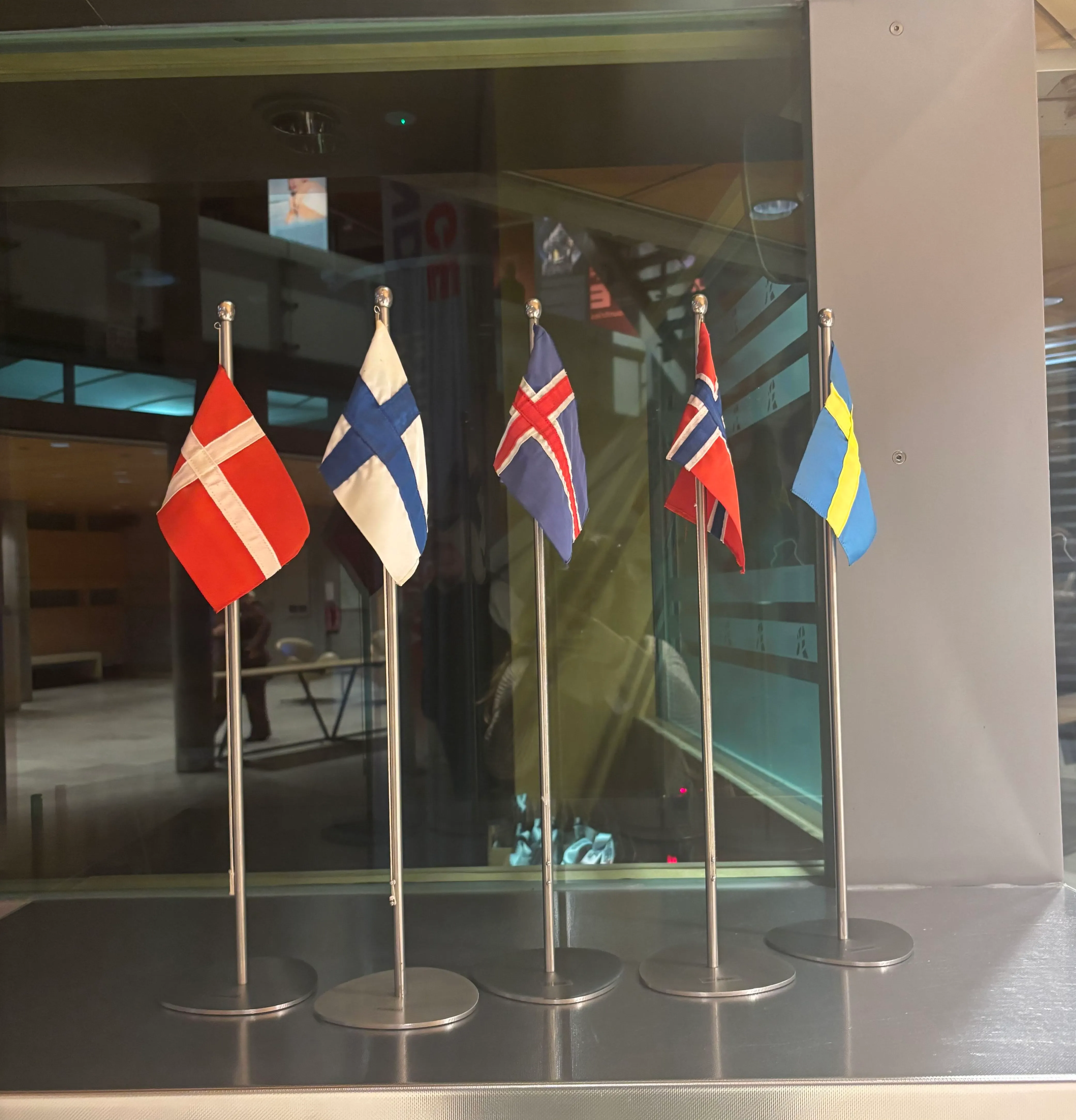
Flags at the event at the Nordic Embassy
Beyond the question of how we should develop international research guidelines, there’s the question of how we even define “security” and “freedom.” A 2025 article titled “Academic freedom and international research collaboration: A longitudinal analysis of global network evolution” attempted to understand these terms, posited that historically, academic freedom was focused on the university as a private (autonomous), non-religious actor, but in the modern day, academic freedom is defined in varying ways around the globe. The researchers also note that countries are not stagnant; places evolve over time and can transition across a gradient of liberty. They also land on something I’ve reflected on personally: that “shifts in academic freedom are explained by power transitions, including processes of democratization or autocratization.”[12] Research landscapes are, thus, not stagnant, but shaped by the sociopolitical environments in which they exist.
The Organization for Economic Cooperation and Development (OECD) put it best when, in their 2022 report titled “Integrity and Security in the Global Research Ecosystem,” they wrote, “Scientific discovery occurs in an interconnected, international ecosystem that collectively leverages intellect, know-how, talent, financial resources, and infrastructure from around the world.” [10] In this document, rather than recommending that international research be restricted, the OECD posits that all actors in the process have a duty to ensure that research is conducted in a thoughtful way. Their policy recommendations include research institutions and universities maintaining welcoming environments, integrating security concerns into research design rather than addressing them after the fact, transparency in the research process, a development of key research guidelines that are unambiguous and “targeted at specific risks to avoid unnecessarily burdening researchers,” and collaboration across sectors on these guidelines. Finally, they also recommend enhancing international information exchange on research integrity and security. They suggest that rather than being fearful of each other, we can collaborate across our shared concerns for safety to answer scientific questions we all have. And though the National Institutions of Health (NIH), which funds many scientific research activities in the U.S., includes guidelines and regulations for international research on their website and international research may lead to more complex ethical review processes, they do not, in these guidelines, discourage international research. Rather, they encourage researching local ethics rules, engaging with local collaborators, and promoting cultural competence. [13] They also permit funding research abroad. [14] Despite these official guidelines, the NIH itself is at odds with the public sentiment that the federal government is trying to drum up via the aforementioned OMB rule proposal or a recent announcement that an Executive Order may give a chief of staff final say on NIH grant funding, since their official guidelines support international research. [15] What this demonstrates is that the scientists and the policymakers are at odds, at least in this context. The National Science Foundation (NSF), another major funder in the U.S., has also found themselves at the center of this tension. [16]
So, what’s next?
There are no easy answers, but the good news is that this isn’t the first time in the history of the scientific enterprise that researchers have found themselves at odds with the powers that be. The other piece of good news is that while tensions over collaboration internationally are rising and security concerns, (sometimes based in discriminatory practices and sentiments) abound, collaboration persists. While collaboration is down overall, there have been shifts from bilateral to multilateral collaboration, so more scientists are working with researchers from multiple countries. [17] This is more prominent in EU countries, but even in those places multilateral collaborations make up between 30% and 40% of the research enterprise. Additionally, China’s collaborations with Western nations have increased again after a dip immediately following the pandemic, and they also worked more with “emerging” scientific research countries in Africa and the Middle East. [17] There is also evidence of international research collaboration in Latin and South America; the EU has formal agreements with Argentina, Brazil, Chile, and Mexico, [18] and countries like Germany, France, and Switzerland have specific research collaborations with a variety of countries in the region, including the aforementioned countries and also Costa Rica, Colombia, Peru, and Uruguay. [19, 20, 21] The main country not following the trend? The U.S., which researchers believe is at an “inflection point.” [21] Though the U.S. has traditionally led scientific research, the country’s output and collaborations are declining, in large part due to policy decisions and even policy proposals which, while unofficial, alter public sentiment; “Policy decisions have played a role. Restrictions on foreign collaboration and reduced funding for key areas like mRNA vaccine development risk isolating the U.S. from the global research ecosystem.” [22]
For myself as a public health practitioner, health-related withdrawals by the U.S. have been especially concerning to me; the country began withdrawal from the World Health Organization (WHO) in January of 2025, and in the winter and spring of 2025, the United States Agency for International Development (USAID) was shuttered. It’s estimated that USAID assistance, which focused on diseases like HIV, tuberculosis, malaria, polio, as well as reducing maternal/child deaths and alleviating malnutrition, had saved 92 million lives in the two decades before its closure. [22] Researchers also estimate that 600,000 preventable deaths have occurred since USAID’s closure. [23] Physician and public health advocate Atul Gawande has described these deaths as, “Public man-made death.” [24] In addition to mortality impacts, an estimated 23 million children around the world have lost access to education and 95 million people have lost access to healthcare since the closure. [25] Furthermore, despite the cuts to foreign aid being positioned as part of an “America First” policy strategy, [26] the majority of U.S. citizens from both sides of the aisle do not support this closure and are in support of providing assistance and relief programs abroad. [27] The U.S.’s attempt to remove itself from global health infrastructure is incredibly damaging not only to the country but also to the lives of real people and communities around the globe. To put it bluntly, the group Oxfam America’s president Abby Maxman described these actions as the presidential administration “taking a sledgehammer to…the entire global aid system.” [25] By 2030, there could be 9.4 million excess deaths worldwide as a result of these actions…and this is just in the field of things shaped by public health. [28]
The U.S. removing itself, bit by bit, from global research, via policy and/or directly leaving global organizations, might not seem like a major problem for the country itself, even if it is a major problem for other residents of the globe. After all, the U.S. is a big country with funders like the NIH and NSF, along with plenty of research universities. We have, however, a cautionary tale in the form of Brexit, when the United Kingdom voted to leave the EU in 2016. Brexit fundamentally reshaped the relationship between the U.K. and EU member countries, including research and intellectual exchange. Through Brexit, the U.K. lost a variety of important research supports, such as ease of international collaboration, global networking, and funding. [29] EU funding for U.K. researchers has dropped to 5.8%, and papers co-authored between EU and U.K. researchers is at a low of 52%. [30] In addition to research impacts, U.K. gross domestic product (GDP) is estimated to have been reduced by up to 8% by Brexit, and investments, employment, and economic activity have also been reduced. [31] Before its exit from the EU, the U.K.was considered a “cornerstone” of European research and there have been some positive changes (such as the agreement to allow the U.K. to rejoin the Erasmus educational exchange program). However, talks between the EU and U.K. are currently stalled and experts believe the same research position is not recoverable. [30] Sadly, we already have examples of similar things happening to the U.S. as it withdraws. For example, radiology researchers have reported that the funding, collaboration, and mobility of their research have been impacted negatively, and the majority of these researchers expect slowed research progress. For researchers in the U.S., they felt the impacts of the slowdown in terms of research efficiency and the ability to collaborate, while researchers outside of the U.S. felt that it was more difficult to not only work with U.S. researchers but also attend conferences and access work and study materials and opportunities. Radiology researchers are also extremely concerned about funding disruptions and administrative barriers, and they’re not alone. [32]
The scientific future may be grim, but there are still slivers of hope. The event I attended at the Nordic Embassies took place in the Felleshus, also known as the Pan-Nordic Building, which is shared by all five Nordic countries. The word “Felleshus” uses the Norwegian and Danish words for “common” or “shared” and “house,” meaning the name literally translates to “shared house.” This space was purposely shared by five countries, and they invited speakers and an audience from other countries around the world to take part; one of the speakers was even the president of an American university. While official doctrine of many states in the present day may be to withdraw, it’s clear that the people want to come together, and that’s a reason to believe that one day there will be unity again.
Recognition:
Edith-Marie Green is a PhD Candidate in Population Health Sciences at the University of Wisconsin-Madison. Her research broadly focuses on aging and end-of-life healthcare, as well as global health and the rural-urban continuum. She is currently a Fulbright Scholar at Humboldt-Universität and the Survey of Health, Ageing, and Retirement in Europe.
Special thanks to fellow SNAP members who provided feedback on this article: Andrew Ramirez, an adjunct professor at The College of New Jersey and Middlesex College who received his PhD from UCLA developing machine learning models to analyze single-cell gene expression data; Disha Patel, a PhD Candidate in Biochemistry at the University of Notre Dame leveraging cell-based high-throughput methodologies to study functional protein folding processes and production; and Jordan Williams, a pharmacology PhD candidate studying how to alter the lung’s innate immune responses to better treat chronic respiratory diseases.
References:
- United States Congress (2026). May 2026 Proposed Rule on Uniform Guidance for Federal Grants: Summary of Selected Changes.
- Association of American Medical Colleges. (2026) OMB Proposed Rule to Revise the Uniform Guidance.
- Issues in Science and Technology (2023). Navigating the Gray Zones of International Research.
- National Science Board Science and Engineering Indicators (2021). Publications Output: U.S. Trends and International Comparisons.
- Cornell University (2026). International Research Matters for the United States.
- The Guardian (2025). ‘Total discrimination’: Chinese students facing US visa ban say their lives are in limbo.
- Federal Bureau of Investigation (2020). The Threat Posed by the Chinese Government and the Chinese Communist Party to the Economic and National Security of the United States.
- Nature (2021). Protect precious scientific collaboration from geopolitics.
- Science Business (2022). G7 science ministers urge democracies to unite research efforts.
- Organization for Economic Cooperation and Development (2022). Integrity and security in the global research ecosystem.
- Publications Office of the European Union (2022). Tackling R&I foreign interference.
- MIT Press Direct Quantitative Science Studies (2025). Academic freedom and international research collaboration: A longitudinal analysis of global network evolution.
- National Institutes of Health Office of Human Subjects Research Protections (2024). International Research.
- National Center for Complementary and Integrative Health (2026). International Health Research.
- Science (2026). White House move to seize control of NIH grant decisions upsets senators and scientists.
- U.S. National Science Foundation Office of the Director (2026). NSF Leadership in a New Golden Age of Science.
- Clarivate (2025). Global research collaboration is changing: Key insights from our latest ISI report.
- European Union Research and Innovation (2025). Latin America and Caribbean.
- Deutsche Forschungsgemeinschaft (2026). Collaborating with Latin America.
- Centre National de la Recherche Scientifique (2026). South America CNRS office.
- University of St. Gallen Institute of Management in Latin America (2026). Leading House.
- The Lancet (2025). Evaluating the impact of two decades of USAID interventions and projecting the effects of defunding on mortality up to 2030: a retrospective impact evaluation and forecasting analysis.
- Impact Counter (2026). Impact Metrics Dashboard.
- Harvard T.H. Chan School of Public Health (2025). USAID shutdown has led to hundreds of thousands of deaths.
- Oxfam America (2025). What USAID did, and the effects of Trump’s cuts on lifesaving aid.
- Tropical Medicine and Health (2026). The impact of U.S. foreign aid reduction on global health.
- The Rockefeller Foundation (2026). New Echelon Insights Survey Commissioned by Rockefeller Foundation: Most Americans Back Foreign Aid a Year After USAID’s End.
- The Lancet Global Health (2026). Impact of two decades of humanitarian and development assistance and the projected mortality consequences of current defunding to 2030: retrospective evaluation and forecasting analysis.
- Brexit Fact Base (2026). Science and research.
- Nature (2026). Brexit tore apart European science — now the research rifts are healing.
- National Bureau of Economic Research (2025). The Economic Impact of Brexit.
- Clinical Imaging (2026). Impact of U.S. government policies under the Trump administration on radiology and medical research: a survey of international researchers.