Frank Ginn
RepublicanThis candidate did not respond to Stance on Science.
Created by the Georgia Stance on Science team, Coalition of Athens Scientists, Science for Georgia, Engineers and Scientists Acting Locally, Athens Politics Nerd, Alpha Kappa Alpha Iota Psi Omega Chapter, Southern Sustainability Institute, 100% Athens, Athens Land Trust, C-Change, and Citizen's Climate Lobby Athens. Please contact coalitionofathensscientists@gmail.com with any questions. Follow us on Instagram and Linktree.
Last updated: October 13, 2026
Georgia will face many challenges in the coming years, and it is increasingly critical that our policymakers understand the importance of evidence-based decision-making. The goals of this resource are to:
Through Stance on Science, we hope to help Georgians understand how their elected representatives will utilize science to improve the state that they love. Learn more about this initiative on the home page.
This webpage houses the responses to 12 questions crafted by the Georgia Stance on Science team.
Only official candidates who will appear on ballots were contacted.
Candidates were contacted in July 2026 (with a follow-up to those who did not initially respond) and given the opportunity to answer all questions. Only the responses of candidates who answered the questions are included. None of the candidates' responses were modified in any way before being published on this resource page.
For the November 2026 General Election, only candidates in the following elections were contacted:
The responses of candidates shared on this webpage do not reflect the views of the Georgia Stance on Science team or the Scientist Network for Advancing Policy (SNAP) Coalition. SNAP is a non-partisan organization (please see more about SNAP here). SNAP and the Georgia Stance on Science team do not endorse any candidates. The goals of this initiative can be found here. Please contact coalitionofathensscientists@gmail.com with any questions.
To find your districts for state and federal races and see who is on your ballot, please visit the Georgia Secretary of State My Voter Page.
If you cannot find a candidate, it means they have not yet submitted their response to Stance on Science. Please check back soon.
The order of responses is randomized by default. Use the filters below to find the candidate and race you are interested in.
Q1 Georgia is becoming a hub for data centers due to tax breaks, amenable regulations, and available land (Perdue, 2025). While data centers may grow the tech industry in Georgia, data centers also have environmental and health impacts, such as significant water and electricity usage, as well as noise pollution (Science for Georgia, 2026). How will you protect Georgian health and property values with data center legislation?
I’m in favor of a one year moratorium to give us time to properly regulate these projects. We don’t currently have sufficient safeguards to ensure that the costs, both financial and environmental, don’t fall disproportionately on local residents. We should require them to cover the full cost of transmission and generation upgrades that are built to supply them with power.
Q2 How will you ensure communities have meaningful opportunities to provide public comments that inform state and local decision making?
On public input, no elected official or public employee should sign a non-disclosure agreement about a project that needs a public vote. The public has a right to know what impacts these projects will have on their local communities and have an opportunity to bring their concerns before the local government before the projects are approved.
Q3 How have you learned about data centers in the past, and how will you stay abreast of important findings based on scientific research regarding data center impacts on energy affordability and the environment?
On policy I go to primary sources: Georgia Power’s filings at the Public Service Commission, where I submitted public comment on its All-Source RFP, state audits of the tax exemption, and EPD permit records. In office I’d lean on researchers at UGA and Georgia Tech and groups like Science for Georgia.
Q4 How will you work and communicate with voters to ensure your policy decisions around data centers reflect the values of your constituency?
I will be as responsive as possible to calls and emails from constituents, and I’m always happy to talk about someone’s concerns. I plan to hold monthly town halls for the duration of my term. I encourage anyone to reach out.
Q5 Extreme heat is a serious public health issue and vulnerable populations are most at risk (Bell et al., 2024; Ebi et al., 2021; Hess et al., 2023). Additionally, the number of annual extreme heat days have increased statewide and are projected to increase in the future (McCullough, 2026). At the same time, Georgia is projected to experience more frequent and intense droughts (National Integrated Drought Information System, 2026). What policies do you plan to implement to mitigate the rising health risk of extreme heat and drought on Georgians?
Georgia has no heat standard for workers, and neither does the federal government. I support a state standard guaranteeing water, shade, rest breaks, and time to acclimate, indoors and out. Workers aren’t the only ones at risk, so I’d fund cooling centers and weatherization for seniors and low-income households and protect families from utility shutoffs in extreme heat. On drought, large water users, data centers included, should report their consumption publicly and follow the same restrictions as everyone else, and the state should invest in leak repair and water reuse.
Q6 PFAS, or forever chemicals, are common, long-lasting chemicals used in dyes, pesticides, and common household products, like water-resistant clothes, cleaners, and cookware (EPA, 2026a). Forever chemicals have contributed to high risk of thyroid disruption, developmental delays, and cancer (EPA, 2026a). The EPA recently rolled back regulation on some forever chemicals and extended the deadline for utility companies to limit exposure to contaminated water (EPA, 2026b). What policies or investments would you support to improve drinking water safety in Georgia?
I will support expanded testing programs to screen for major sources to eliminate the most harmful. I will also support additional testing and reporting requirements for companies that use PFAS in their products to monitor any potential contamination or exposure. We need data driven reporting and concrete mitigation procedures to prevent harm to human health and the environment.
Q7 Environmental harms are not distributed evenly: landfills, industrial plants, and waste treatment facilities are disproportionately placed in communities of color and low income neighborhoods (Deganian & Thompson, 2012; Jbaily et al., 2022; Liddie et al., 2023). For example, the Pittard Road and Pinewoods communities in Athens have struggled to gain access to safe drinking water for decades (Dua-Swartz, 2025). Such environmental burdens cause generational health and economic impacts (Colmer & Voorheis, 2025; Grineski et al., 2025). How will you address environmental injustice in your district?
I’d require EPD to weigh cumulative impacts on the surrounding community before permitting or expanding a landfill or industrial site, with early notice and public monitoring data. And I’d direct state infrastructure money to water lines for communities that have been passed over. Currently there are site suitability studies that are required, but not a comprehensive community impact study.
Q8 Nitrate run off and pesticide use have been correlated with risk of long-term illnesses, like cancer, and ecosystem degradation, for example water deoxygenation and “dead zones” (EPA, 2013, 2015; European Commission, 2026; Zhao et al., 2026). How will your policies balance farmers’ technological needs while reducing the impact of previously restricted pesticides and overfertilization on agricultural workers, their neighbors, and our water systems?
I’d expand cost-share funding and UGA Extension support for soil testing, precision application, cover crops, and stream buffers, so using less fertilizer is the cheaper choice. For pesticides once restricted for health reasons, the people closest need protection: training and protective equipment for farmworkers, notice before spraying near homes and schools, and state monitoring of wells and streams in farm country.
Q9 The construction of data centers has triggered the call for an expansion in energy production (Science for Georgia, 2025). Georgia, and its largest energy provider, Georgia Power, derives 87% of its energy output from natural gas, coal, and nuclear sources, while 6% comes from renewables (Georgia Power, 2025). GA Power is proposing an expansion of a “natural gas” pipeline through Georgia and Alabama to meet their projected energy demands; however, there are several viable options for expanding solar energy, including plug-in solar panels, agrivoltaics, and parking lot solar systems, that would give consumers power over their electricity bills (Science for Georgia, 2026). What policies do you support to expand consumer energy choice and renewable energy?
Georgia is one of four states with no consumer advocate at the Public Service Commission. I’d restore the Consumers’ Utility Counsel so ratepayers have a lawyer in the room in rate cases. I’d lift the cap on net metering for rooftop solar, pass community solar so renters can take part, legalize plug-in solar, and open virtual power plant programs that pay customers for batteries and smart thermostats they already own. The state should lead by moving its own fleets to electric and hybrid vehicles.
Q10 The globalization of groceries has given us access to a diverse selection of produce products. At the same time, international supply chains can heighten the risk of foodborne illnesses. Recent outbreaks of foodborne illnesses, like Cyclospora and Salmonella, have resulted in recalls of common foods, including lettuce, blueberries, and eggs (Vollers, 2026). What actions should we take on the state level to track and reduce foodborne illnesses?
Georgia is one of ten FoodNet states, CDC’s active surveillance system for foodborne illness. In July 2025, CDC cut the pathogens FoodNet requires states to track from eight to two, and Cyclospora was one of the six dropped. That doesn’t cause outbreaks, but we find them later, after more people are sick. I’d fund the Department of Public Health and the state lab to keep full active surveillance of all eight, and fund enough inspectors to trace an outbreak to its source quickly.
Q11 What assistance, if any, does GA need from the federal government to track and reduce foodborne illnesses?
Restore FoodNet funding for all eight pathogens, and give states stable multi-year funding through the Emerging Infections Program so we aren’t rebuilding capacity every budget cycle. Most recalled food crosses state or national borders. Only the federal government can inspect imports and coordinate recalls across state lines.
Q12 About 17% of Georgia adults lack health insurance (The Commonwealth Fund, 2025). Since tax credits for Affordable Care Act plans expired in December 2025, more than half a million Georgians have lost health insurance (Hart, 2026). What are your views on medicaid expansion, and what policies will you support to assist Georgians struggling to access quality healthcare?
We should fully expand Medicaid, and with the ACA tax credits gone it’s more urgent than a year ago. Coverage doesn’t help if there’s no one to see you. I’d let nurse practitioners practice to the full extent of their training without a physician protocol agreement. And I’d fund LPN-to-RN bridge programs along with the nursing faculty positions that limit how many students those programs can admit.
Q1 Georgia is becoming a hub for data centers due to tax breaks, amenable regulations, and available land (Perdue, 2025). While data centers may grow the tech industry in Georgia, data centers also have environmental and health impacts, such as significant water and electricity usage, as well as noise pollution (Science for Georgia, 2026). How will you protect Georgian health and property values with data center legislation?
I will start by repealing the current state tax credits1. Beyond that, the state should set standards for water consumption, and perhaps offer tax credits for reaching certain “stretch goals”. As far as power, at a bare minimum, legislation should ensure that residents do not foot the bill for infrastructure improvements, and datacenter owners should be incentivized to use green energy sources as much as possible. Local residents should have final say on location and whether datacenters are allowed in their communities at all. Ideally that should be done through local representatives, but if requiring referendums is necessary, so be it.
Q2 How will you ensure communities have meaningful opportunities to provide public comments that inform state and local decision making?
In my short time as a State Rep, I have gone out of my way to be transparent and accessible. In our system, I think it is up to elected officials to ensure that they provide these opportunities.
Q3 How have you learned about data centers in the past, and how will you stay abreast of important findings based on scientific research regarding data center impacts on energy affordability and the environment?
I have mostly learned through activists and reading reasonably-sourced news articles. I plan to continue doing that and I am open to learning from people who are able to stay up to speed on these issues.
Q4 How will you work and communicate with voters to ensure your policy decisions around data centers reflect the values of your constituency?
I have had 9 town halls since being elected, not including a town hall focused specifically on data centers, and I am hosting another one in a couple of weeks. Being present in the community and open to discussion is the best way to work with and communicate with voters.
Q5 Extreme heat is a serious public health issue and vulnerable populations are most at risk (Bell et al., 2024; Ebi et al., 2021; Hess et al., 2023). Additionally, the number of annual extreme heat days have increased statewide and are projected to increase in the future (McCullough, 2026). At the same time, Georgia is projected to experience more frequent and intense droughts (National Integrated Drought Information System, 2026). What policies do you plan to implement to mitigate the rising health risk of extreme heat and drought on Georgians?
Setting hard limits on data center water consumption, and predicating any tax credits on going above and beyond those requirements is a way to stop the bleeding. I support laws that promote green energy and local generation as much as possible to reduce our reliance on fossil fuels, but that is a longer term solution. In the short term, we need to ensure that people are protected from extreme heat exposure. That could include delaying certain sports seasons for youth, and ensuring that cooling centers are available during the hottest months.
Q6 PFAS, or forever chemicals, are common, long-lasting chemicals used in dyes, pesticides, and common household products, like water-resistant clothes, cleaners, and cookware (EPA, 2026a). Forever chemicals have contributed to high risk of thyroid disruption, developmental delays, and cancer (EPA, 2026a). The EPA recently rolled back regulation on some forever chemicals and extended the deadline for utility companies to limit exposure to contaminated water (EPA, 2026b). What policies or investments would you support to improve drinking water safety in Georgia?
I actually sponsored legislation last year (HB 1501)1 to require the state to maintain a public website showing monitored levels of forever chemicals, and to require water utilities to notify customers if certain thresholds are met.
Q7 Environmental harms are not distributed evenly: landfills, industrial plants, and waste treatment facilities are disproportionately placed in communities of color and low income neighborhoods (Deganian & Thompson, 2012; Jbaily et al., 2022; Liddie et al., 2023). For example, the Pittard Road and Pinewoods communities in Athens have struggled to gain access to safe drinking water for decades (Dua-Swartz, 2025). Such environmental burdens cause generational health and economic impacts (Colmer & Voorheis, 2025; Grineski et al., 2025). How will you address environmental injustice in your district?
I’ll be honest. I know that environmental injustice is an issue, but I do not have specific ideas for how to address this at this time. I am open to suggestions.
Q8 Nitrate run off and pesticide use have been correlated with risk of long-term illnesses, like cancer, and ecosystem degradation, for example water deoxygenation and “dead zones” (EPA, 2013, 2015; European Commission, 2026; Zhao et al., 2026). How will your policies balance farmers’ technological needs while reducing the impact of previously restricted pesticides and overfertilization on agricultural workers, their neighbors, and our water systems?
I believe we should work with experts in the field and academia to determine the correct balance for the use of these chemicals when it comes to growing food vs. “downstream” impacts. As I understand it, the industry is probably too reliant on chemicals today and newer technologies may help reduce that dependence. When we find the right balance, we should be able to set reasonable regulations on usage.
Q9 The construction of data centers has triggered the call for an expansion in energy production (Science for Georgia, 2025). Georgia, and its largest energy provider, Georgia Power, derives 87% of its energy output from natural gas, coal, and nuclear sources, while 6% comes from renewables (Georgia Power, 2025). GA Power is proposing an expansion of a “natural gas” pipeline through Georgia and Alabama to meet their projected energy demands; however, there are several viable options for expanding solar energy, including plug-in solar panels, agrivoltaics, and parking lot solar systems, that would give consumers power over their electricity bills (Science for Georgia, 2026). What policies do you support to expand consumer energy choice and renewable energy?
All of them. I co-sponsored the “Plug-in Solar” bill last year, and I know how hard the industry fought against it. It was shameful. Georgia is a very sunny state and is ripe for solar energy production. We even have manufacturers right here in Georgia building solar panels from raw materials through to finished product. We should be promoting green energy solutions every way we can.
Q10 The globalization of groceries has given us access to a diverse selection of produce products. At the same time, international supply chains can heighten the risk of foodborne illnesses. Recent outbreaks of foodborne illnesses, like Cyclospora and Salmonella, have resulted in recalls of common foods, including lettuce, blueberries, and eggs (Vollers, 2026). What actions should we take on the state level to track and reduce foodborne illnesses?
We used to be able to rely on the Federal level for much of this, but that has obviously changed. I am also aware that the VDL lab at UGA is aging and is losing capacity to do much of this diagnostic work. If the feds are abandoning much of their prior responsibility, the state has no choice but to invest in the necessary resources to keep GA residents safe through increased local regulation.
Q11 What assistance, if any, does GA need from the federal government to track and reduce foodborne illnesses?
Since much of our food system comes from places outside of the state, it is critical to be able to have resources that can track food coming from other states or countries.
Q12 About 17% of Georgia adults lack health insurance (The Commonwealth Fund, 2025). Since tax credits for Affordable Care Act plans expired in December 2025, more than half a million Georgians have lost health insurance (Hart, 2026). What are your views on medicaid expansion, and what policies will you support to assist Georgians struggling to access quality healthcare?
Healthcare in Georgia is a full-on crisis, in nearly every conceivable way. Medicaid expansion would help, but with the hardest cuts to Medicaid from HR1 coming next year, it is probably too late. I am open to any ideas from any source, from a mystery “free market” solution, to a state-run exchange with a state-run public option, to a full Medicare For All solution at the state level, and anything in between. We have let this get to crisis levels, and it is only getting worse by the day.
Q1 Georgia is becoming a hub for data centers due to tax breaks, amenable regulations, and available land (Perdue, 2025). While data centers may grow the tech industry in Georgia, data centers also have environmental and health impacts, such as significant water and electricity usage, as well as noise pollution (Science for Georgia, 2026). How will you protect Georgian health and property values with data center legislation?
I support an immediate moratorium on all data centers, until the legislature can better assess their impact on our state. I also would legislate that they have to innovate their cooling systems to not use our fresh drinking water. Data centers should only be built in Industrial zones.
Q2 How will you ensure communities have meaningful opportunities to provide public comments that inform state and local decision making?
There are already many opportunities for public comment in these processes, what we need is elected representatives that will actually listen to public input.
Q3 How have you learned about data centers in the past, and how will you stay abreast of important findings based on scientific research regarding data center impacts on energy affordability and the environment?
I stay up to date on current events in Georgia, and I follow the Public Service Commission proceedings with regards to data centers. I have seen the public outcry against the water usage, the noise pollution, the energy demands and rising costs, and I will continue to prioritize my constituents concerns surrounding data centers. Personally I am alarmed at the blind disregard of usage of our natural resources.
Q4 How will you work and communicate with voters to ensure your policy decisions around data centers reflect the values of your constituency?
I plan to continue daily communication with voters through a variety of outlets. Once elected I plan to have town halls and an open door policy to always hear voters concerns.
Q5 Extreme heat is a serious public health issue and vulnerable populations are most at risk (Bell et al., 2024; Ebi et al., 2021; Hess et al., 2023). Additionally, the number of annual extreme heat days have increased statewide and are projected to increase in the future (McCullough, 2026). At the same time, Georgia is projected to experience more frequent and intense droughts (National Integrated Drought Information System, 2026). What policies do you plan to implement to mitigate the rising health risk of extreme heat and drought on Georgians?
This is very concerning to me. We need a statewide extreme heat emergency plan to protect citizens from power company shut-offs due to unpaid bills, and ensure access to cooling centers for citizens without a/c. We must start focusing on renewable energies, solar power and invest in the recyclables industry statewide which we are woefully behind on. I believe Georgia should implement a water/drought resilience plan to ensure longevity of our water resources.
Q6 PFAS, or forever chemicals, are common, long-lasting chemicals used in dyes, pesticides, and common household products, like water-resistant clothes, cleaners, and cookware (EPA, 2026a). Forever chemicals have contributed to high risk of thyroid disruption, developmental delays, and cancer (EPA, 2026a). The EPA recently rolled back regulation on some forever chemicals and extended the deadline for utility companies to limit exposure to contaminated water (EPA, 2026b). What policies or investments would you support to improve drinking water safety in Georgia?
Georgia is a state of 11 million people and we need to strengthen all of our own agencies to protect ourselves if DC is going to loosen all their regulatory system that protect the population. Georgia should ban harmful forever chemicals and require improved filtration and water systems. I fully support regulations that keep us safe and healthy.
Q7 Environmental harms are not distributed evenly: landfills, industrial plants, and waste treatment facilities are disproportionately placed in communities of color and low income neighborhoods (Deganian & Thompson, 2012; Jbaily et al., 2022; Liddie et al., 2023). For example, the Pittard Road and Pinewoods communities in Athens have struggled to gain access to safe drinking water for decades (Dua-Swartz, 2025). Such environmental burdens cause generational health and economic impacts (Colmer & Voorheis, 2025; Grineski et al., 2025). How will you address environmental injustice in your district?
Increase regulations on the waste industry to the standard that it would be safe no matter where it was located. I believe no matter what your income level is, you should have access to the same clean air, water, and land as anyone else. I would never ignore communities that are clearly affected by their environmental contamination.
Q8 Nitrate run off and pesticide use have been correlated with risk of long-term illnesses, like cancer, and ecosystem degradation, for example water deoxygenation and “dead zones” (EPA, 2013, 2015; European Commission, 2026; Zhao et al., 2026). How will your policies balance farmers’ technological needs while reducing the impact of previously restricted pesticides and overfertilization on agricultural workers, their neighbors, and our water systems?
Educate farmers on soil testing and proper fertilization rates and use more nature based solutions that lower the need for synthetic fertilizer. Expand funding to assist farmers with clean irrigation and cover crop seeds to improve soil quality and reduce runoff. Georgia needs to regulate harmful fertilizers and pesticides where DC has deregulated them.
Q9 The construction of data centers has triggered the call for an expansion in energy production (Science for Georgia, 2025). Georgia, and its largest energy provider, Georgia Power, derives 87% of its energy output from natural gas, coal, and nuclear sources, while 6% comes from renewables (Georgia Power, 2025). GA Power is proposing an expansion of a “natural gas” pipeline through Georgia and Alabama to meet their projected energy demands; however, there are several viable options for expanding solar energy, including plug-in solar panels, agrivoltaics, and parking lot solar systems, that would give consumers power over their electricity bills (Science for Georgia, 2026). What policies do you support to expand consumer energy choice and renewable energy?
The Georgia Legislature should require Georgia Power to have a much higher percentage of renewables with an ultimate goal of 100% renewables. I would expand funding to residential and municipal renewable energy microgrids. As mentioned before, extreme weather will test our power grids and we need to innovate and reduce the risk of disruptions. I fully support expanding solar energy as much as possible including balcony solar, plug-in solar, agrivoltaics, parking lot solar and abandoned farming lots producing energy for free.
Q10 The globalization of groceries has given us access to a diverse selection of produce products. At the same time, international supply chains can heighten the risk of foodborne illnesses. Recent outbreaks of foodborne illnesses, like Cyclospora and Salmonella, have resulted in recalls of common foods, including lettuce, blueberries, and eggs (Vollers, 2026). What actions should we take on the state level to track and reduce foodborne illnesses?
Increase all operations and staff at the Georgia Department of Public Health to make up for the cuts to the CDC, FDA and HHS. If the federal government is not ensuring public safety then Georgia must do what’s right for our state. I would also support legislation in Georgia for an Urban Agriculture Incentive Zones for Residential property.
Q11 What assistance, if any, does GA need from the federal government to track and reduce foodborne illnesses?
Georgia and all states need the federal government to stop making cuts to all the federal agencies that test our foods for bacteria, foodborne diseases and communicable diseases.
Q12 About 17% of Georgia adults lack health insurance (The Commonwealth Fund, 2025). Since tax credits for Affordable Care Act plans expired in December 2025, more than half a million Georgians have lost health insurance (Hart, 2026). What are your views on medicaid expansion, and what policies will you support to assist Georgians struggling to access quality healthcare?
The first thing I will do once elected is advocate for full Georgia Medicaid Expansion. But I would not stop there, every person in our state should have affordable health insurance where no claim is denied and no one is going into medical debt. Right now our for-profit system is untenable, and is designed to profit off our illnesses instead of prioritizing better health outcomes. We need to reform the entire Georgia medical industry.
Pick a topic to see how every candidate answered the related question(s), then optionally narrow by race.
Select a topic above to see the candidate responses.
Q8 Nitrate run off and pesticide use have been correlated with risk of long-term illnesses, like cancer, and ecosystem degradation, for example water deoxygenation and “dead zones” (EPA, 2013, 2015; European Commission, 2026; Zhao et al., 2026). How will your policies balance farmers’ technological needs while reducing the impact of previously restricted pesticides and overfertilization on agricultural workers, their neighbors, and our water systems?
I believe we should work with experts in the field and academia to determine the correct balance for the use of these chemicals when it comes to growing food vs. “downstream” impacts. As I understand it, the industry is probably too reliant on chemicals today and newer technologies may help reduce that dependence. When we find the right balance, we should be able to set reasonable regulations on usage.
Q8 Nitrate run off and pesticide use have been correlated with risk of long-term illnesses, like cancer, and ecosystem degradation, for example water deoxygenation and “dead zones” (EPA, 2013, 2015; European Commission, 2026; Zhao et al., 2026). How will your policies balance farmers’ technological needs while reducing the impact of previously restricted pesticides and overfertilization on agricultural workers, their neighbors, and our water systems?
Educate farmers on soil testing and proper fertilization rates and use more nature based solutions that lower the need for synthetic fertilizer. Expand funding to assist farmers with clean irrigation and cover crop seeds to improve soil quality and reduce runoff. Georgia needs to regulate harmful fertilizers and pesticides where DC has deregulated them.
Q8 Nitrate run off and pesticide use have been correlated with risk of long-term illnesses, like cancer, and ecosystem degradation, for example water deoxygenation and “dead zones” (EPA, 2013, 2015; European Commission, 2026; Zhao et al., 2026). How will your policies balance farmers’ technological needs while reducing the impact of previously restricted pesticides and overfertilization on agricultural workers, their neighbors, and our water systems?
I’d expand cost-share funding and UGA Extension support for soil testing, precision application, cover crops, and stream buffers, so using less fertilizer is the cheaper choice. For pesticides once restricted for health reasons, the people closest need protection: training and protective equipment for farmworkers, notice before spraying near homes and schools, and state monitoring of wells and streams in farm country.
Q1 Georgia is becoming a hub for data centers due to tax breaks, amenable regulations, and available land (Perdue, 2025). While data centers may grow the tech industry in Georgia, data centers also have environmental and health impacts, such as significant water and electricity usage, as well as noise pollution (Science for Georgia, 2026). How will you protect Georgian health and property values with data center legislation?
I will start by repealing the current state tax credits1. Beyond that, the state should set standards for water consumption, and perhaps offer tax credits for reaching certain “stretch goals”. As far as power, at a bare minimum, legislation should ensure that residents do not foot the bill for infrastructure improvements, and datacenter owners should be incentivized to use green energy sources as much as possible. Local residents should have final say on location and whether datacenters are allowed in their communities at all. Ideally that should be done through local representatives, but if requiring referendums is necessary, so be it.
Q2 How will you ensure communities have meaningful opportunities to provide public comments that inform state and local decision making?
In my short time as a State Rep, I have gone out of my way to be transparent and accessible. In our system, I think it is up to elected officials to ensure that they provide these opportunities.
Q3 How have you learned about data centers in the past, and how will you stay abreast of important findings based on scientific research regarding data center impacts on energy affordability and the environment?
I have mostly learned through activists and reading reasonably-sourced news articles. I plan to continue doing that and I am open to learning from people who are able to stay up to speed on these issues.
Q4 How will you work and communicate with voters to ensure your policy decisions around data centers reflect the values of your constituency?
I have had 9 town halls since being elected, not including a town hall focused specifically on data centers, and I am hosting another one in a couple of weeks. Being present in the community and open to discussion is the best way to work with and communicate with voters.
Q9 The construction of data centers has triggered the call for an expansion in energy production (Science for Georgia, 2025). Georgia, and its largest energy provider, Georgia Power, derives 87% of its energy output from natural gas, coal, and nuclear sources, while 6% comes from renewables (Georgia Power, 2025). GA Power is proposing an expansion of a “natural gas” pipeline through Georgia and Alabama to meet their projected energy demands; however, there are several viable options for expanding solar energy, including plug-in solar panels, agrivoltaics, and parking lot solar systems, that would give consumers power over their electricity bills (Science for Georgia, 2026). What policies do you support to expand consumer energy choice and renewable energy?
All of them. I co-sponsored the “Plug-in Solar” bill last year, and I know how hard the industry fought against it. It was shameful. Georgia is a very sunny state and is ripe for solar energy production. We even have manufacturers right here in Georgia building solar panels from raw materials through to finished product. We should be promoting green energy solutions every way we can.
Q1 Georgia is becoming a hub for data centers due to tax breaks, amenable regulations, and available land (Perdue, 2025). While data centers may grow the tech industry in Georgia, data centers also have environmental and health impacts, such as significant water and electricity usage, as well as noise pollution (Science for Georgia, 2026). How will you protect Georgian health and property values with data center legislation?
I support an immediate moratorium on all data centers, until the legislature can better assess their impact on our state. I also would legislate that they have to innovate their cooling systems to not use our fresh drinking water. Data centers should only be built in Industrial zones.
Q2 How will you ensure communities have meaningful opportunities to provide public comments that inform state and local decision making?
There are already many opportunities for public comment in these processes, what we need is elected representatives that will actually listen to public input.
Q3 How have you learned about data centers in the past, and how will you stay abreast of important findings based on scientific research regarding data center impacts on energy affordability and the environment?
I stay up to date on current events in Georgia, and I follow the Public Service Commission proceedings with regards to data centers. I have seen the public outcry against the water usage, the noise pollution, the energy demands and rising costs, and I will continue to prioritize my constituents concerns surrounding data centers. Personally I am alarmed at the blind disregard of usage of our natural resources.
Q4 How will you work and communicate with voters to ensure your policy decisions around data centers reflect the values of your constituency?
I plan to continue daily communication with voters through a variety of outlets. Once elected I plan to have town halls and an open door policy to always hear voters concerns.
Q9 The construction of data centers has triggered the call for an expansion in energy production (Science for Georgia, 2025). Georgia, and its largest energy provider, Georgia Power, derives 87% of its energy output from natural gas, coal, and nuclear sources, while 6% comes from renewables (Georgia Power, 2025). GA Power is proposing an expansion of a “natural gas” pipeline through Georgia and Alabama to meet their projected energy demands; however, there are several viable options for expanding solar energy, including plug-in solar panels, agrivoltaics, and parking lot solar systems, that would give consumers power over their electricity bills (Science for Georgia, 2026). What policies do you support to expand consumer energy choice and renewable energy?
The Georgia Legislature should require Georgia Power to have a much higher percentage of renewables with an ultimate goal of 100% renewables. I would expand funding to residential and municipal renewable energy microgrids. As mentioned before, extreme weather will test our power grids and we need to innovate and reduce the risk of disruptions. I fully support expanding solar energy as much as possible including balcony solar, plug-in solar, agrivoltaics, parking lot solar and abandoned farming lots producing energy for free.
Q1 Georgia is becoming a hub for data centers due to tax breaks, amenable regulations, and available land (Perdue, 2025). While data centers may grow the tech industry in Georgia, data centers also have environmental and health impacts, such as significant water and electricity usage, as well as noise pollution (Science for Georgia, 2026). How will you protect Georgian health and property values with data center legislation?
I’m in favor of a one year moratorium to give us time to properly regulate these projects. We don’t currently have sufficient safeguards to ensure that the costs, both financial and environmental, don’t fall disproportionately on local residents. We should require them to cover the full cost of transmission and generation upgrades that are built to supply them with power.
Q2 How will you ensure communities have meaningful opportunities to provide public comments that inform state and local decision making?
On public input, no elected official or public employee should sign a non-disclosure agreement about a project that needs a public vote. The public has a right to know what impacts these projects will have on their local communities and have an opportunity to bring their concerns before the local government before the projects are approved.
Q3 How have you learned about data centers in the past, and how will you stay abreast of important findings based on scientific research regarding data center impacts on energy affordability and the environment?
On policy I go to primary sources: Georgia Power’s filings at the Public Service Commission, where I submitted public comment on its All-Source RFP, state audits of the tax exemption, and EPD permit records. In office I’d lean on researchers at UGA and Georgia Tech and groups like Science for Georgia.
Q4 How will you work and communicate with voters to ensure your policy decisions around data centers reflect the values of your constituency?
I will be as responsive as possible to calls and emails from constituents, and I’m always happy to talk about someone’s concerns. I plan to hold monthly town halls for the duration of my term. I encourage anyone to reach out.
Q9 The construction of data centers has triggered the call for an expansion in energy production (Science for Georgia, 2025). Georgia, and its largest energy provider, Georgia Power, derives 87% of its energy output from natural gas, coal, and nuclear sources, while 6% comes from renewables (Georgia Power, 2025). GA Power is proposing an expansion of a “natural gas” pipeline through Georgia and Alabama to meet their projected energy demands; however, there are several viable options for expanding solar energy, including plug-in solar panels, agrivoltaics, and parking lot solar systems, that would give consumers power over their electricity bills (Science for Georgia, 2026). What policies do you support to expand consumer energy choice and renewable energy?
Georgia is one of four states with no consumer advocate at the Public Service Commission. I’d restore the Consumers’ Utility Counsel so ratepayers have a lawyer in the room in rate cases. I’d lift the cap on net metering for rooftop solar, pass community solar so renters can take part, legalize plug-in solar, and open virtual power plant programs that pay customers for batteries and smart thermostats they already own. The state should lead by moving its own fleets to electric and hybrid vehicles.
Q5 Extreme heat is a serious public health issue and vulnerable populations are most at risk (Bell et al., 2024; Ebi et al., 2021; Hess et al., 2023). Additionally, the number of annual extreme heat days have increased statewide and are projected to increase in the future (McCullough, 2026). At the same time, Georgia is projected to experience more frequent and intense droughts (National Integrated Drought Information System, 2026). What policies do you plan to implement to mitigate the rising health risk of extreme heat and drought on Georgians?
Setting hard limits on data center water consumption, and predicating any tax credits on going above and beyond those requirements is a way to stop the bleeding. I support laws that promote green energy and local generation as much as possible to reduce our reliance on fossil fuels, but that is a longer term solution. In the short term, we need to ensure that people are protected from extreme heat exposure. That could include delaying certain sports seasons for youth, and ensuring that cooling centers are available during the hottest months.
Q5 Extreme heat is a serious public health issue and vulnerable populations are most at risk (Bell et al., 2024; Ebi et al., 2021; Hess et al., 2023). Additionally, the number of annual extreme heat days have increased statewide and are projected to increase in the future (McCullough, 2026). At the same time, Georgia is projected to experience more frequent and intense droughts (National Integrated Drought Information System, 2026). What policies do you plan to implement to mitigate the rising health risk of extreme heat and drought on Georgians?
This is very concerning to me. We need a statewide extreme heat emergency plan to protect citizens from power company shut-offs due to unpaid bills, and ensure access to cooling centers for citizens without a/c. We must start focusing on renewable energies, solar power and invest in the recyclables industry statewide which we are woefully behind on. I believe Georgia should implement a water/drought resilience plan to ensure longevity of our water resources.
Q5 Extreme heat is a serious public health issue and vulnerable populations are most at risk (Bell et al., 2024; Ebi et al., 2021; Hess et al., 2023). Additionally, the number of annual extreme heat days have increased statewide and are projected to increase in the future (McCullough, 2026). At the same time, Georgia is projected to experience more frequent and intense droughts (National Integrated Drought Information System, 2026). What policies do you plan to implement to mitigate the rising health risk of extreme heat and drought on Georgians?
Georgia has no heat standard for workers, and neither does the federal government. I support a state standard guaranteeing water, shade, rest breaks, and time to acclimate, indoors and out. Workers aren’t the only ones at risk, so I’d fund cooling centers and weatherization for seniors and low-income households and protect families from utility shutoffs in extreme heat. On drought, large water users, data centers included, should report their consumption publicly and follow the same restrictions as everyone else, and the state should invest in leak repair and water reuse.
Q1 Georgia is becoming a hub for data centers due to tax breaks, amenable regulations, and available land (Perdue, 2025). While data centers may grow the tech industry in Georgia, data centers also have environmental and health impacts, such as significant water and electricity usage, as well as noise pollution (Science for Georgia, 2026). How will you protect Georgian health and property values with data center legislation?
I will start by repealing the current state tax credits1. Beyond that, the state should set standards for water consumption, and perhaps offer tax credits for reaching certain “stretch goals”. As far as power, at a bare minimum, legislation should ensure that residents do not foot the bill for infrastructure improvements, and datacenter owners should be incentivized to use green energy sources as much as possible. Local residents should have final say on location and whether datacenters are allowed in their communities at all. Ideally that should be done through local representatives, but if requiring referendums is necessary, so be it.
Q2 How will you ensure communities have meaningful opportunities to provide public comments that inform state and local decision making?
In my short time as a State Rep, I have gone out of my way to be transparent and accessible. In our system, I think it is up to elected officials to ensure that they provide these opportunities.
Q3 How have you learned about data centers in the past, and how will you stay abreast of important findings based on scientific research regarding data center impacts on energy affordability and the environment?
I have mostly learned through activists and reading reasonably-sourced news articles. I plan to continue doing that and I am open to learning from people who are able to stay up to speed on these issues.
Q4 How will you work and communicate with voters to ensure your policy decisions around data centers reflect the values of your constituency?
I have had 9 town halls since being elected, not including a town hall focused specifically on data centers, and I am hosting another one in a couple of weeks. Being present in the community and open to discussion is the best way to work with and communicate with voters.
Q9 The construction of data centers has triggered the call for an expansion in energy production (Science for Georgia, 2025). Georgia, and its largest energy provider, Georgia Power, derives 87% of its energy output from natural gas, coal, and nuclear sources, while 6% comes from renewables (Georgia Power, 2025). GA Power is proposing an expansion of a “natural gas” pipeline through Georgia and Alabama to meet their projected energy demands; however, there are several viable options for expanding solar energy, including plug-in solar panels, agrivoltaics, and parking lot solar systems, that would give consumers power over their electricity bills (Science for Georgia, 2026). What policies do you support to expand consumer energy choice and renewable energy?
All of them. I co-sponsored the “Plug-in Solar” bill last year, and I know how hard the industry fought against it. It was shameful. Georgia is a very sunny state and is ripe for solar energy production. We even have manufacturers right here in Georgia building solar panels from raw materials through to finished product. We should be promoting green energy solutions every way we can.
Q1 Georgia is becoming a hub for data centers due to tax breaks, amenable regulations, and available land (Perdue, 2025). While data centers may grow the tech industry in Georgia, data centers also have environmental and health impacts, such as significant water and electricity usage, as well as noise pollution (Science for Georgia, 2026). How will you protect Georgian health and property values with data center legislation?
I support an immediate moratorium on all data centers, until the legislature can better assess their impact on our state. I also would legislate that they have to innovate their cooling systems to not use our fresh drinking water. Data centers should only be built in Industrial zones.
Q2 How will you ensure communities have meaningful opportunities to provide public comments that inform state and local decision making?
There are already many opportunities for public comment in these processes, what we need is elected representatives that will actually listen to public input.
Q3 How have you learned about data centers in the past, and how will you stay abreast of important findings based on scientific research regarding data center impacts on energy affordability and the environment?
I stay up to date on current events in Georgia, and I follow the Public Service Commission proceedings with regards to data centers. I have seen the public outcry against the water usage, the noise pollution, the energy demands and rising costs, and I will continue to prioritize my constituents concerns surrounding data centers. Personally I am alarmed at the blind disregard of usage of our natural resources.
Q4 How will you work and communicate with voters to ensure your policy decisions around data centers reflect the values of your constituency?
I plan to continue daily communication with voters through a variety of outlets. Once elected I plan to have town halls and an open door policy to always hear voters concerns.
Q9 The construction of data centers has triggered the call for an expansion in energy production (Science for Georgia, 2025). Georgia, and its largest energy provider, Georgia Power, derives 87% of its energy output from natural gas, coal, and nuclear sources, while 6% comes from renewables (Georgia Power, 2025). GA Power is proposing an expansion of a “natural gas” pipeline through Georgia and Alabama to meet their projected energy demands; however, there are several viable options for expanding solar energy, including plug-in solar panels, agrivoltaics, and parking lot solar systems, that would give consumers power over their electricity bills (Science for Georgia, 2026). What policies do you support to expand consumer energy choice and renewable energy?
The Georgia Legislature should require Georgia Power to have a much higher percentage of renewables with an ultimate goal of 100% renewables. I would expand funding to residential and municipal renewable energy microgrids. As mentioned before, extreme weather will test our power grids and we need to innovate and reduce the risk of disruptions. I fully support expanding solar energy as much as possible including balcony solar, plug-in solar, agrivoltaics, parking lot solar and abandoned farming lots producing energy for free.
Q1 Georgia is becoming a hub for data centers due to tax breaks, amenable regulations, and available land (Perdue, 2025). While data centers may grow the tech industry in Georgia, data centers also have environmental and health impacts, such as significant water and electricity usage, as well as noise pollution (Science for Georgia, 2026). How will you protect Georgian health and property values with data center legislation?
I’m in favor of a one year moratorium to give us time to properly regulate these projects. We don’t currently have sufficient safeguards to ensure that the costs, both financial and environmental, don’t fall disproportionately on local residents. We should require them to cover the full cost of transmission and generation upgrades that are built to supply them with power.
Q2 How will you ensure communities have meaningful opportunities to provide public comments that inform state and local decision making?
On public input, no elected official or public employee should sign a non-disclosure agreement about a project that needs a public vote. The public has a right to know what impacts these projects will have on their local communities and have an opportunity to bring their concerns before the local government before the projects are approved.
Q3 How have you learned about data centers in the past, and how will you stay abreast of important findings based on scientific research regarding data center impacts on energy affordability and the environment?
On policy I go to primary sources: Georgia Power’s filings at the Public Service Commission, where I submitted public comment on its All-Source RFP, state audits of the tax exemption, and EPD permit records. In office I’d lean on researchers at UGA and Georgia Tech and groups like Science for Georgia.
Q4 How will you work and communicate with voters to ensure your policy decisions around data centers reflect the values of your constituency?
I will be as responsive as possible to calls and emails from constituents, and I’m always happy to talk about someone’s concerns. I plan to hold monthly town halls for the duration of my term. I encourage anyone to reach out.
Q9 The construction of data centers has triggered the call for an expansion in energy production (Science for Georgia, 2025). Georgia, and its largest energy provider, Georgia Power, derives 87% of its energy output from natural gas, coal, and nuclear sources, while 6% comes from renewables (Georgia Power, 2025). GA Power is proposing an expansion of a “natural gas” pipeline through Georgia and Alabama to meet their projected energy demands; however, there are several viable options for expanding solar energy, including plug-in solar panels, agrivoltaics, and parking lot solar systems, that would give consumers power over their electricity bills (Science for Georgia, 2026). What policies do you support to expand consumer energy choice and renewable energy?
Georgia is one of four states with no consumer advocate at the Public Service Commission. I’d restore the Consumers’ Utility Counsel so ratepayers have a lawyer in the room in rate cases. I’d lift the cap on net metering for rooftop solar, pass community solar so renters can take part, legalize plug-in solar, and open virtual power plant programs that pay customers for batteries and smart thermostats they already own. The state should lead by moving its own fleets to electric and hybrid vehicles.
Q1 Georgia is becoming a hub for data centers due to tax breaks, amenable regulations, and available land (Perdue, 2025). While data centers may grow the tech industry in Georgia, data centers also have environmental and health impacts, such as significant water and electricity usage, as well as noise pollution (Science for Georgia, 2026). How will you protect Georgian health and property values with data center legislation?
I will start by repealing the current state tax credits1. Beyond that, the state should set standards for water consumption, and perhaps offer tax credits for reaching certain “stretch goals”. As far as power, at a bare minimum, legislation should ensure that residents do not foot the bill for infrastructure improvements, and datacenter owners should be incentivized to use green energy sources as much as possible. Local residents should have final say on location and whether datacenters are allowed in their communities at all. Ideally that should be done through local representatives, but if requiring referendums is necessary, so be it.
Q2 How will you ensure communities have meaningful opportunities to provide public comments that inform state and local decision making?
In my short time as a State Rep, I have gone out of my way to be transparent and accessible. In our system, I think it is up to elected officials to ensure that they provide these opportunities.
Q3 How have you learned about data centers in the past, and how will you stay abreast of important findings based on scientific research regarding data center impacts on energy affordability and the environment?
I have mostly learned through activists and reading reasonably-sourced news articles. I plan to continue doing that and I am open to learning from people who are able to stay up to speed on these issues.
Q4 How will you work and communicate with voters to ensure your policy decisions around data centers reflect the values of your constituency?
I have had 9 town halls since being elected, not including a town hall focused specifically on data centers, and I am hosting another one in a couple of weeks. Being present in the community and open to discussion is the best way to work with and communicate with voters.
Q5 Extreme heat is a serious public health issue and vulnerable populations are most at risk (Bell et al., 2024; Ebi et al., 2021; Hess et al., 2023). Additionally, the number of annual extreme heat days have increased statewide and are projected to increase in the future (McCullough, 2026). At the same time, Georgia is projected to experience more frequent and intense droughts (National Integrated Drought Information System, 2026). What policies do you plan to implement to mitigate the rising health risk of extreme heat and drought on Georgians?
Setting hard limits on data center water consumption, and predicating any tax credits on going above and beyond those requirements is a way to stop the bleeding. I support laws that promote green energy and local generation as much as possible to reduce our reliance on fossil fuels, but that is a longer term solution. In the short term, we need to ensure that people are protected from extreme heat exposure. That could include delaying certain sports seasons for youth, and ensuring that cooling centers are available during the hottest months.
Q6 PFAS, or forever chemicals, are common, long-lasting chemicals used in dyes, pesticides, and common household products, like water-resistant clothes, cleaners, and cookware (EPA, 2026a). Forever chemicals have contributed to high risk of thyroid disruption, developmental delays, and cancer (EPA, 2026a). The EPA recently rolled back regulation on some forever chemicals and extended the deadline for utility companies to limit exposure to contaminated water (EPA, 2026b). What policies or investments would you support to improve drinking water safety in Georgia?
I actually sponsored legislation last year (HB 1501)1 to require the state to maintain a public website showing monitored levels of forever chemicals, and to require water utilities to notify customers if certain thresholds are met.
Q7 Environmental harms are not distributed evenly: landfills, industrial plants, and waste treatment facilities are disproportionately placed in communities of color and low income neighborhoods (Deganian & Thompson, 2012; Jbaily et al., 2022; Liddie et al., 2023). For example, the Pittard Road and Pinewoods communities in Athens have struggled to gain access to safe drinking water for decades (Dua-Swartz, 2025). Such environmental burdens cause generational health and economic impacts (Colmer & Voorheis, 2025; Grineski et al., 2025). How will you address environmental injustice in your district?
I’ll be honest. I know that environmental injustice is an issue, but I do not have specific ideas for how to address this at this time. I am open to suggestions.
Q8 Nitrate run off and pesticide use have been correlated with risk of long-term illnesses, like cancer, and ecosystem degradation, for example water deoxygenation and “dead zones” (EPA, 2013, 2015; European Commission, 2026; Zhao et al., 2026). How will your policies balance farmers’ technological needs while reducing the impact of previously restricted pesticides and overfertilization on agricultural workers, their neighbors, and our water systems?
I believe we should work with experts in the field and academia to determine the correct balance for the use of these chemicals when it comes to growing food vs. “downstream” impacts. As I understand it, the industry is probably too reliant on chemicals today and newer technologies may help reduce that dependence. When we find the right balance, we should be able to set reasonable regulations on usage.
Q1 Georgia is becoming a hub for data centers due to tax breaks, amenable regulations, and available land (Perdue, 2025). While data centers may grow the tech industry in Georgia, data centers also have environmental and health impacts, such as significant water and electricity usage, as well as noise pollution (Science for Georgia, 2026). How will you protect Georgian health and property values with data center legislation?
I support an immediate moratorium on all data centers, until the legislature can better assess their impact on our state. I also would legislate that they have to innovate their cooling systems to not use our fresh drinking water. Data centers should only be built in Industrial zones.
Q2 How will you ensure communities have meaningful opportunities to provide public comments that inform state and local decision making?
There are already many opportunities for public comment in these processes, what we need is elected representatives that will actually listen to public input.
Q3 How have you learned about data centers in the past, and how will you stay abreast of important findings based on scientific research regarding data center impacts on energy affordability and the environment?
I stay up to date on current events in Georgia, and I follow the Public Service Commission proceedings with regards to data centers. I have seen the public outcry against the water usage, the noise pollution, the energy demands and rising costs, and I will continue to prioritize my constituents concerns surrounding data centers. Personally I am alarmed at the blind disregard of usage of our natural resources.
Q4 How will you work and communicate with voters to ensure your policy decisions around data centers reflect the values of your constituency?
I plan to continue daily communication with voters through a variety of outlets. Once elected I plan to have town halls and an open door policy to always hear voters concerns.
Q5 Extreme heat is a serious public health issue and vulnerable populations are most at risk (Bell et al., 2024; Ebi et al., 2021; Hess et al., 2023). Additionally, the number of annual extreme heat days have increased statewide and are projected to increase in the future (McCullough, 2026). At the same time, Georgia is projected to experience more frequent and intense droughts (National Integrated Drought Information System, 2026). What policies do you plan to implement to mitigate the rising health risk of extreme heat and drought on Georgians?
This is very concerning to me. We need a statewide extreme heat emergency plan to protect citizens from power company shut-offs due to unpaid bills, and ensure access to cooling centers for citizens without a/c. We must start focusing on renewable energies, solar power and invest in the recyclables industry statewide which we are woefully behind on. I believe Georgia should implement a water/drought resilience plan to ensure longevity of our water resources.
Q6 PFAS, or forever chemicals, are common, long-lasting chemicals used in dyes, pesticides, and common household products, like water-resistant clothes, cleaners, and cookware (EPA, 2026a). Forever chemicals have contributed to high risk of thyroid disruption, developmental delays, and cancer (EPA, 2026a). The EPA recently rolled back regulation on some forever chemicals and extended the deadline for utility companies to limit exposure to contaminated water (EPA, 2026b). What policies or investments would you support to improve drinking water safety in Georgia?
Georgia is a state of 11 million people and we need to strengthen all of our own agencies to protect ourselves if DC is going to loosen all their regulatory system that protect the population. Georgia should ban harmful forever chemicals and require improved filtration and water systems. I fully support regulations that keep us safe and healthy.
Q7 Environmental harms are not distributed evenly: landfills, industrial plants, and waste treatment facilities are disproportionately placed in communities of color and low income neighborhoods (Deganian & Thompson, 2012; Jbaily et al., 2022; Liddie et al., 2023). For example, the Pittard Road and Pinewoods communities in Athens have struggled to gain access to safe drinking water for decades (Dua-Swartz, 2025). Such environmental burdens cause generational health and economic impacts (Colmer & Voorheis, 2025; Grineski et al., 2025). How will you address environmental injustice in your district?
Increase regulations on the waste industry to the standard that it would be safe no matter where it was located. I believe no matter what your income level is, you should have access to the same clean air, water, and land as anyone else. I would never ignore communities that are clearly affected by their environmental contamination.
Q8 Nitrate run off and pesticide use have been correlated with risk of long-term illnesses, like cancer, and ecosystem degradation, for example water deoxygenation and “dead zones” (EPA, 2013, 2015; European Commission, 2026; Zhao et al., 2026). How will your policies balance farmers’ technological needs while reducing the impact of previously restricted pesticides and overfertilization on agricultural workers, their neighbors, and our water systems?
Educate farmers on soil testing and proper fertilization rates and use more nature based solutions that lower the need for synthetic fertilizer. Expand funding to assist farmers with clean irrigation and cover crop seeds to improve soil quality and reduce runoff. Georgia needs to regulate harmful fertilizers and pesticides where DC has deregulated them.
Q1 Georgia is becoming a hub for data centers due to tax breaks, amenable regulations, and available land (Perdue, 2025). While data centers may grow the tech industry in Georgia, data centers also have environmental and health impacts, such as significant water and electricity usage, as well as noise pollution (Science for Georgia, 2026). How will you protect Georgian health and property values with data center legislation?
I’m in favor of a one year moratorium to give us time to properly regulate these projects. We don’t currently have sufficient safeguards to ensure that the costs, both financial and environmental, don’t fall disproportionately on local residents. We should require them to cover the full cost of transmission and generation upgrades that are built to supply them with power.
Q2 How will you ensure communities have meaningful opportunities to provide public comments that inform state and local decision making?
On public input, no elected official or public employee should sign a non-disclosure agreement about a project that needs a public vote. The public has a right to know what impacts these projects will have on their local communities and have an opportunity to bring their concerns before the local government before the projects are approved.
Q3 How have you learned about data centers in the past, and how will you stay abreast of important findings based on scientific research regarding data center impacts on energy affordability and the environment?
On policy I go to primary sources: Georgia Power’s filings at the Public Service Commission, where I submitted public comment on its All-Source RFP, state audits of the tax exemption, and EPD permit records. In office I’d lean on researchers at UGA and Georgia Tech and groups like Science for Georgia.
Q4 How will you work and communicate with voters to ensure your policy decisions around data centers reflect the values of your constituency?
I will be as responsive as possible to calls and emails from constituents, and I’m always happy to talk about someone’s concerns. I plan to hold monthly town halls for the duration of my term. I encourage anyone to reach out.
Q5 Extreme heat is a serious public health issue and vulnerable populations are most at risk (Bell et al., 2024; Ebi et al., 2021; Hess et al., 2023). Additionally, the number of annual extreme heat days have increased statewide and are projected to increase in the future (McCullough, 2026). At the same time, Georgia is projected to experience more frequent and intense droughts (National Integrated Drought Information System, 2026). What policies do you plan to implement to mitigate the rising health risk of extreme heat and drought on Georgians?
Georgia has no heat standard for workers, and neither does the federal government. I support a state standard guaranteeing water, shade, rest breaks, and time to acclimate, indoors and out. Workers aren’t the only ones at risk, so I’d fund cooling centers and weatherization for seniors and low-income households and protect families from utility shutoffs in extreme heat. On drought, large water users, data centers included, should report their consumption publicly and follow the same restrictions as everyone else, and the state should invest in leak repair and water reuse.
Q6 PFAS, or forever chemicals, are common, long-lasting chemicals used in dyes, pesticides, and common household products, like water-resistant clothes, cleaners, and cookware (EPA, 2026a). Forever chemicals have contributed to high risk of thyroid disruption, developmental delays, and cancer (EPA, 2026a). The EPA recently rolled back regulation on some forever chemicals and extended the deadline for utility companies to limit exposure to contaminated water (EPA, 2026b). What policies or investments would you support to improve drinking water safety in Georgia?
I will support expanded testing programs to screen for major sources to eliminate the most harmful. I will also support additional testing and reporting requirements for companies that use PFAS in their products to monitor any potential contamination or exposure. We need data driven reporting and concrete mitigation procedures to prevent harm to human health and the environment.
Q7 Environmental harms are not distributed evenly: landfills, industrial plants, and waste treatment facilities are disproportionately placed in communities of color and low income neighborhoods (Deganian & Thompson, 2012; Jbaily et al., 2022; Liddie et al., 2023). For example, the Pittard Road and Pinewoods communities in Athens have struggled to gain access to safe drinking water for decades (Dua-Swartz, 2025). Such environmental burdens cause generational health and economic impacts (Colmer & Voorheis, 2025; Grineski et al., 2025). How will you address environmental injustice in your district?
I’d require EPD to weigh cumulative impacts on the surrounding community before permitting or expanding a landfill or industrial site, with early notice and public monitoring data. And I’d direct state infrastructure money to water lines for communities that have been passed over. Currently there are site suitability studies that are required, but not a comprehensive community impact study.
Q8 Nitrate run off and pesticide use have been correlated with risk of long-term illnesses, like cancer, and ecosystem degradation, for example water deoxygenation and “dead zones” (EPA, 2013, 2015; European Commission, 2026; Zhao et al., 2026). How will your policies balance farmers’ technological needs while reducing the impact of previously restricted pesticides and overfertilization on agricultural workers, their neighbors, and our water systems?
I’d expand cost-share funding and UGA Extension support for soil testing, precision application, cover crops, and stream buffers, so using less fertilizer is the cheaper choice. For pesticides once restricted for health reasons, the people closest need protection: training and protective equipment for farmworkers, notice before spraying near homes and schools, and state monitoring of wells and streams in farm country.
Q2 How will you ensure communities have meaningful opportunities to provide public comments that inform state and local decision making?
In my short time as a State Rep, I have gone out of my way to be transparent and accessible. In our system, I think it is up to elected officials to ensure that they provide these opportunities.
Q3 How have you learned about data centers in the past, and how will you stay abreast of important findings based on scientific research regarding data center impacts on energy affordability and the environment?
I have mostly learned through activists and reading reasonably-sourced news articles. I plan to continue doing that and I am open to learning from people who are able to stay up to speed on these issues.
Q4 How will you work and communicate with voters to ensure your policy decisions around data centers reflect the values of your constituency?
I have had 9 town halls since being elected, not including a town hall focused specifically on data centers, and I am hosting another one in a couple of weeks. Being present in the community and open to discussion is the best way to work with and communicate with voters.
Q2 How will you ensure communities have meaningful opportunities to provide public comments that inform state and local decision making?
There are already many opportunities for public comment in these processes, what we need is elected representatives that will actually listen to public input.
Q3 How have you learned about data centers in the past, and how will you stay abreast of important findings based on scientific research regarding data center impacts on energy affordability and the environment?
I stay up to date on current events in Georgia, and I follow the Public Service Commission proceedings with regards to data centers. I have seen the public outcry against the water usage, the noise pollution, the energy demands and rising costs, and I will continue to prioritize my constituents concerns surrounding data centers. Personally I am alarmed at the blind disregard of usage of our natural resources.
Q4 How will you work and communicate with voters to ensure your policy decisions around data centers reflect the values of your constituency?
I plan to continue daily communication with voters through a variety of outlets. Once elected I plan to have town halls and an open door policy to always hear voters concerns.
Q2 How will you ensure communities have meaningful opportunities to provide public comments that inform state and local decision making?
On public input, no elected official or public employee should sign a non-disclosure agreement about a project that needs a public vote. The public has a right to know what impacts these projects will have on their local communities and have an opportunity to bring their concerns before the local government before the projects are approved.
Q3 How have you learned about data centers in the past, and how will you stay abreast of important findings based on scientific research regarding data center impacts on energy affordability and the environment?
On policy I go to primary sources: Georgia Power’s filings at the Public Service Commission, where I submitted public comment on its All-Source RFP, state audits of the tax exemption, and EPD permit records. In office I’d lean on researchers at UGA and Georgia Tech and groups like Science for Georgia.
Q4 How will you work and communicate with voters to ensure your policy decisions around data centers reflect the values of your constituency?
I will be as responsive as possible to calls and emails from constituents, and I’m always happy to talk about someone’s concerns. I plan to hold monthly town halls for the duration of my term. I encourage anyone to reach out.
Q1 Georgia is becoming a hub for data centers due to tax breaks, amenable regulations, and available land (Perdue, 2025). While data centers may grow the tech industry in Georgia, data centers also have environmental and health impacts, such as significant water and electricity usage, as well as noise pollution (Science for Georgia, 2026). How will you protect Georgian health and property values with data center legislation?
I will start by repealing the current state tax credits1. Beyond that, the state should set standards for water consumption, and perhaps offer tax credits for reaching certain “stretch goals”. As far as power, at a bare minimum, legislation should ensure that residents do not foot the bill for infrastructure improvements, and datacenter owners should be incentivized to use green energy sources as much as possible. Local residents should have final say on location and whether datacenters are allowed in their communities at all. Ideally that should be done through local representatives, but if requiring referendums is necessary, so be it.
Q5 Extreme heat is a serious public health issue and vulnerable populations are most at risk (Bell et al., 2024; Ebi et al., 2021; Hess et al., 2023). Additionally, the number of annual extreme heat days have increased statewide and are projected to increase in the future (McCullough, 2026). At the same time, Georgia is projected to experience more frequent and intense droughts (National Integrated Drought Information System, 2026). What policies do you plan to implement to mitigate the rising health risk of extreme heat and drought on Georgians?
Setting hard limits on data center water consumption, and predicating any tax credits on going above and beyond those requirements is a way to stop the bleeding. I support laws that promote green energy and local generation as much as possible to reduce our reliance on fossil fuels, but that is a longer term solution. In the short term, we need to ensure that people are protected from extreme heat exposure. That could include delaying certain sports seasons for youth, and ensuring that cooling centers are available during the hottest months.
Q6 PFAS, or forever chemicals, are common, long-lasting chemicals used in dyes, pesticides, and common household products, like water-resistant clothes, cleaners, and cookware (EPA, 2026a). Forever chemicals have contributed to high risk of thyroid disruption, developmental delays, and cancer (EPA, 2026a). The EPA recently rolled back regulation on some forever chemicals and extended the deadline for utility companies to limit exposure to contaminated water (EPA, 2026b). What policies or investments would you support to improve drinking water safety in Georgia?
I actually sponsored legislation last year (HB 1501)1 to require the state to maintain a public website showing monitored levels of forever chemicals, and to require water utilities to notify customers if certain thresholds are met.
Q7 Environmental harms are not distributed evenly: landfills, industrial plants, and waste treatment facilities are disproportionately placed in communities of color and low income neighborhoods (Deganian & Thompson, 2012; Jbaily et al., 2022; Liddie et al., 2023). For example, the Pittard Road and Pinewoods communities in Athens have struggled to gain access to safe drinking water for decades (Dua-Swartz, 2025). Such environmental burdens cause generational health and economic impacts (Colmer & Voorheis, 2025; Grineski et al., 2025). How will you address environmental injustice in your district?
I’ll be honest. I know that environmental injustice is an issue, but I do not have specific ideas for how to address this at this time. I am open to suggestions.
Q8 Nitrate run off and pesticide use have been correlated with risk of long-term illnesses, like cancer, and ecosystem degradation, for example water deoxygenation and “dead zones” (EPA, 2013, 2015; European Commission, 2026; Zhao et al., 2026). How will your policies balance farmers’ technological needs while reducing the impact of previously restricted pesticides and overfertilization on agricultural workers, their neighbors, and our water systems?
I believe we should work with experts in the field and academia to determine the correct balance for the use of these chemicals when it comes to growing food vs. “downstream” impacts. As I understand it, the industry is probably too reliant on chemicals today and newer technologies may help reduce that dependence. When we find the right balance, we should be able to set reasonable regulations on usage.
Q10 The globalization of groceries has given us access to a diverse selection of produce products. At the same time, international supply chains can heighten the risk of foodborne illnesses. Recent outbreaks of foodborne illnesses, like Cyclospora and Salmonella, have resulted in recalls of common foods, including lettuce, blueberries, and eggs (Vollers, 2026). What actions should we take on the state level to track and reduce foodborne illnesses?
We used to be able to rely on the Federal level for much of this, but that has obviously changed. I am also aware that the VDL lab at UGA is aging and is losing capacity to do much of this diagnostic work. If the feds are abandoning much of their prior responsibility, the state has no choice but to invest in the necessary resources to keep GA residents safe through increased local regulation.
Q11 What assistance, if any, does GA need from the federal government to track and reduce foodborne illnesses?
Since much of our food system comes from places outside of the state, it is critical to be able to have resources that can track food coming from other states or countries.
Q12 About 17% of Georgia adults lack health insurance (The Commonwealth Fund, 2025). Since tax credits for Affordable Care Act plans expired in December 2025, more than half a million Georgians have lost health insurance (Hart, 2026). What are your views on medicaid expansion, and what policies will you support to assist Georgians struggling to access quality healthcare?
Healthcare in Georgia is a full-on crisis, in nearly every conceivable way. Medicaid expansion would help, but with the hardest cuts to Medicaid from HR1 coming next year, it is probably too late. I am open to any ideas from any source, from a mystery “free market” solution, to a state-run exchange with a state-run public option, to a full Medicare For All solution at the state level, and anything in between. We have let this get to crisis levels, and it is only getting worse by the day.
Q1 Georgia is becoming a hub for data centers due to tax breaks, amenable regulations, and available land (Perdue, 2025). While data centers may grow the tech industry in Georgia, data centers also have environmental and health impacts, such as significant water and electricity usage, as well as noise pollution (Science for Georgia, 2026). How will you protect Georgian health and property values with data center legislation?
I support an immediate moratorium on all data centers, until the legislature can better assess their impact on our state. I also would legislate that they have to innovate their cooling systems to not use our fresh drinking water. Data centers should only be built in Industrial zones.
Q5 Extreme heat is a serious public health issue and vulnerable populations are most at risk (Bell et al., 2024; Ebi et al., 2021; Hess et al., 2023). Additionally, the number of annual extreme heat days have increased statewide and are projected to increase in the future (McCullough, 2026). At the same time, Georgia is projected to experience more frequent and intense droughts (National Integrated Drought Information System, 2026). What policies do you plan to implement to mitigate the rising health risk of extreme heat and drought on Georgians?
This is very concerning to me. We need a statewide extreme heat emergency plan to protect citizens from power company shut-offs due to unpaid bills, and ensure access to cooling centers for citizens without a/c. We must start focusing on renewable energies, solar power and invest in the recyclables industry statewide which we are woefully behind on. I believe Georgia should implement a water/drought resilience plan to ensure longevity of our water resources.
Q6 PFAS, or forever chemicals, are common, long-lasting chemicals used in dyes, pesticides, and common household products, like water-resistant clothes, cleaners, and cookware (EPA, 2026a). Forever chemicals have contributed to high risk of thyroid disruption, developmental delays, and cancer (EPA, 2026a). The EPA recently rolled back regulation on some forever chemicals and extended the deadline for utility companies to limit exposure to contaminated water (EPA, 2026b). What policies or investments would you support to improve drinking water safety in Georgia?
Georgia is a state of 11 million people and we need to strengthen all of our own agencies to protect ourselves if DC is going to loosen all their regulatory system that protect the population. Georgia should ban harmful forever chemicals and require improved filtration and water systems. I fully support regulations that keep us safe and healthy.
Q7 Environmental harms are not distributed evenly: landfills, industrial plants, and waste treatment facilities are disproportionately placed in communities of color and low income neighborhoods (Deganian & Thompson, 2012; Jbaily et al., 2022; Liddie et al., 2023). For example, the Pittard Road and Pinewoods communities in Athens have struggled to gain access to safe drinking water for decades (Dua-Swartz, 2025). Such environmental burdens cause generational health and economic impacts (Colmer & Voorheis, 2025; Grineski et al., 2025). How will you address environmental injustice in your district?
Increase regulations on the waste industry to the standard that it would be safe no matter where it was located. I believe no matter what your income level is, you should have access to the same clean air, water, and land as anyone else. I would never ignore communities that are clearly affected by their environmental contamination.
Q8 Nitrate run off and pesticide use have been correlated with risk of long-term illnesses, like cancer, and ecosystem degradation, for example water deoxygenation and “dead zones” (EPA, 2013, 2015; European Commission, 2026; Zhao et al., 2026). How will your policies balance farmers’ technological needs while reducing the impact of previously restricted pesticides and overfertilization on agricultural workers, their neighbors, and our water systems?
Educate farmers on soil testing and proper fertilization rates and use more nature based solutions that lower the need for synthetic fertilizer. Expand funding to assist farmers with clean irrigation and cover crop seeds to improve soil quality and reduce runoff. Georgia needs to regulate harmful fertilizers and pesticides where DC has deregulated them.
Q10 The globalization of groceries has given us access to a diverse selection of produce products. At the same time, international supply chains can heighten the risk of foodborne illnesses. Recent outbreaks of foodborne illnesses, like Cyclospora and Salmonella, have resulted in recalls of common foods, including lettuce, blueberries, and eggs (Vollers, 2026). What actions should we take on the state level to track and reduce foodborne illnesses?
Increase all operations and staff at the Georgia Department of Public Health to make up for the cuts to the CDC, FDA and HHS. If the federal government is not ensuring public safety then Georgia must do what’s right for our state. I would also support legislation in Georgia for an Urban Agriculture Incentive Zones for Residential property.
Q11 What assistance, if any, does GA need from the federal government to track and reduce foodborne illnesses?
Georgia and all states need the federal government to stop making cuts to all the federal agencies that test our foods for bacteria, foodborne diseases and communicable diseases.
Q12 About 17% of Georgia adults lack health insurance (The Commonwealth Fund, 2025). Since tax credits for Affordable Care Act plans expired in December 2025, more than half a million Georgians have lost health insurance (Hart, 2026). What are your views on medicaid expansion, and what policies will you support to assist Georgians struggling to access quality healthcare?
The first thing I will do once elected is advocate for full Georgia Medicaid Expansion. But I would not stop there, every person in our state should have affordable health insurance where no claim is denied and no one is going into medical debt. Right now our for-profit system is untenable, and is designed to profit off our illnesses instead of prioritizing better health outcomes. We need to reform the entire Georgia medical industry.
Q1 Georgia is becoming a hub for data centers due to tax breaks, amenable regulations, and available land (Perdue, 2025). While data centers may grow the tech industry in Georgia, data centers also have environmental and health impacts, such as significant water and electricity usage, as well as noise pollution (Science for Georgia, 2026). How will you protect Georgian health and property values with data center legislation?
I’m in favor of a one year moratorium to give us time to properly regulate these projects. We don’t currently have sufficient safeguards to ensure that the costs, both financial and environmental, don’t fall disproportionately on local residents. We should require them to cover the full cost of transmission and generation upgrades that are built to supply them with power.
Q5 Extreme heat is a serious public health issue and vulnerable populations are most at risk (Bell et al., 2024; Ebi et al., 2021; Hess et al., 2023). Additionally, the number of annual extreme heat days have increased statewide and are projected to increase in the future (McCullough, 2026). At the same time, Georgia is projected to experience more frequent and intense droughts (National Integrated Drought Information System, 2026). What policies do you plan to implement to mitigate the rising health risk of extreme heat and drought on Georgians?
Georgia has no heat standard for workers, and neither does the federal government. I support a state standard guaranteeing water, shade, rest breaks, and time to acclimate, indoors and out. Workers aren’t the only ones at risk, so I’d fund cooling centers and weatherization for seniors and low-income households and protect families from utility shutoffs in extreme heat. On drought, large water users, data centers included, should report their consumption publicly and follow the same restrictions as everyone else, and the state should invest in leak repair and water reuse.
Q6 PFAS, or forever chemicals, are common, long-lasting chemicals used in dyes, pesticides, and common household products, like water-resistant clothes, cleaners, and cookware (EPA, 2026a). Forever chemicals have contributed to high risk of thyroid disruption, developmental delays, and cancer (EPA, 2026a). The EPA recently rolled back regulation on some forever chemicals and extended the deadline for utility companies to limit exposure to contaminated water (EPA, 2026b). What policies or investments would you support to improve drinking water safety in Georgia?
I will support expanded testing programs to screen for major sources to eliminate the most harmful. I will also support additional testing and reporting requirements for companies that use PFAS in their products to monitor any potential contamination or exposure. We need data driven reporting and concrete mitigation procedures to prevent harm to human health and the environment.
Q7 Environmental harms are not distributed evenly: landfills, industrial plants, and waste treatment facilities are disproportionately placed in communities of color and low income neighborhoods (Deganian & Thompson, 2012; Jbaily et al., 2022; Liddie et al., 2023). For example, the Pittard Road and Pinewoods communities in Athens have struggled to gain access to safe drinking water for decades (Dua-Swartz, 2025). Such environmental burdens cause generational health and economic impacts (Colmer & Voorheis, 2025; Grineski et al., 2025). How will you address environmental injustice in your district?
I’d require EPD to weigh cumulative impacts on the surrounding community before permitting or expanding a landfill or industrial site, with early notice and public monitoring data. And I’d direct state infrastructure money to water lines for communities that have been passed over. Currently there are site suitability studies that are required, but not a comprehensive community impact study.
Q8 Nitrate run off and pesticide use have been correlated with risk of long-term illnesses, like cancer, and ecosystem degradation, for example water deoxygenation and “dead zones” (EPA, 2013, 2015; European Commission, 2026; Zhao et al., 2026). How will your policies balance farmers’ technological needs while reducing the impact of previously restricted pesticides and overfertilization on agricultural workers, their neighbors, and our water systems?
I’d expand cost-share funding and UGA Extension support for soil testing, precision application, cover crops, and stream buffers, so using less fertilizer is the cheaper choice. For pesticides once restricted for health reasons, the people closest need protection: training and protective equipment for farmworkers, notice before spraying near homes and schools, and state monitoring of wells and streams in farm country.
Q10 The globalization of groceries has given us access to a diverse selection of produce products. At the same time, international supply chains can heighten the risk of foodborne illnesses. Recent outbreaks of foodborne illnesses, like Cyclospora and Salmonella, have resulted in recalls of common foods, including lettuce, blueberries, and eggs (Vollers, 2026). What actions should we take on the state level to track and reduce foodborne illnesses?
Georgia is one of ten FoodNet states, CDC’s active surveillance system for foodborne illness. In July 2025, CDC cut the pathogens FoodNet requires states to track from eight to two, and Cyclospora was one of the six dropped. That doesn’t cause outbreaks, but we find them later, after more people are sick. I’d fund the Department of Public Health and the state lab to keep full active surveillance of all eight, and fund enough inspectors to trace an outbreak to its source quickly.
Q11 What assistance, if any, does GA need from the federal government to track and reduce foodborne illnesses?
Restore FoodNet funding for all eight pathogens, and give states stable multi-year funding through the Emerging Infections Program so we aren’t rebuilding capacity every budget cycle. Most recalled food crosses state or national borders. Only the federal government can inspect imports and coordinate recalls across state lines.
Q12 About 17% of Georgia adults lack health insurance (The Commonwealth Fund, 2025). Since tax credits for Affordable Care Act plans expired in December 2025, more than half a million Georgians have lost health insurance (Hart, 2026). What are your views on medicaid expansion, and what policies will you support to assist Georgians struggling to access quality healthcare?
We should fully expand Medicaid, and with the ACA tax credits gone it’s more urgent than a year ago. Coverage doesn’t help if there’s no one to see you. I’d let nurse practitioners practice to the full extent of their training without a physician protocol agreement. And I’d fund LPN-to-RN bridge programs along with the nursing faculty positions that limit how many students those programs can admit.
Q10 The globalization of groceries has given us access to a diverse selection of produce products. At the same time, international supply chains can heighten the risk of foodborne illnesses. Recent outbreaks of foodborne illnesses, like Cyclospora and Salmonella, have resulted in recalls of common foods, including lettuce, blueberries, and eggs (Vollers, 2026). What actions should we take on the state level to track and reduce foodborne illnesses?
We used to be able to rely on the Federal level for much of this, but that has obviously changed. I am also aware that the VDL lab at UGA is aging and is losing capacity to do much of this diagnostic work. If the feds are abandoning much of their prior responsibility, the state has no choice but to invest in the necessary resources to keep GA residents safe through increased local regulation.
Q11 What assistance, if any, does GA need from the federal government to track and reduce foodborne illnesses?
Since much of our food system comes from places outside of the state, it is critical to be able to have resources that can track food coming from other states or countries.
Q10 The globalization of groceries has given us access to a diverse selection of produce products. At the same time, international supply chains can heighten the risk of foodborne illnesses. Recent outbreaks of foodborne illnesses, like Cyclospora and Salmonella, have resulted in recalls of common foods, including lettuce, blueberries, and eggs (Vollers, 2026). What actions should we take on the state level to track and reduce foodborne illnesses?
Increase all operations and staff at the Georgia Department of Public Health to make up for the cuts to the CDC, FDA and HHS. If the federal government is not ensuring public safety then Georgia must do what’s right for our state. I would also support legislation in Georgia for an Urban Agriculture Incentive Zones for Residential property.
Q11 What assistance, if any, does GA need from the federal government to track and reduce foodborne illnesses?
Georgia and all states need the federal government to stop making cuts to all the federal agencies that test our foods for bacteria, foodborne diseases and communicable diseases.
Q10 The globalization of groceries has given us access to a diverse selection of produce products. At the same time, international supply chains can heighten the risk of foodborne illnesses. Recent outbreaks of foodborne illnesses, like Cyclospora and Salmonella, have resulted in recalls of common foods, including lettuce, blueberries, and eggs (Vollers, 2026). What actions should we take on the state level to track and reduce foodborne illnesses?
Georgia is one of ten FoodNet states, CDC’s active surveillance system for foodborne illness. In July 2025, CDC cut the pathogens FoodNet requires states to track from eight to two, and Cyclospora was one of the six dropped. That doesn’t cause outbreaks, but we find them later, after more people are sick. I’d fund the Department of Public Health and the state lab to keep full active surveillance of all eight, and fund enough inspectors to trace an outbreak to its source quickly.
Q11 What assistance, if any, does GA need from the federal government to track and reduce foodborne illnesses?
Restore FoodNet funding for all eight pathogens, and give states stable multi-year funding through the Emerging Infections Program so we aren’t rebuilding capacity every budget cycle. Most recalled food crosses state or national borders. Only the federal government can inspect imports and coordinate recalls across state lines.
Pick a race to view candidate responses side by side. Only races with two or more responding candidates are shown.
I will start by repealing the current state tax credits1. Beyond that, the state should set standards for water consumption, and perhaps offer tax credits for reaching certain “stretch goals”. As far as power, at a bare minimum, legislation should ensure that residents do not foot the bill for infrastructure improvements, and datacenter owners should be incentivized to use green energy sources as much as possible. Local residents should have final say on location and whether datacenters are allowed in their communities at all. Ideally that should be done through local representatives, but if requiring referendums is necessary, so be it.
I support an immediate moratorium on all data centers, until the legislature can better assess their impact on our state. I also would legislate that they have to innovate their cooling systems to not use our fresh drinking water. Data centers should only be built in Industrial zones.
In my short time as a State Rep, I have gone out of my way to be transparent and accessible. In our system, I think it is up to elected officials to ensure that they provide these opportunities.
There are already many opportunities for public comment in these processes, what we need is elected representatives that will actually listen to public input.
I have mostly learned through activists and reading reasonably-sourced news articles. I plan to continue doing that and I am open to learning from people who are able to stay up to speed on these issues.
I stay up to date on current events in Georgia, and I follow the Public Service Commission proceedings with regards to data centers. I have seen the public outcry against the water usage, the noise pollution, the energy demands and rising costs, and I will continue to prioritize my constituents concerns surrounding data centers. Personally I am alarmed at the blind disregard of usage of our natural resources.
I have had 9 town halls since being elected, not including a town hall focused specifically on data centers, and I am hosting another one in a couple of weeks. Being present in the community and open to discussion is the best way to work with and communicate with voters.
I plan to continue daily communication with voters through a variety of outlets. Once elected I plan to have town halls and an open door policy to always hear voters concerns.
Setting hard limits on data center water consumption, and predicating any tax credits on going above and beyond those requirements is a way to stop the bleeding. I support laws that promote green energy and local generation as much as possible to reduce our reliance on fossil fuels, but that is a longer term solution. In the short term, we need to ensure that people are protected from extreme heat exposure. That could include delaying certain sports seasons for youth, and ensuring that cooling centers are available during the hottest months.
This is very concerning to me. We need a statewide extreme heat emergency plan to protect citizens from power company shut-offs due to unpaid bills, and ensure access to cooling centers for citizens without a/c. We must start focusing on renewable energies, solar power and invest in the recyclables industry statewide which we are woefully behind on. I believe Georgia should implement a water/drought resilience plan to ensure longevity of our water resources.
I actually sponsored legislation last year (HB 1501)1 to require the state to maintain a public website showing monitored levels of forever chemicals, and to require water utilities to notify customers if certain thresholds are met.
Georgia is a state of 11 million people and we need to strengthen all of our own agencies to protect ourselves if DC is going to loosen all their regulatory system that protect the population. Georgia should ban harmful forever chemicals and require improved filtration and water systems. I fully support regulations that keep us safe and healthy.
I’ll be honest. I know that environmental injustice is an issue, but I do not have specific ideas for how to address this at this time. I am open to suggestions.
Increase regulations on the waste industry to the standard that it would be safe no matter where it was located. I believe no matter what your income level is, you should have access to the same clean air, water, and land as anyone else. I would never ignore communities that are clearly affected by their environmental contamination.
I believe we should work with experts in the field and academia to determine the correct balance for the use of these chemicals when it comes to growing food vs. “downstream” impacts. As I understand it, the industry is probably too reliant on chemicals today and newer technologies may help reduce that dependence. When we find the right balance, we should be able to set reasonable regulations on usage.
Educate farmers on soil testing and proper fertilization rates and use more nature based solutions that lower the need for synthetic fertilizer. Expand funding to assist farmers with clean irrigation and cover crop seeds to improve soil quality and reduce runoff. Georgia needs to regulate harmful fertilizers and pesticides where DC has deregulated them.
All of them. I co-sponsored the “Plug-in Solar” bill last year, and I know how hard the industry fought against it. It was shameful. Georgia is a very sunny state and is ripe for solar energy production. We even have manufacturers right here in Georgia building solar panels from raw materials through to finished product. We should be promoting green energy solutions every way we can.
The Georgia Legislature should require Georgia Power to have a much higher percentage of renewables with an ultimate goal of 100% renewables. I would expand funding to residential and municipal renewable energy microgrids. As mentioned before, extreme weather will test our power grids and we need to innovate and reduce the risk of disruptions. I fully support expanding solar energy as much as possible including balcony solar, plug-in solar, agrivoltaics, parking lot solar and abandoned farming lots producing energy for free.
We used to be able to rely on the Federal level for much of this, but that has obviously changed. I am also aware that the VDL lab at UGA is aging and is losing capacity to do much of this diagnostic work. If the feds are abandoning much of their prior responsibility, the state has no choice but to invest in the necessary resources to keep GA residents safe through increased local regulation.
Increase all operations and staff at the Georgia Department of Public Health to make up for the cuts to the CDC, FDA and HHS. If the federal government is not ensuring public safety then Georgia must do what’s right for our state. I would also support legislation in Georgia for an Urban Agriculture Incentive Zones for Residential property.
Since much of our food system comes from places outside of the state, it is critical to be able to have resources that can track food coming from other states or countries.
Georgia and all states need the federal government to stop making cuts to all the federal agencies that test our foods for bacteria, foodborne diseases and communicable diseases.
Healthcare in Georgia is a full-on crisis, in nearly every conceivable way. Medicaid expansion would help, but with the hardest cuts to Medicaid from HR1 coming next year, it is probably too late. I am open to any ideas from any source, from a mystery “free market” solution, to a state-run exchange with a state-run public option, to a full Medicare For All solution at the state level, and anything in between. We have let this get to crisis levels, and it is only getting worse by the day.
The first thing I will do once elected is advocate for full Georgia Medicaid Expansion. But I would not stop there, every person in our state should have affordable health insurance where no claim is denied and no one is going into medical debt. Right now our for-profit system is untenable, and is designed to profit off our illnesses instead of prioritizing better health outcomes. We need to reform the entire Georgia medical industry.
I’m in favor of a one year moratorium to give us time to properly regulate these projects. We don’t currently have sufficient safeguards to ensure that the costs, both financial and environmental, don’t fall disproportionately on local residents. We should require them to cover the full cost of transmission and generation upgrades that are built to supply them with power.
On public input, no elected official or public employee should sign a non-disclosure agreement about a project that needs a public vote. The public has a right to know what impacts these projects will have on their local communities and have an opportunity to bring their concerns before the local government before the projects are approved.
On policy I go to primary sources: Georgia Power’s filings at the Public Service Commission, where I submitted public comment on its All-Source RFP, state audits of the tax exemption, and EPD permit records. In office I’d lean on researchers at UGA and Georgia Tech and groups like Science for Georgia.
I will be as responsive as possible to calls and emails from constituents, and I’m always happy to talk about someone’s concerns. I plan to hold monthly town halls for the duration of my term. I encourage anyone to reach out.
Georgia has no heat standard for workers, and neither does the federal government. I support a state standard guaranteeing water, shade, rest breaks, and time to acclimate, indoors and out. Workers aren’t the only ones at risk, so I’d fund cooling centers and weatherization for seniors and low-income households and protect families from utility shutoffs in extreme heat. On drought, large water users, data centers included, should report their consumption publicly and follow the same restrictions as everyone else, and the state should invest in leak repair and water reuse.
I will support expanded testing programs to screen for major sources to eliminate the most harmful. I will also support additional testing and reporting requirements for companies that use PFAS in their products to monitor any potential contamination or exposure. We need data driven reporting and concrete mitigation procedures to prevent harm to human health and the environment.
I’d require EPD to weigh cumulative impacts on the surrounding community before permitting or expanding a landfill or industrial site, with early notice and public monitoring data. And I’d direct state infrastructure money to water lines for communities that have been passed over. Currently there are site suitability studies that are required, but not a comprehensive community impact study.
I’d expand cost-share funding and UGA Extension support for soil testing, precision application, cover crops, and stream buffers, so using less fertilizer is the cheaper choice. For pesticides once restricted for health reasons, the people closest need protection: training and protective equipment for farmworkers, notice before spraying near homes and schools, and state monitoring of wells and streams in farm country.
Georgia is one of four states with no consumer advocate at the Public Service Commission. I’d restore the Consumers’ Utility Counsel so ratepayers have a lawyer in the room in rate cases. I’d lift the cap on net metering for rooftop solar, pass community solar so renters can take part, legalize plug-in solar, and open virtual power plant programs that pay customers for batteries and smart thermostats they already own. The state should lead by moving its own fleets to electric and hybrid vehicles.
Georgia is one of ten FoodNet states, CDC’s active surveillance system for foodborne illness. In July 2025, CDC cut the pathogens FoodNet requires states to track from eight to two, and Cyclospora was one of the six dropped. That doesn’t cause outbreaks, but we find them later, after more people are sick. I’d fund the Department of Public Health and the state lab to keep full active surveillance of all eight, and fund enough inspectors to trace an outbreak to its source quickly.
Restore FoodNet funding for all eight pathogens, and give states stable multi-year funding through the Emerging Infections Program so we aren’t rebuilding capacity every budget cycle. Most recalled food crosses state or national borders. Only the federal government can inspect imports and coordinate recalls across state lines.
We should fully expand Medicaid, and with the ACA tax credits gone it’s more urgent than a year ago. Coverage doesn’t help if there’s no one to see you. I’d let nurse practitioners practice to the full extent of their training without a physician protocol agreement. And I’d fund LPN-to-RN bridge programs along with the nursing faculty positions that limit how many students those programs can admit.
The candidate responses to the Athens, Georgia 2026 Candidate Survey on Energy and the Environment are hosted on the Athens Politics Nerd website.
No upcoming events right now — check back soon!
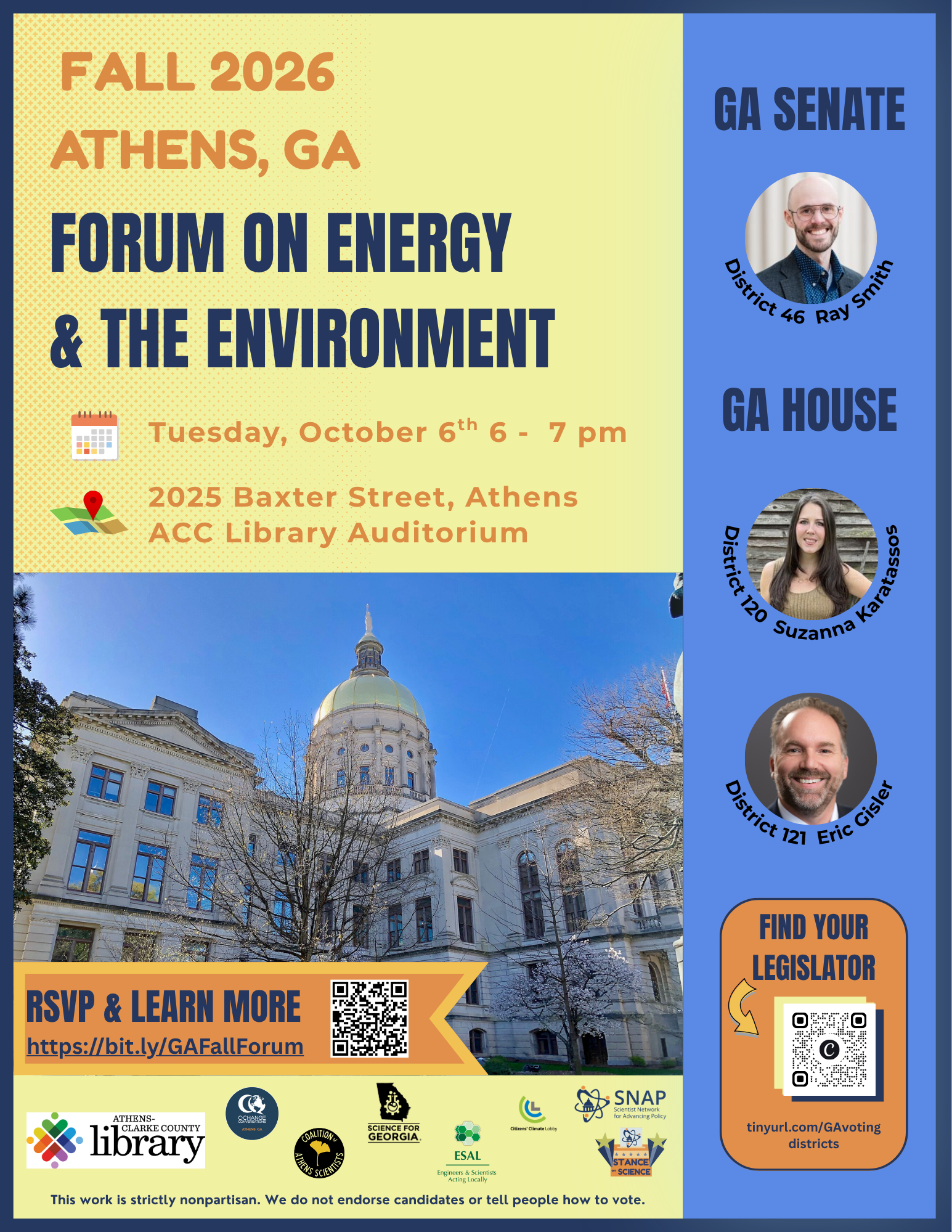
October 6, 2026
Stance on Science GA
UPDATE: Here is the recording of this event.
Want to know where GA State House candidates stand on energy and environmental issues? Please join us for the Candidate Forum on Energy and the Environment at the ACC Library Auditorium on 2025 Baxter Street on October 6th from 6 - 7 pm. Candidates for GA Senate Districts 46 and 47 and GA House District 121 will share their views on data centers, the environment, renewable energy, and environmental justice. Doors open at 5:30 pm with an opportunity to connect with candidates’ campaign teams and forum sponsors.
RSVP at https://bit.ly/GAFallForum
Hosted by: Coalition of Athens Scientists, Planning Committee for Candidate Forum on Energy and the Environment, ACC Library
Part of the Scientist Network for Advancing Policy’s 2026 Stance on Science non-partisan initiative.
No past events.
Oct 08, 2026: Athens scientists host candidate forum on energy and the environment in Athens Politics Nerd
Oct 07, 2026: Local candidates talk data centers, energy policy at environmental forum in The Red & Black
May 06, 2026: Mayoral Candidates Discuss Clean Energy and Other Environmental Issues in Flagpole
May 05, 2026: Mayoral forum on energy and the environment in Athens Politics Nerd
Apr 28, 2026: Candidates debate data centers, water access issues at environmental forum in The Red & Black
Apr 27, 2026: Athens mayoral candidates to share views on environment during forum in WUGA