Back to map

New Jersey

Created by the New Jersey Stance on Science team. Please contact stanceonsciencenj@gmail.com with any questions. Follow us on Instagram, Facebook, and Reddit.

Last updated: October 14, 2026

Jump to candidate responses

New Jersey will face many challenges in the coming years, and it is increasingly critical that our policymakers understand the importance of evidence-based decision-making. The goals of this resource are to:

  1. Provide voters with clear, accessible information so they can see how candidates value science in decision-making.
  2. Hold candidates accountable by sharing their responses publicly on our website and via local media.
  3. Encourage thoughtful engagement between communities and policymakers on science policy-related topics in our state.

Through Stance on Science, we hope to help New Jerseyans understand how their elected representatives will utilize science to improve the state that they love. Learn more about this initiative on the home page.

How to use this resource

This webpage houses the responses to 6 questions crafted by the New Jersey Stance on Science team.

Candidates were contacted beginning in August 2026 and given the opportunity to answer all questions. Only the responses candidates submitted are included, and none were modified before publication.

For the November 2026 Midterm Election, candidates in the following elections were contacted:

US Senate — Cory Booker, Justin Murphy, Veronica Fernandez, and Natalie Rivera
US House of Representatives
  • District 1 — Donald Norcross and Damon Galdo
  • District 2 — Jeff Van Drew, Zach Mullock, and Ramon Mora Jr.
  • District 3 — Herbert C. Conaway Jr., Michael McGuire, Ryan Michael Kelly, and Steven Welzer
  • District 4 — Chris Smith and Rachel Peace
  • District 5 — Josh Gottheimer, Sean Kirrane, and Adam Rueda
  • District 6 — Frank Pallone Jr., Hillary Herzig, and Fahad Akhtar
  • District 7 — Thomas Kean Jr., Rebecca Bennett, and Lana Leguia
  • District 8 — Robert Menendez Jr., Da'shone Hughey, and Ari Eliopoulos
  • District 9 — Nellie Pou, Rosie Pino, and Terrisa Bukovinac
  • District 10 — LaMonica McIver and Carmen Bucco
  • District 11 — Analilia Mejia, Joe Hathaway, and Alan Bond
  • District 12 — Adam Hamawy, Gregg Mele, Andres Jinete, and Winston Jordan
The questions posed
  1. Exposure to PFAS has been associated with weakened immune response and impaired liver and kidney function. In 2018, New Jersey passed a rule setting enforceable limits on PFAS in drinking water, one of the first states in the country to do so. Levels of two of the most harmful PFAS chemicals have since dropped by nearly 50% compared to 2006, when concerningly high levels were first found. Despite this progress, gaps persist, including soils, air pollution, and private wells, which have limited monitoring of but serve 10% of the state’s population. Do you think current policies related to forever chemicals have had a positive impact on NJ residents and what additions, changes, or different policies, if any, would you implement regarding managing PFAS levels in New Jersey’s air, soil, and drinking water? (Source - NJ Spotlight news) (see "Public Health")
  2. In 2025, the National Institute of Health (NIH) awarded over $460 million for research grants and contracts to New Jersey universities and biotech companies, which directly supported over 5,800 jobs and $1.51 billion of economic activity in New Jersey. Additionally, New Jersey legislators have proposed a bipartisan bill that would repurpose tax revenue from tobacco sales as funding for cancer research. What policies, if any, do you suggest regarding maintaining current levels of federal support for health-related research and healthcare in NJ? Do you support a push towards channeling more of that financial support through state funding, and if so, through what policies? (see "Science Funding")
  3. New Jersey’s school-based mental health professionals-to-students ratios remain much higher than recommended levels, even as 42% of high school students and 50% of middle schoolers in the state reported feeling sad and hopeless according to a 2023 study. Do you support allocating resources towards researching this topic, and what policies, if any, do you support to address youth mental health and well-being in the state? (Source - Advocates for children of New Jersey, Source - NJ Spotlight news) (see "Public Health")
  4. New Jersey has a longstanding history of being seriously affected by natural disasters. Recently, heavy rainfall brought a significant amount of flooding that caused damage and loss of business in commercial and residential areas of NJ. What policies, if any, would you pursue to mitigate the effects of natural disasters, and what role would state scientists and flood experts have in the policies you propose to mitigate the effects of flooding? (see "Environment")
  5. In 2025, only 26% of NJ students met proficiency in science on standardized tests. In cities such as Newark, this is as low as 7%. Furthermore the number of math and science educators in NJ is waning (9% decrease). What policies, if any, would you propose to increase access to quality STEM education across the state and to address the decline in evidence-based learning? (see "Investment in Higher Education", "Jobs and Workforce", and "K-12 Science Education")
  6. To date, there are over 80 operational data centers present in New Jersey, four more proposed, and another currently under construction. Governor Mikie Sherill has recently signed the Data Center Fair Share Act, allowing centers to offset energy demands by paying for clean energy upgrades to local homes. What other policies and regulations, if any, would you support to assess and manage the impact of these data centers on the environment and infrastructure of New Jersey? (see "Energy")

Disclaimer

The responses of candidates shared on this webpage do not reflect the views of the New Jersey Stance on Science team or the Scientist Network for Advancing Policy (SNAP) Coalition. SNAP is a non-partisan organization (please see more about SNAP here). SNAP and the New Jersey Stance on Science team do not endorse any candidates. The goals of this initiative can be found here. Please contact stanceonsciencenj@gmail.com with any questions.

To find your districts for state and federal races and see who is on your ballot, please visit the Ballotpedia Sample Ballot Lookup.


November 2026 Midterm Election

If you cannot find a candidate, it means they have not yet submitted their response to Stance on Science. Please check back soon.

The order of responses is randomized by default. Use the filters below to find the candidate and race you are interested in.

Filter & sort responses

US House of RepresentativesDistrict 8
Submitted September 21, 2026

Q1 Exposure to PFAS has been associated with weakened immune response and impaired liver and kidney function. In 2018, New Jersey passed a rule setting enforceable limits on PFAS in drinking water, one of the first states in the country to do so. Levels of two of the most harmful PFAS chemicals have since dropped by nearly 50% compared to 2006, when concerningly high levels were first found. Despite this progress, gaps persist, including soils, air pollution, and private wells, which have limited monitoring of but serve 10% of the state’s population. Do you think current policies related to forever chemicals have had a positive impact on NJ residents and what additions, changes, or different policies, if any, would you implement regarding managing PFAS levels in New Jersey’s air, soil, and drinking water? (Source - NJ Spotlight news)

Public Health

NJ’s PFAS policies have had a measurable positive impact. That progress demonstrates that strong regulation, monitoring, and investment in clean water infrastructure can protect public health. I would build on New Jersey’s progress with a comprehensive “source-to-tap” strategy. First, expand PFAS monitoring in air, soil, groundwater, and surface water, particularly near industrial facilities, landfills, airports, fire-training sites, and wastewater facilities. Second, strengthen protections for private-well owners through testing, public notification, and financial assistance for filtration where contamination is detected. Third, hold responsible polluters accountable so taxpayers and ratepayers are not forced to bear cleanup costs when responsible parties can be identified. Finally, we should continue reducing PFAS at the source by restricting unnecessary uses of these chemicals in consumer and industrial products. Clean water should not depend on a family’s ZIP code or whether they rely on a public system or private well. New Jersey should continue the progress it has made while closing the remaining gaps in PFAS protection.

Q2 In 2025, the National Institute of Health (NIH) awarded over $460 million for research grants and contracts to New Jersey universities and biotech companies, which directly supported over 5,800 jobs and $1.51 billion of economic activity in New Jersey. Additionally, New Jersey legislators have proposed a bipartisan bill that would repurpose tax revenue from tobacco sales as funding for cancer research. What policies, if any, do you suggest regarding maintaining current levels of federal support for health-related research and healthcare in NJ? Do you support a push towards channeling more of that financial support through state funding, and if so, through what policies?

Science Funding

I would work in Congress to maintain strong, predictable federal funding for NIH, medical research, cancer research, and programs that expand access to healthcare. Federal investment is essential because it provides the scale and stability necessary for long-term research that individual states cannot replicate. At the same time, New Jersey should strengthen its own research infrastructure rather than relying exclusively on Washington. I support creating dedicated, predictable state funding for cancer and other high-priority health research, including the proposed increase in funding for the New Jersey Commission on Cancer Research from $1 million to $10 million. State funding should prioritize competitive research grants, pediatric and rare diseases, clinical trials, prevention, and communities historically underserved by medical research. I would also support partnerships between New Jersey universities, hospitals, biotech companies, and government to move discoveries from the laboratory into affordable treatments. Federal and state investments should complement—not replace—each other, ensuring New Jersey remains a national leader in medical innovation while delivering tangible benefits to patients and families.

Q3 New Jersey’s school-based mental health professionals-to-students ratios remain much higher than recommended levels, even as 42% of high school students and 50% of middle schoolers in the state reported feeling sad and hopeless according to a 2023 study. Do you support allocating resources towards researching this topic, and what policies, if any, do you support to address youth mental health and well-being in the state? (Source - Advocates for children of New Jersey, Source - NJ Spotlight news)

Public Health

Yes. Youth mental health deserves both greater research and greater investment. Schools are often the first place where warning signs appear, yet New Jersey continues to face shortages of school counselors, psychologists, social workers, and other mental-health professionals. We need better data to understand which interventions work and where resources are most urgently needed. I support increasing federal and state funding for school-based mental-health services, with priority given to districts experiencing the greatest shortages and highest levels of student need. Schools should have sufficient counselors, psychologists, and social workers to provide early intervention—not simply respond when a crisis occurs. I would also support expanding school-based partnerships with licensed mental-health providers, telehealth options, and programs that connect students and families with affordable community-based care. Federal funding should help districts hire and retain qualified professionals, particularly in underserved communities. Prevention must also be part of the solution. Schools should provide age-appropriate education on mental health, stress management, substance-use prevention, and how to seek help, while protecting student privacy and parental involvement. Finally, I support continued research into youth mental health, including the effects of social media, bullying, academic pressure, and economic insecurity. Our goal should be a system that identifies problems early, provides accessible support, and ensures no child has to face a mental-health crisis alone.

Q4 New Jersey has a longstanding history of being seriously affected by natural disasters. Recently, heavy rainfall brought a significant amount of flooding that caused damage and loss of business in commercial and residential areas of NJ. What policies, if any, would you pursue to mitigate the effects of natural disasters, and what role would state scientists and flood experts have in the policies you propose to mitigate the effects of flooding?

Environment

New Jersey needs to invest in both prevention and preparedness as flooding becomes an increasingly costly threat to homeowners, businesses, and infrastructure. I support expanding federal and state funding for stormwater systems, drainage upgrades, flood-control infrastructure, green infrastructure, and voluntary buyouts in repeatedly flooded areas. New development should also meet stronger, forward-looking flood-resilience standards rather than relying solely on historical flood maps. New Jersey has already moved in this direction through its Inland Flood Protection Rule and recent resilience initiatives. State scientists and flood experts should be central to these decisions. They should regularly update flood maps and rainfall projections, identify vulnerable communities, evaluate proposed infrastructure projects, and ensure taxpayer dollars are directed toward projects supported by the best available science. New Jersey’s Division of Science and Research already provides scientific support for climate-resilience planning. We should also improve emergency-warning systems and provide small businesses and homeowners with resources to prepare before disasters occur. The goal should be simple: use science to anticipate flooding, invest before disasters happen, and protect lives, homes, businesses, and taxpayers.

Q5 In 2025, only 26% of NJ students met proficiency in science on standardized tests. In cities such as Newark, this is as low as 7%. Furthermore the number of math and science educators in NJ is waning (9% decrease). What policies, if any, would you propose to increase access to quality STEM education across the state and to address the decline in evidence-based learning?

Investment in Higher EducationJobs and WorkforceK-12 Science Education

NJ cannot remain a national leader if too many students are leaving school without strong foundations in science, technology, engineering, and mathematics. I would focus on both improving instruction and rebuilding the STEM educator pipeline. First, I support expanding federal and state funding for STEM programs, particularly in districts where students have historically had less access to laboratories, technology, advanced courses, and qualified teachers. Funding should follow student need, not simply district boundaries. Second, we need to make teaching STEM subjects more attractive. I would support scholarships and loan-forgiveness programs for students who commit to teaching science, math, engineering, or technology in New Jersey schools, along with competitive salaries and retention incentives for experienced educators. Third, schools should expand hands-on, evidence-based STEM instruction through laboratory experiences, career and technical education, apprenticeships, and partnerships with New Jersey’s universities, research institutions, and technology industries. Finally, we must strengthen evidence-based teaching practices and provide educators with meaningful professional development rather than relying on one-size-fits-all mandates.

Q6 To date, there are over 80 operational data centers present in New Jersey, four more proposed, and another currently under construction. Governor Mikie Sherill has recently signed the Data Center Fair Share Act, allowing centers to offset energy demands by paying for clean energy upgrades to local homes. What other policies and regulations, if any, would you support to assess and manage the impact of these data centers on the environment and infrastructure of New Jersey?

Energy

NJ should welcome technological investment while ensuring data centers do not shift their environmental and infrastructure costs onto residents. I support requiring comprehensive environmental and infrastructure impact assessments before major data centers are approved, including impacts on electricity demand, water consumption, wastewater, traffic, and local grid capacity. Developers should pay their fair share of necessary infrastructure upgrades rather than relying on existing ratepayers. I would also support stronger energy-efficiency standards, renewable-energy requirements, water-reuse systems, and transparent reporting of energy and water consumption. State regulators should coordinate with utilities and municipalities to ensure projects do not compromise grid reliability or increase costs for families. Finally, communities should have meaningful opportunities for public input before approval. Economic development should go hand-in-hand with environmental responsibility, infrastructure capacity, and protecting New Jersey residents from unintended costs.
Hillary Herzig

Republican
US House of RepresentativesDistrict 6
Submitted September 30, 2026

Q1 Exposure to PFAS has been associated with weakened immune response and impaired liver and kidney function. In 2018, New Jersey passed a rule setting enforceable limits on PFAS in drinking water, one of the first states in the country to do so. Levels of two of the most harmful PFAS chemicals have since dropped by nearly 50% compared to 2006, when concerningly high levels were first found. Despite this progress, gaps persist, including soils, air pollution, and private wells, which have limited monitoring of but serve 10% of the state’s population. Do you think current policies related to forever chemicals have had a positive impact on NJ residents and what additions, changes, or different policies, if any, would you implement regarding managing PFAS levels in New Jersey’s air, soil, and drinking water? (Source - NJ Spotlight news)

Public Health

New Jersey’s drinking water protections have produced measurable progress, but drinking water is only one part of the problem. Reducing PFAS exposure requires addressing contamination at its source, particularly in industrial discharge, agricultural soil, biosolid fertilizers and private wells. I would prioritize expanding PFAS testing in private wells, establishing stronger monitoring of contaminated soil and industrial emissions, and improving coordination between the EPA, NJDEP and local governments. Residents deserve accessible testing, transparent results and timely notification when contamination is discovered. I would also support targeted research into PFAS remediation, including technologies that remove or destroy these chemicals rather than simply transferring them elsewhere. Polluters should bear responsibility for contamination they cause, with financial and technical assistance available to affected homeowners and farmers. New Jersey’s experience demonstrates that enforceable standards can reduce exposure. The next step is extending those protections beyond public drinking water systems to the air, soil and private water supplies that families depend on.

Q2 In 2025, the National Institute of Health (NIH) awarded over $460 million for research grants and contracts to New Jersey universities and biotech companies, which directly supported over 5,800 jobs and $1.51 billion of economic activity in New Jersey. Additionally, New Jersey legislators have proposed a bipartisan bill that would repurpose tax revenue from tobacco sales as funding for cancer research. What policies, if any, do you suggest regarding maintaining current levels of federal support for health-related research and healthcare in NJ? Do you support a push towards channeling more of that financial support through state funding, and if so, through what policies?

Science Funding

I support maintaining reliable federal funding for medical research, particularly cancer research, environmental health and emerging medical technologies. New Jersey’s universities and biotechnology companies are important contributors to medical innovation, and I want to see that research translate into more affordable, accessible healthcare for our families. I also support expanding state investment through dedicated funding rather than relying exclusively on Washington. Redirecting a portion of existing tobacco tax revenue toward cancer research is an approach worth supporting, provided those funds are protected from diversion and distributed through transparent, competitive grants. I would encourage public and private research partnerships, opportunities for smaller biotechnology companies and greater investment in studying the long term health effects of environmental contaminants.

Q3 New Jersey’s school-based mental health professionals-to-students ratios remain much higher than recommended levels, even as 42% of high school students and 50% of middle schoolers in the state reported feeling sad and hopeless according to a 2023 study. Do you support allocating resources towards researching this topic, and what policies, if any, do you support to address youth mental health and well-being in the state? (Source - Advocates for children of New Jersey, Source - NJ Spotlight news)

Public Health

I support research into the underlying causes of declining youth mental health, including bullying, social isolation, excessive screen time and the effects of technology on developing minds. However, I firmly believe that healthcare decisions belong to parents, not schools. We must stop blurring the lines between educational institutions and healthcare facilities. Schools exist to educate children, schools are not a substitute for mental health clinics. Psychological evaluations, counseling and therapy are healthcare services that should be provided by qualified healthcare professionals in appropriate clinical settings, with informed consent. I support investing in community based mental health services, improving access to pediatric specialists, and ensuring families have affordable options for obtaining care outside the school system. Schools should focus on providing safe learning environments, preventing bullying, and promptly notifying parents when a child needs additional support. Federal funding should prioritize evidence based research, parental education and accessible family directed healthcare.

Q4 New Jersey has a longstanding history of being seriously affected by natural disasters. Recently, heavy rainfall brought a significant amount of flooding that caused damage and loss of business in commercial and residential areas of NJ. What policies, if any, would you pursue to mitigate the effects of natural disasters, and what role would state scientists and flood experts have in the policies you propose to mitigate the effects of flooding?

Environment

For our coastal communities, I want to explore dutch-inspired flood management, strategic land reclamation where environmentally appropriate, restored wetlands, living shorelines and natural wave-attenuation systems. Inland communities need modernized stormwater infrastructure, improved drainage, flood resistant bridges and reliable road closure warning systems. I would also pursue FEMA and National Flood Insurance Program reforms that prioritize prevention and resilience rather than repeatedly paying to rebuild after disasters. Federal grants should support proactive infrastructure projects, with particular attention to small businesses, working waterfronts and neighborhoods that experience repetitive flooding. State scientists and flood experts should play a central role in designing, testing and monitoring these solutions. Their research should inform public investment, with transparent data and measurable results. We must work with our natural environment, not continually fight against it, while protecting our communities, local economies and coastal ecosystems.

Q5 In 2025, only 26% of NJ students met proficiency in science on standardized tests. In cities such as Newark, this is as low as 7%. Furthermore the number of math and science educators in NJ is waning (9% decrease). What policies, if any, would you propose to increase access to quality STEM education across the state and to address the decline in evidence-based learning?

Investment in Higher EducationJobs and WorkforceK-12 Science Education

To address the shortage of STEM educators, I would support alternative certification pathways for qualified scientists, engineers and skilled trades professionals. I support modernizing STEM education, students should have opportunities to explore career interests earlier, visit workplaces and experience professions firsthand. We must prepare students for careers that are less vulnerable to AI automation, including skilled trades, healthcare, engineering and other hands on professions. While children must master mathematics and computational skills, AI will increasingly outperform humans at routine calculations. Education must therefore emphasize critical thinking, creativity, problem solving and applying knowledge in the real world.

Q6 To date, there are over 80 operational data centers present in New Jersey, four more proposed, and another currently under construction. Governor Mikie Sherill has recently signed the Data Center Fair Share Act, allowing centers to offset energy demands by paying for clean energy upgrades to local homes. What other policies and regulations, if any, would you support to assess and manage the impact of these data centers on the environment and infrastructure of New Jersey?

Energy

I support water efficient cooling, wastewater recycling, rainwater harvesting, rooftop solar and reliable energy sources, including advanced nuclear technology. Facilities should also reuse waste heat wherever practical. State scientists, engineers and local residents must have a meaningful role in siting decisions. Data centers and AI companies should pay for the additional electricity generation and grid infrastructure they require, rather than passing those costs on to households and small businesses. Consumers should have the freedom to choose whether to use and pay for AI services. AI should be an optional service, not an involuntary expense hidden in everyone’s utility bills. We can lead in AI innovation while protecting our natural resources, preserving residential quality of life and keeping energy affordable.

Da'Shone Hughey

We the People
US House of RepresentativesDistrict 8
Submitted September 29, 2026

Q4 New Jersey has a longstanding history of being seriously affected by natural disasters. Recently, heavy rainfall brought a significant amount of flooding that caused damage and loss of business in commercial and residential areas of NJ. What policies, if any, would you pursue to mitigate the effects of natural disasters, and what role would state scientists and flood experts have in the policies you propose to mitigate the effects of flooding?

Environment

New Jersey needs to move from disaster response to disaster prevention and resilience. My New Thinking philosophy is simple: if science can help predict flooding, government should act before communities suffer the damage. As a representative, I would pursue a New Jersey Flood Resilience Initiative with four priorities:

  1. Map the risk: Create continuously updated flood-risk maps using rainfall, watershed, drainage, infrastructure, and sea-level data, with state scientists and hydrologists guiding decisions.
  2. Fund prevention: Direct federal infrastructure and disaster-resilience dollars toward stormwater systems, drainage, dams, roads, bridges, wetlands restoration, and green infrastructure in the communities facing the greatest risk.
  3. Protect property: Expand grants and low-interest financing for homeowners and small businesses to elevate buildings, install flood barriers, improve drainage, and relocate critical equipment above flood levels.
  4. Improve response: Establish coordinated early-warning systems and require municipalities to maintain emergency flood-response plans based on current scientific data. I would also support accelerating federal disaster assistance after major floods while ensuring that prevention receives funding before disasters occur. State scientists, engineers, hydrologists, and flood experts should have a central role in setting priorities—not politics. New Thinking means using science to anticipate tomorrow’s problems rather than simply paying to repair yesterday’s damage. Protect lives. Protect property. Protect New Jersey’s communities.

Q5 In 2025, only 26% of NJ students met proficiency in science on standardized tests. In cities such as Newark, this is as low as 7%. Furthermore the number of math and science educators in NJ is waning (9% decrease). What policies, if any, would you propose to increase access to quality STEM education across the state and to address the decline in evidence-based learning?

Investment in Higher EducationJobs and WorkforceK-12 Science Education

New Jersey cannot build a 21st-century economy with a 20th-century STEM education system. My New Thinking philosophy is to prepare students for the world they are entering—not the world we inherited. I would propose a New Jersey STEM and Future Workforce Initiative with five concrete actions:

  1. STEM Opportunity Grants: Direct federal and state funds to schools for robotics, AI, computer science, engineering labs, and hands-on science, prioritizing underserved districts.
  2. STEM Teacher Corps: Provide scholarships, loan assistance, paid residencies, and competitive retention incentives for qualified math and science teachers.
  3. Queriosity Learning Centers: Pilot centers that provide AI-assisted tutoring, robotics, VR, experimentation, and project-based learning after school and during summers. Successful models could be expanded statewide through public-school and community partnerships.
  4. STEM Career Pathways: Require participating schools to develop partnerships with universities, manufacturers, technology companies, hospitals, laboratories, and apprenticeship programs.
  5. Measure Results: Track science and math proficiency, teacher vacancies, STEM course enrollment, certifications, internships, and post-graduation outcomes—and redirect resources toward programs demonstrating measurable improvement. New Thinking means replacing passive learning with curiosity, experimentation, technology, and measurable results. Every New Jersey student should have the opportunity to become a creator of the future, not merely a consumer of it.

Q6 To date, there are over 80 operational data centers present in New Jersey, four more proposed, and another currently under construction. Governor Mikie Sherill has recently signed the Data Center Fair Share Act, allowing centers to offset energy demands by paying for clean energy upgrades to local homes. What other policies and regulations, if any, would you support to assess and manage the impact of these data centers on the environment and infrastructure of New Jersey?

Energy

New Jersey should not choose between leading the AI economy and protecting our communities. We should do both. My New Thinking philosophy is that transformative technology requires equally transformative infrastructure and accountability. I would support a New Jersey Data Center Impact Standard requiring:

  • Impact assessments before approval covering electricity, water, emissions, noise, traffic, and infrastructure.
  • Fair-share costs: Developers help fund grid, water, road, and emergency-service upgrades their facilities require.
  • Clean-energy plans: Large data centers should demonstrate how they will meet new energy demand through clean generation, storage, efficiency, or other verified solutions.
  • Water accountability: Require monitoring, conservation, and reuse where feasible.
  • Community investment: Host communities should receive infrastructure improvements, workforce training, and local economic benefits.
  • STEM workforce development: Connect data centers with New Jersey schools, colleges, apprenticeships, and innovative programs such as Queriosity. I would also require transparent reporting so residents can see the economic and environmental impacts of major facilities. New Thinking means building tomorrow’s infrastructure without leaving today’s communities with the bill. New Jersey should become a national leader in responsible AI infrastructure where innovation, economic opportunity, environmental stewardship, and community investment advance together.

Winston Jordan

No Party Preference
US House of RepresentativesDistrict 12
Submitted September 10, 2026

Q1 Exposure to PFAS has been associated with weakened immune response and impaired liver and kidney function. In 2018, New Jersey passed a rule setting enforceable limits on PFAS in drinking water, one of the first states in the country to do so. Levels of two of the most harmful PFAS chemicals have since dropped by nearly 50% compared to 2006, when concerningly high levels were first found. Despite this progress, gaps persist, including soils, air pollution, and private wells, which have limited monitoring of but serve 10% of the state’s population. Do you think current policies related to forever chemicals have had a positive impact on NJ residents and what additions, changes, or different policies, if any, would you implement regarding managing PFAS levels in New Jersey’s air, soil, and drinking water? (Source - NJ Spotlight news)

Public Health

New Jersey’s drinking water standards for PFOA, PFOS, and PFNA have proven that stringent regulatory limits deliver public health results. However, protecting 90% of residents while leaving private wells, soil, and air unmonitored creates an unacceptable disparity. As U.S. Representative, I support extending state and federal oversight across all exposure pathways. We must mandate baseline PFAS testing for private well systems, fully fund remediation assistance through the Spill Compensation Fund, and set strict discharge limits on industrial soil and atmospheric emissions. Environmental protection cannot stop at municipal water lines.

Q2 In 2025, the National Institute of Health (NIH) awarded over $460 million for research grants and contracts to New Jersey universities and biotech companies, which directly supported over 5,800 jobs and $1.51 billion of economic activity in New Jersey. Additionally, New Jersey legislators have proposed a bipartisan bill that would repurpose tax revenue from tobacco sales as funding for cancer research. What policies, if any, do you suggest regarding maintaining current levels of federal support for health-related research and healthcare in NJ? Do you support a push towards channeling more of that financial support through state funding, and if so, through what policies?

Science Funding

Federal health research investments generate vital medical breakthroughs and local economic stability. I oppose federal budget cuts to NIH and NSF programs. To safeguard New Jersey against federal gridlock, state-level mechanisms—including channeling dedicated tax revenue directly into cancer research—provide necessary stability. We must protect public health from private capture by pairing state and federal research grants with strict public interest disclosures, ensuring taxpayer-funded breakthroughs yield affordable, accessible healthcare rather than corporate monopolies.

Q3 New Jersey’s school-based mental health professionals-to-students ratios remain much higher than recommended levels, even as 42% of high school students and 50% of middle schoolers in the state reported feeling sad and hopeless according to a 2023 study. Do you support allocating resources towards researching this topic, and what policies, if any, do you support to address youth mental health and well-being in the state? (Source - Advocates for children of New Jersey, Source - NJ Spotlight news)

Public Health

The youth mental health crisis demands evidence-based public intervention, not administrative indifference. I support fully funding research into social and environmental stressors affecting students. In Congress and through state partnership, I advocate channeling resources toward meeting recommended student-to-professional ratios in public schools, expanding community health centers, and removing corporate algorithms that profit from youth psychological distress.

Q4 New Jersey has a longstanding history of being seriously affected by natural disasters. Recently, heavy rainfall brought a significant amount of flooding that caused damage and loss of business in commercial and residential areas of NJ. What policies, if any, would you pursue to mitigate the effects of natural disasters, and what role would state scientists and flood experts have in the policies you propose to mitigate the effects of flooding?

Environment

Mitigating extreme weather in New Jersey requires prioritizing public infrastructure and ecological resilience over speculative real estate development. I advocate integrating state flood experts, geologists, and civil engineers directly into land-use and zoning decisions. Public policy must enforce strict stormwater management standards, mandate regional infrastructure upgrades, and restore natural wetlands rather than continuing to build in vulnerable floodplains.

Q5 In 2025, only 26% of NJ students met proficiency in science on standardized tests. In cities such as Newark, this is as low as 7%. Furthermore the number of math and science educators in NJ is waning (9% decrease). What policies, if any, would you propose to increase access to quality STEM education across the state and to address the decline in evidence-based learning?

Investment in Higher EducationJobs and WorkforceK-12 Science Education

The decline in STEM proficiency reflects systemic underinvestment in public education and teacher retention. We must fully fund public STEM pipelines, incentivize educators with competitive salaries, and increase state support for under-resourced districts. Additionally, we must keep evidence-based science education focused on rigorous inquiry, technical literacy, and critical thinking, free from political interference.

Q6 To date, there are over 80 operational data centers present in New Jersey, four more proposed, and another currently under construction. Governor Mikie Sherill has recently signed the Data Center Fair Share Act, allowing centers to offset energy demands by paying for clean energy upgrades to local homes. What other policies and regulations, if any, would you support to assess and manage the impact of these data centers on the environment and infrastructure of New Jersey?

Energy

Unchecked data center expansion presents a structural risk to taxpayers, public utility grids, and economic stability. With AI hardware facing rapid 3-to-5-year obsolescence cycles, speculative private buildouts threaten to leave public ratepayers funding stranded electrical grid upgrades if hype outpaces economic utility. While state-level ratepayer protections are a starting point, federal and state policy must address systemic financial risk. I support national data center capacity audits to distinguish durable computing demand from speculative overbuilding. Furthermore, I advocate ending uncapped corporate sales-tax exemptions for data center hardware, enforcing binding ““take-or-pay”” energy contracts so tech corporations—not working families—pay for 100% of grid expansion, and mandating off-grid self-generation for high-density compute facilities.

Ryan Michael Kelly

Affordability, Accountability, People
US House of RepresentativesDistrict 3
Submitted September 21, 2026

Q1 Exposure to PFAS has been associated with weakened immune response and impaired liver and kidney function. In 2018, New Jersey passed a rule setting enforceable limits on PFAS in drinking water, one of the first states in the country to do so. Levels of two of the most harmful PFAS chemicals have since dropped by nearly 50% compared to 2006, when concerningly high levels were first found. Despite this progress, gaps persist, including soils, air pollution, and private wells, which have limited monitoring of but serve 10% of the state’s population. Do you think current policies related to forever chemicals have had a positive impact on NJ residents and what additions, changes, or different policies, if any, would you implement regarding managing PFAS levels in New Jersey’s air, soil, and drinking water? (Source - NJ Spotlight news)

Public Health

Yes. New Jersey’s experience demonstrates that enforceable standards, monitoring, and science-based regulation can reduce exposure to dangerous chemicals. I support continuing and strengthening that approach. At the federal level, I support strong EPA drinking-water standards for PFAS, continued research into their health effects, expanded monitoring, and federal assistance to communities facing expensive testing and remediation. We also need to address exposure beyond public water systems, including private wells, soil, air, industrial sites, and the movement of PFAS through our environment. I believe in the polluter-pays principle. The cost of cleaning up contamination should not simply be transferred to homeowners and taxpayers when responsible parties can be identified. I would also support funding to help private-well owners test their water and, when contamination is detected, obtain appropriate treatment or alternative water supplies. Finally, policy should evolve with the science. PFAS represents a large family of chemicals, and government should not wait for decades of damage before responding when credible scientific evidence identifies additional risks.

Q2 In 2025, the National Institute of Health (NIH) awarded over $460 million for research grants and contracts to New Jersey universities and biotech companies, which directly supported over 5,800 jobs and $1.51 billion of economic activity in New Jersey. Additionally, New Jersey legislators have proposed a bipartisan bill that would repurpose tax revenue from tobacco sales as funding for cancer research. What policies, if any, do you suggest regarding maintaining current levels of federal support for health-related research and healthcare in NJ? Do you support a push towards channeling more of that financial support through state funding, and if so, through what policies?

Science Funding

I strongly support robust federal funding for health and scientific research, including NIH funding. New Jersey is home to universities, hospitals, researchers, pharmaceutical and biotechnology companies, and other institutions that contribute significantly to medical innovation. Federal research funding is not simply an expense. It supports jobs, trains scientists, strengthens our economy, and produces discoveries that can improve and save lives. I would oppose arbitrary or politically motivated cuts to peer-reviewed scientific research. Funding decisions should be based primarily on scientific merit, public need, research integrity, and potential benefit. I am also open to New Jersey supplementing federal research funding, including dedicated state support for areas such as cancer research. However, state funding should supplement rather than replace the federal government’s role. Medical research benefits people across state lines and requires sustained national investment. I would also support strengthening opportunities for early-career researchers and ensuring that promising research is not abandoned simply because scientists face unpredictable funding cycles.

Q3 New Jersey’s school-based mental health professionals-to-students ratios remain much higher than recommended levels, even as 42% of high school students and 50% of middle schoolers in the state reported feeling sad and hopeless according to a 2023 study. Do you support allocating resources towards researching this topic, and what policies, if any, do you support to address youth mental health and well-being in the state? (Source - Advocates for children of New Jersey, Source - NJ Spotlight news)

Public Health

Yes. I support both research into youth mental health and resources that translate evidence into accessible care. Mental healthcare is healthcare. Students should not have to reach a crisis before they can receive help. At the federal level, I support funding programs that increase the number of qualified school counselors, psychologists, social workers, and other mental-health professionals. I also support partnerships between schools, universities, healthcare providers, and community organizations that can expand the pipeline of trained professionals. Research is essential because we need to understand not only rates of anxiety, depression, suicide risk, and other concerns, but what interventions actually work. Policy should follow evidence rather than political assumptions. I would also support prevention, early intervention, suicide-prevention resources, and better connections between schools and community-based care. Ultimately, my support for universal healthcare includes comprehensive mental healthcare. A young person’s ability to receive treatment should not depend upon family income, insurance status, or whether their school happens to have sufficient resources.

Q4 New Jersey has a longstanding history of being seriously affected by natural disasters. Recently, heavy rainfall brought a significant amount of flooding that caused damage and loss of business in commercial and residential areas of NJ. What policies, if any, would you pursue to mitigate the effects of natural disasters, and what role would state scientists and flood experts have in the policies you propose to mitigate the effects of flooding?

Environment

New Jersey cannot treat increasingly serious flooding as a problem to address only after disaster strikes. We need to invest in prevention and resilience before communities are underwater. I support sustained federal investment in flood mitigation, modern stormwater systems, resilient roads and infrastructure, improved drainage, floodplain restoration, wetlands and other nature-based solutions where appropriate, and assistance for communities and property owners undertaking mitigation. Scientists, engineers, hydrologists, meteorologists, flood experts, emergency managers, and local officials should have a central role in these decisions. Government should use current flood maps, rainfall data, climate projections, land-use information, and modeling when deciding where infrastructure dollars will have the greatest impact. I would also support improving federal, state, county, and municipal data sharing so communities are not planning independently with incomplete information. We will never eliminate every natural disaster, but evidence-based planning can reduce damage, protect lives, lower long-term costs, and help communities recover more quickly when disasters occur.

Q5 In 2025, only 26% of NJ students met proficiency in science on standardized tests. In cities such as Newark, this is as low as 7%. Furthermore the number of math and science educators in NJ is waning (9% decrease). What policies, if any, would you propose to increase access to quality STEM education across the state and to address the decline in evidence-based learning?

Investment in Higher EducationJobs and WorkforceK-12 Science Education

As an educator, I believe access to high-quality STEM education should not depend on a student’s ZIP code. I support federal investment in recruiting, preparing, and retaining qualified STEM educators, along with modern laboratories, technology, broadband, instructional materials, and hands-on learning opportunities. STEM education is also something I have encountered outside the traditional classroom. I am a member of Triangle Fraternity, an organization founded around engineering and now focused on engineering, architecture, and the sciences. I am also involved with Civil Air Patrol, whose aerospace education programs use hands-on STEM learning to introduce young people to aviation, space, technology, and related careers. I strongly support evidence-based education. Students should learn how science actually works: asking questions, evaluating evidence, testing hypotheses, recognizing uncertainty, and changing conclusions when better evidence becomes available. I also support partnerships connecting students with colleges, laboratories, skilled trades, employers, scientists, and other professionals. Our goal should be scientific literacy for every student and meaningful opportunities for students who want to pursue STEM careers.

Q6 To date, there are over 80 operational data centers present in New Jersey, four more proposed, and another currently under construction. Governor Mikie Sherill has recently signed the Data Center Fair Share Act, allowing centers to offset energy demands by paying for clean energy upgrades to local homes. What other policies and regulations, if any, would you support to assess and manage the impact of these data centers on the environment and infrastructure of New Jersey?

Energy

Data centers are necessary infrastructure for our increasingly digital economy and for technologies such as artificial intelligence, but communities should not be expected to subsidize their enormous energy, water, and infrastructure demands. I support New Jersey’s approach of requiring large data centers to pay their fair share of energy and grid costs. I would also support strong transparency requirements for energy and water consumption and meaningful environmental review before major projects are approved. At the federal level, I support research and standards encouraging more energy-efficient computing, advanced cooling technologies, water conservation, clean power generation, battery storage, and grid modernization. Communities should also have meaningful input before projects are approved. Policymakers should evaluate cumulative impacts rather than reviewing each facility in isolation, particularly where multiple data centers could strain the same electric grid, water supply, roads, or community. I am not opposed to technological development. I want innovation to proceed responsibly, with the companies benefiting from these facilities paying the costs they create rather than shifting those costs onto residents and small businesses.

Ramon Mora Jr.

Independent
US House of RepresentativesDistrict 2
Submitted October 1, 2026

Q1 Exposure to PFAS has been associated with weakened immune response and impaired liver and kidney function. In 2018, New Jersey passed a rule setting enforceable limits on PFAS in drinking water, one of the first states in the country to do so. Levels of two of the most harmful PFAS chemicals have since dropped by nearly 50% compared to 2006, when concerningly high levels were first found. Despite this progress, gaps persist, including soils, air pollution, and private wells, which have limited monitoring of but serve 10% of the state’s population. Do you think current policies related to forever chemicals have had a positive impact on NJ residents and what additions, changes, or different policies, if any, would you implement regarding managing PFAS levels in New Jersey’s air, soil, and drinking water? (Source - NJ Spotlight news)

Public Health

Yes. Any measures taken to insure we have clean air water and drinking water are welcomed and encouraged. These are essential to life and should be vigorously protected. I would attempt to pass legislation to hold polluters accountable and use those funds to clean up superfund sites in Nj.

Q2 In 2025, the National Institute of Health (NIH) awarded over $460 million for research grants and contracts to New Jersey universities and biotech companies, which directly supported over 5,800 jobs and $1.51 billion of economic activity in New Jersey. Additionally, New Jersey legislators have proposed a bipartisan bill that would repurpose tax revenue from tobacco sales as funding for cancer research. What policies, if any, do you suggest regarding maintaining current levels of federal support for health-related research and healthcare in NJ? Do you support a push towards channeling more of that financial support through state funding, and if so, through what policies?

Science Funding

I believe we can do better than maintain. We should be heavily investing in peoples quality of life such as investing in research and healthcare. Whether through state directed funding or direct from federal via grants, more financial support will be advocated for.

Q3 New Jersey’s school-based mental health professionals-to-students ratios remain much higher than recommended levels, even as 42% of high school students and 50% of middle schoolers in the state reported feeling sad and hopeless according to a 2023 study. Do you support allocating resources towards researching this topic, and what policies, if any, do you support to address youth mental health and well-being in the state? (Source - Advocates for children of New Jersey, Source - NJ Spotlight news)

Public Health

Yes! Absolutely! Mental health in America is severely under managed and emphasized. I would absolutely support more resources toward this topic. Policies that engage in more outreach and build community centers where our youth can have places to feel belonging and community would be ones I can support.

Q4 New Jersey has a longstanding history of being seriously affected by natural disasters. Recently, heavy rainfall brought a significant amount of flooding that caused damage and loss of business in commercial and residential areas of NJ. What policies, if any, would you pursue to mitigate the effects of natural disasters, and what role would state scientists and flood experts have in the policies you propose to mitigate the effects of flooding?

Environment

I would pursue policies that address climate change, reduce our generalized dependency on old outdated fossil fuels, and reinforce our shores with permanent solutions versus bandaid solutions. Their roles would be to research, bring objective data, and new solutions.

Q5 In 2025, only 26% of NJ students met proficiency in science on standardized tests. In cities such as Newark, this is as low as 7%. Furthermore the number of math and science educators in NJ is waning (9% decrease). What policies, if any, would you propose to increase access to quality STEM education across the state and to address the decline in evidence-based learning?

Investment in Higher EducationJobs and WorkforceK-12 Science Education

To increase better education overall including sciences we need to address the stress of the staff and students. We need to reduce classroom sizes, get a handle on big concerns of teachers such as their healthcare, and make sure that our students are not letting their critical thinking be outsourced to an AI service.

Q6 To date, there are over 80 operational data centers present in New Jersey, four more proposed, and another currently under construction. Governor Mikie Sherill has recently signed the Data Center Fair Share Act, allowing centers to offset energy demands by paying for clean energy upgrades to local homes. What other policies and regulations, if any, would you support to assess and manage the impact of these data centers on the environment and infrastructure of New Jersey?

Energy

I am and have been for a moratorium or ban on these AI hyperscale data centers until we get these exact answers. So far the data points to a lose lose for enviroment and public benefit especially in the most densely populated state. We not only should hold these facilities accountable but we need to really evaluate if they are even best in our state.

Zack Mullock

Democratic
US House of RepresentativesDistrict 2
Submitted September 29, 2026

Q1 Exposure to PFAS has been associated with weakened immune response and impaired liver and kidney function. In 2018, New Jersey passed a rule setting enforceable limits on PFAS in drinking water, one of the first states in the country to do so. Levels of two of the most harmful PFAS chemicals have since dropped by nearly 50% compared to 2006, when concerningly high levels were first found. Despite this progress, gaps persist, including soils, air pollution, and private wells, which have limited monitoring of but serve 10% of the state’s population. Do you think current policies related to forever chemicals have had a positive impact on NJ residents and what additions, changes, or different policies, if any, would you implement regarding managing PFAS levels in New Jersey’s air, soil, and drinking water? (Source - NJ Spotlight news)

Public Health

Absolutely. Lower rates of PFAs in our soil, air, water, and foods should be celebrated. Likewise, we need to continue this work to reduce exposure even further through multi-pronged approaches including policy and community-centered messaging.

Q2 In 2025, the National Institute of Health (NIH) awarded over $460 million for research grants and contracts to New Jersey universities and biotech companies, which directly supported over 5,800 jobs and $1.51 billion of economic activity in New Jersey. Additionally, New Jersey legislators have proposed a bipartisan bill that would repurpose tax revenue from tobacco sales as funding for cancer research. What policies, if any, do you suggest regarding maintaining current levels of federal support for health-related research and healthcare in NJ? Do you support a push towards channeling more of that financial support through state funding, and if so, through what policies?

Science Funding

I believe the federal government plays a critical role in NIH (and similar) funding and will work to restore those policies. While state funding is important, I do not believe that states alone should not bear the burden of funding research that benefits society at large.

Q3 New Jersey’s school-based mental health professionals-to-students ratios remain much higher than recommended levels, even as 42% of high school students and 50% of middle schoolers in the state reported feeling sad and hopeless according to a 2023 study. Do you support allocating resources towards researching this topic, and what policies, if any, do you support to address youth mental health and well-being in the state? (Source - Advocates for children of New Jersey, Source - NJ Spotlight news)

Public Health

Yes – the expansion of mental healthcare and mental health research is top priority of my campaign, as is appropriately funding educational systems through not only state-level departments but also via the federal government.

Q4 New Jersey has a longstanding history of being seriously affected by natural disasters. Recently, heavy rainfall brought a significant amount of flooding that caused damage and loss of business in commercial and residential areas of NJ. What policies, if any, would you pursue to mitigate the effects of natural disasters, and what role would state scientists and flood experts have in the policies you propose to mitigate the effects of flooding?

Environment

NJ needs to address coastline resilience before flooding occurs. I will champion policy and sustained funding for beach replenish, stormwater management, and resilient infrastructure. State scientists offer regional and local insight backed by evidence. Their expertise plays a vital role in developing projects and policies that are effective in the longterm.

Q5 In 2025, only 26% of NJ students met proficiency in science on standardized tests. In cities such as Newark, this is as low as 7%. Furthermore the number of math and science educators in NJ is waning (9% decrease). What policies, if any, would you propose to increase access to quality STEM education across the state and to address the decline in evidence-based learning?

Investment in Higher EducationJobs and WorkforceK-12 Science Education

I support more robust federal funding for public education, some of which should be earmarked specifically for STEM curricula development, programming, teacher training, and expanded scholarship opportunities. A STEM education centered on data and access to laboratory settings is crucial.

Q6 To date, there are over 80 operational data centers present in New Jersey, four more proposed, and another currently under construction. Governor Mikie Sherill has recently signed the Data Center Fair Share Act, allowing centers to offset energy demands by paying for clean energy upgrades to local homes. What other policies and regulations, if any, would you support to assess and manage the impact of these data centers on the environment and infrastructure of New Jersey?

Energy

I previously called for a moratorium on AI data centers until we fully understand the electric, water, and other economic, community, and environmental impacts. We have an opportunity to formulate how engage with this new technology responsibly. We need to shape its rollout so that it benefits the people and not the profit margins of billionaires.

US House of RepresentativesDistrict 3
Submitted September 4, 2026

Q1 Exposure to PFAS has been associated with weakened immune response and impaired liver and kidney function. In 2018, New Jersey passed a rule setting enforceable limits on PFAS in drinking water, one of the first states in the country to do so. Levels of two of the most harmful PFAS chemicals have since dropped by nearly 50% compared to 2006, when concerningly high levels were first found. Despite this progress, gaps persist, including soils, air pollution, and private wells, which have limited monitoring of but serve 10% of the state’s population. Do you think current policies related to forever chemicals have had a positive impact on NJ residents and what additions, changes, or different policies, if any, would you implement regarding managing PFAS levels in New Jersey’s air, soil, and drinking water? (Source - NJ Spotlight news)

Public Health

I do believe current reform policies related to forever chemicals have had a positive impact on NJ residents.

Q2 In 2025, the National Institute of Health (NIH) awarded over $460 million for research grants and contracts to New Jersey universities and biotech companies, which directly supported over 5,800 jobs and $1.51 billion of economic activity in New Jersey. Additionally, New Jersey legislators have proposed a bipartisan bill that would repurpose tax revenue from tobacco sales as funding for cancer research. What policies, if any, do you suggest regarding maintaining current levels of federal support for health-related research and healthcare in NJ? Do you support a push towards channeling more of that financial support through state funding, and if so, through what policies?

Science Funding

I advocate increasing the levels of federal support for health-related research and channeling more of the financial support through state funding.

Q3 New Jersey’s school-based mental health professionals-to-students ratios remain much higher than recommended levels, even as 42% of high school students and 50% of middle schoolers in the state reported feeling sad and hopeless according to a 2023 study. Do you support allocating resources towards researching this topic, and what policies, if any, do you support to address youth mental health and well-being in the state? (Source - Advocates for children of New Jersey, Source - NJ Spotlight news)

Public Health

I support allocating resources towards researching this topic. Additionally, I think that a single-payer “Medicare for All” healthcare insurance system would benefit youth by fostering a mental healthcare system that safeguards human dignity, respects individual autonomy, and protects informed consent.

Q4 New Jersey has a longstanding history of being seriously affected by natural disasters. Recently, heavy rainfall brought a significant amount of flooding that caused damage and loss of business in commercial and residential areas of NJ. What policies, if any, would you pursue to mitigate the effects of natural disasters, and what role would state scientists and flood experts have in the policies you propose to mitigate the effects of flooding?

Environment

Climate science recognizes that warming above 1.5ºC will significantly increase the potential onset of tipping points leading to consequences such as flooding. Reduction of fossil fuel consumption coupled with negative carbon emissions is now imperative. Toward that end Congress should create a cabinet-level Office of Climate Mobilization to coordinate all federal agencies and economic planning to meet climate safety and justice goals.

Q5 In 2025, only 26% of NJ students met proficiency in science on standardized tests. In cities such as Newark, this is as low as 7%. Furthermore the number of math and science educators in NJ is waning (9% decrease). What policies, if any, would you propose to increase access to quality STEM education across the state and to address the decline in evidence-based learning?

Investment in Higher EducationJobs and WorkforceK-12 Science Education

We must stop disinvestment in education and instead put it at the top of our social and economic agenda. Effective schools have sufficient resources. Too many of our teachers are overworked, underpaid, and starved of key materials. We should: . give K-12 classroom teachers professional status and salaries commensurate with advanced education, training and responsibility; . eliminate gross inequalities in school funding (federal policy on education should act principally to provide equal access to a quality education); . increase access to quality STEM education; . oppose efforts to restrict the teaching of scientific information and the portrayal of religious belief as fact; . educate students with courses in the environmental sciences, with a focus on the hands-on practice of Conservation Agriculture and emphasis on energy conservation; . include a comprehensive curriculum on climate change, biodiversity, and other planetary boundaries and environmental concerns.

Q6 To date, there are over 80 operational data centers present in New Jersey, four more proposed, and another currently under construction. Governor Mikie Sherill has recently signed the Data Center Fair Share Act, allowing centers to offset energy demands by paying for clean energy upgrades to local homes. What other policies and regulations, if any, would you support to assess and manage the impact of these data centers on the environment and infrastructure of New Jersey?

Energy

The rapid expansion of data centers, with their enormous appetite for water and power, can exacerbate extant environmental problems. Much of the electricity used to power data centers is presently sourced from fossil fuels, directly contributing to climate change. Data centers often place heavy burdens on local municipal drinking water and nearby watersheds, especially in water-stressed regions. As water evaporates to cool computer servers it concentrates and leaves behind pollutants in wastewater. Chemicals used for system maintenance, heavy metals from degrading pipes and excessive nutrients are then discharged to watersheds or to the surrounding land, leaching into the soil and contaminating groundwater and local wells. Cooling systems can release heated water and air back into the environment. Releasing warm water into local bodies of water, drastically changes ambient temperature, which disrupts aquatic ecosystems. So I support a moratorium out of concern about the ability to regulate the industry.

Press Mentions

    None yet! Check back soon for updates!

Meet the Team

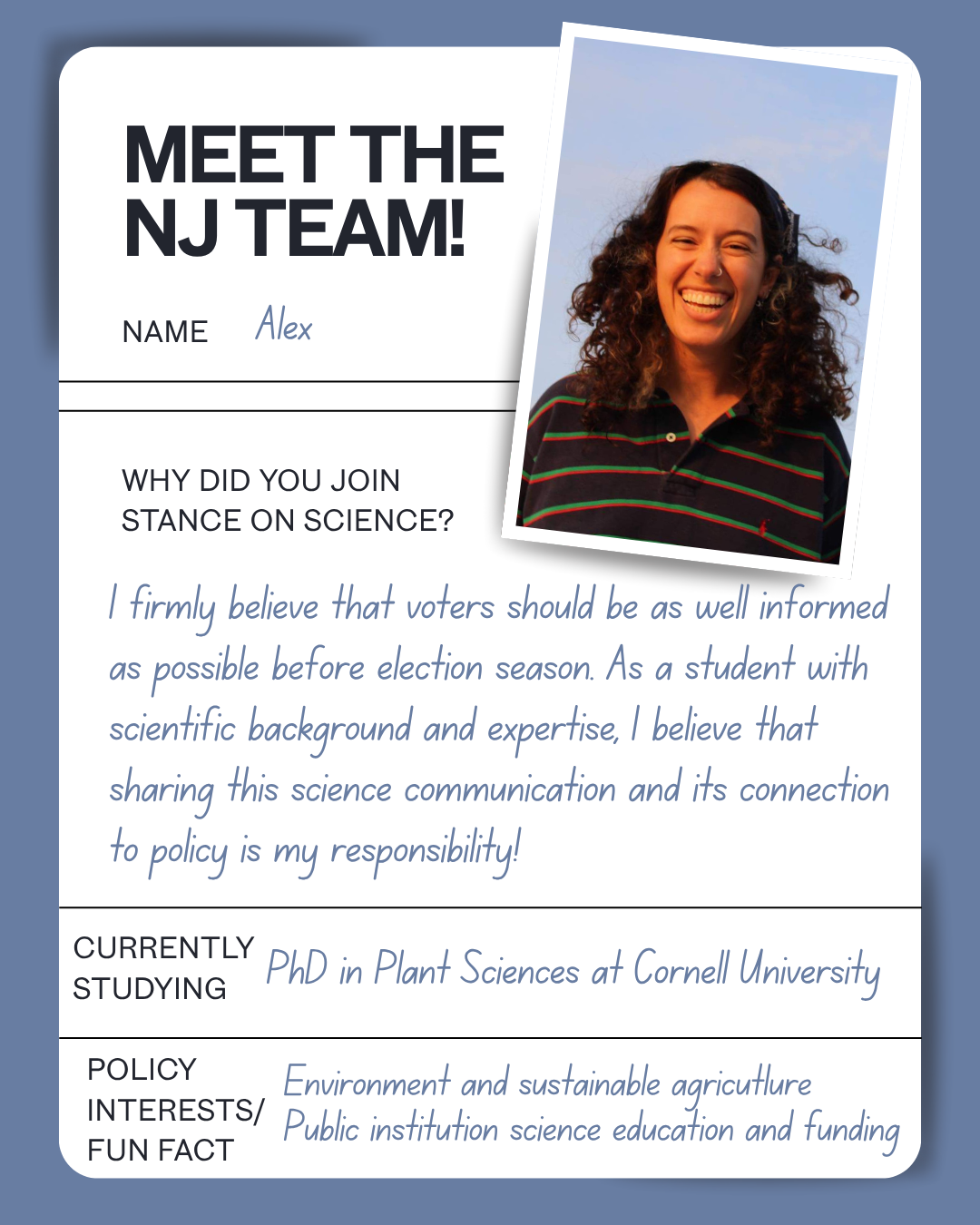
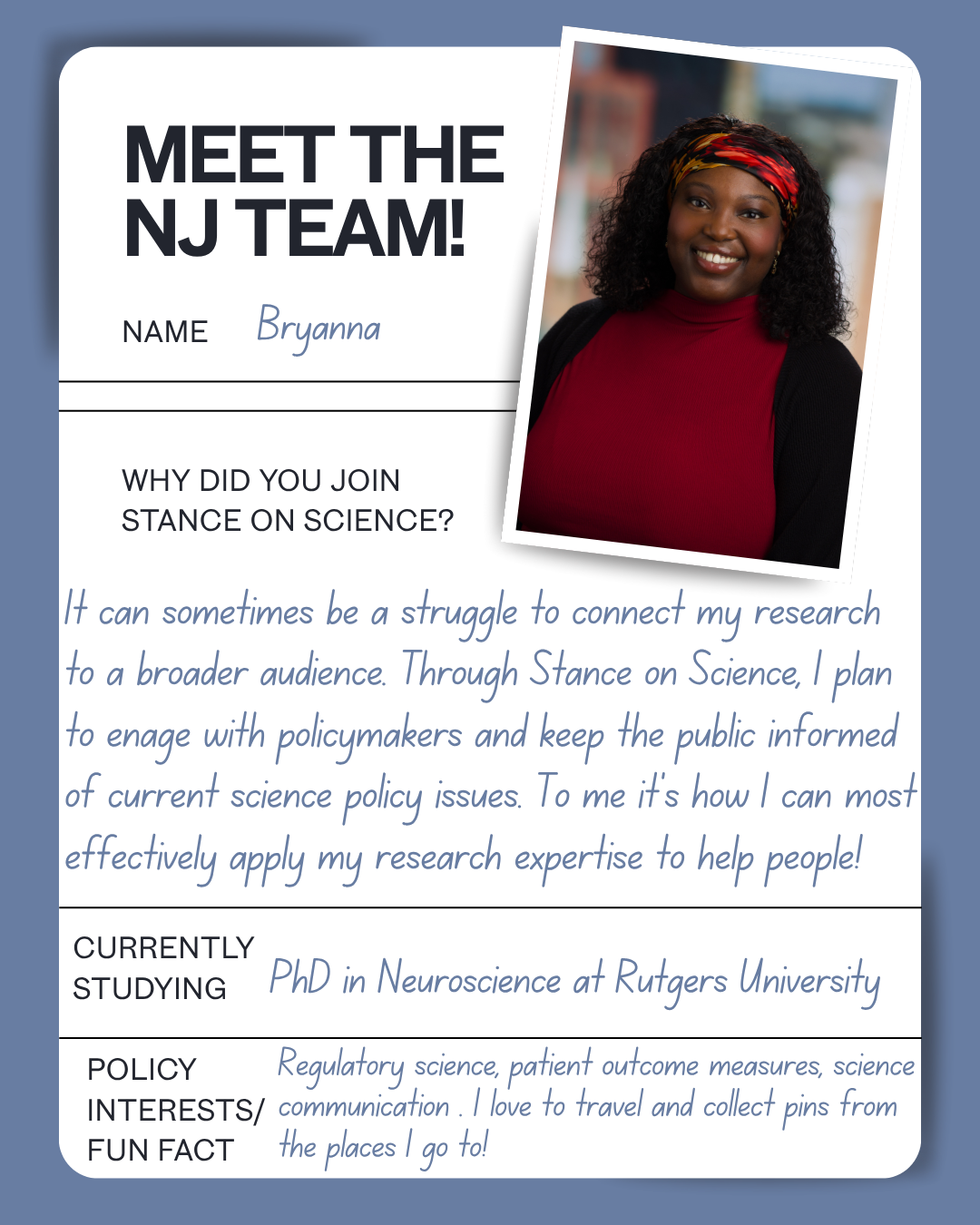
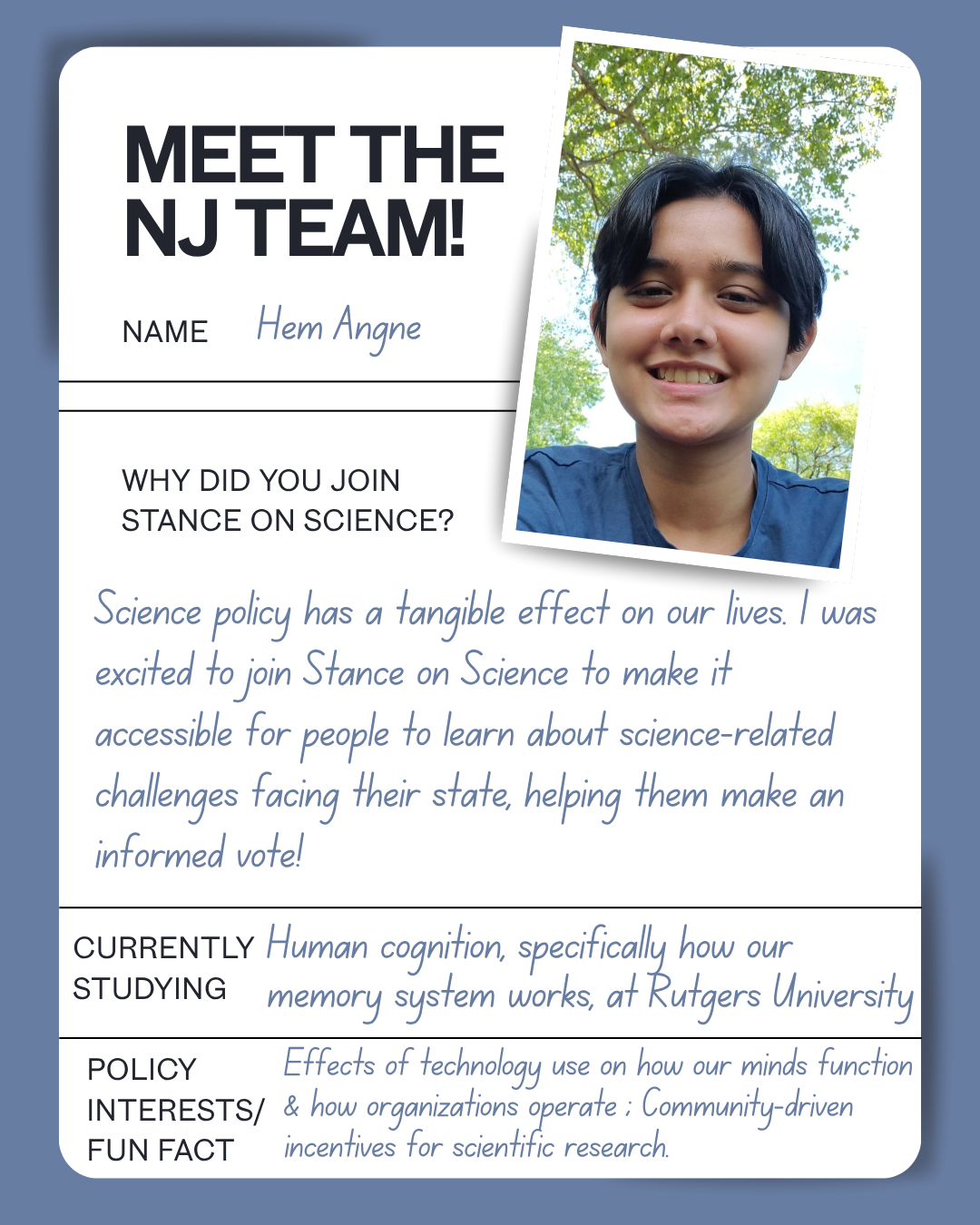
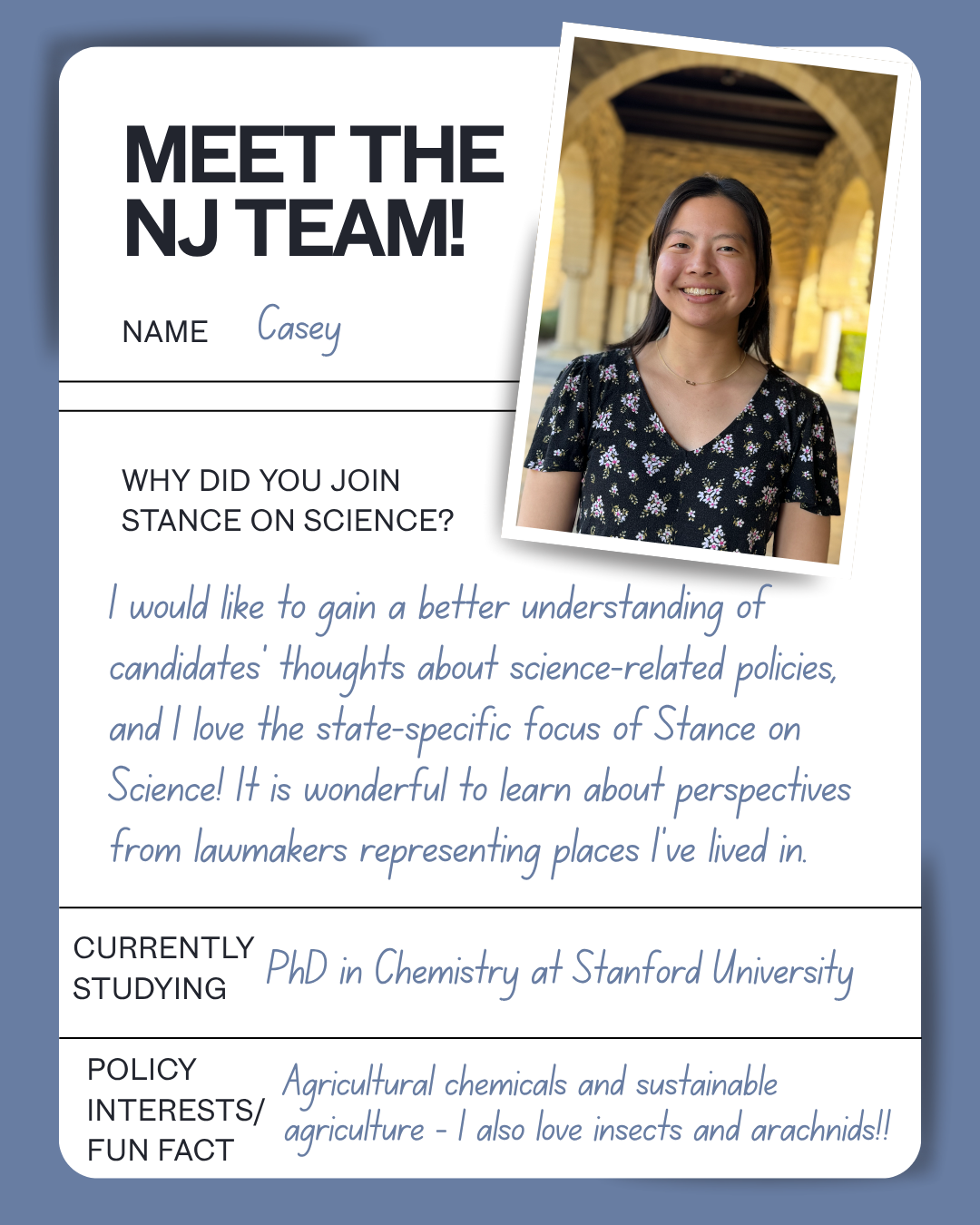
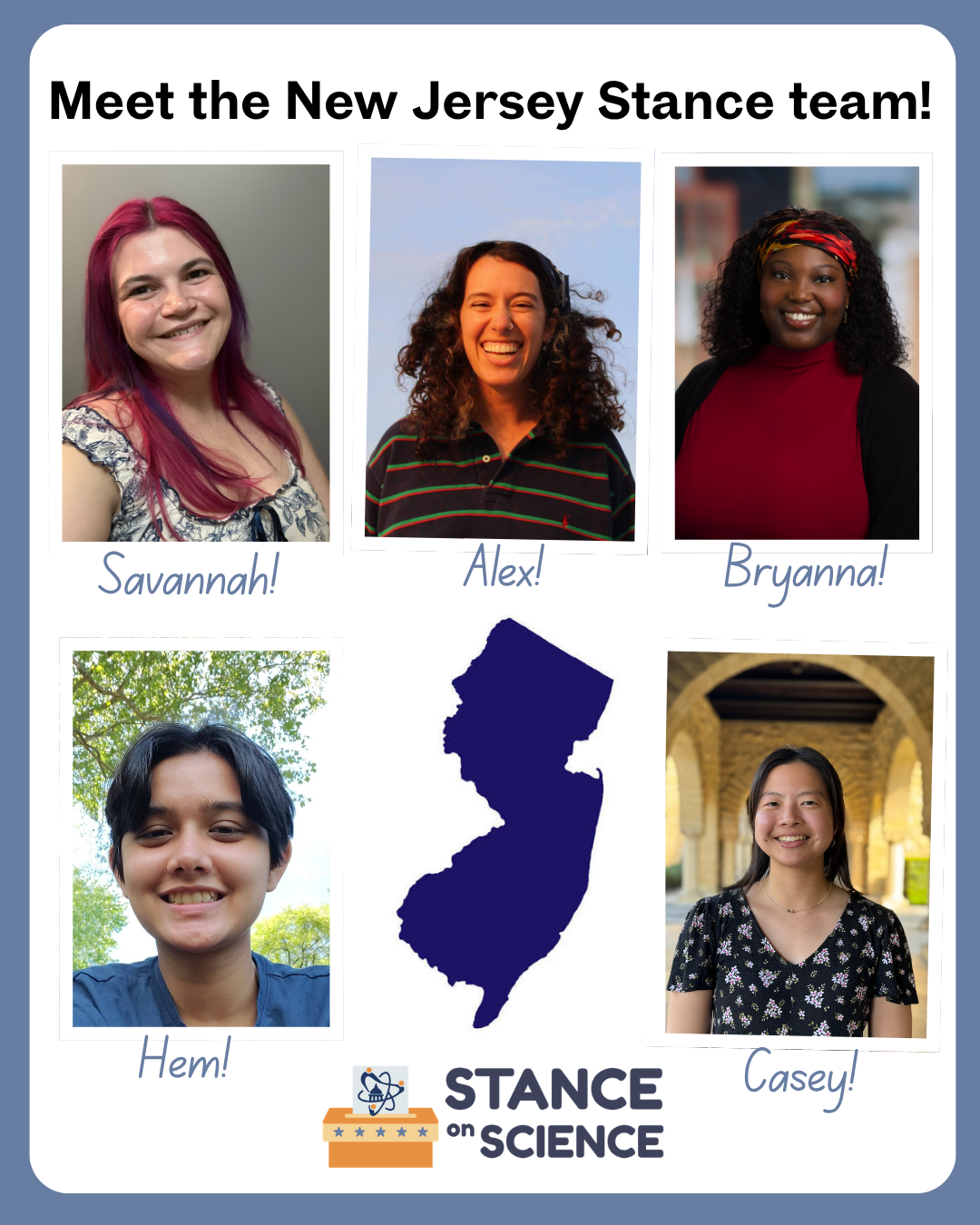
  • Meet the New Jersey team: Savannah, Alex, Bryanna, Hem, and Casey
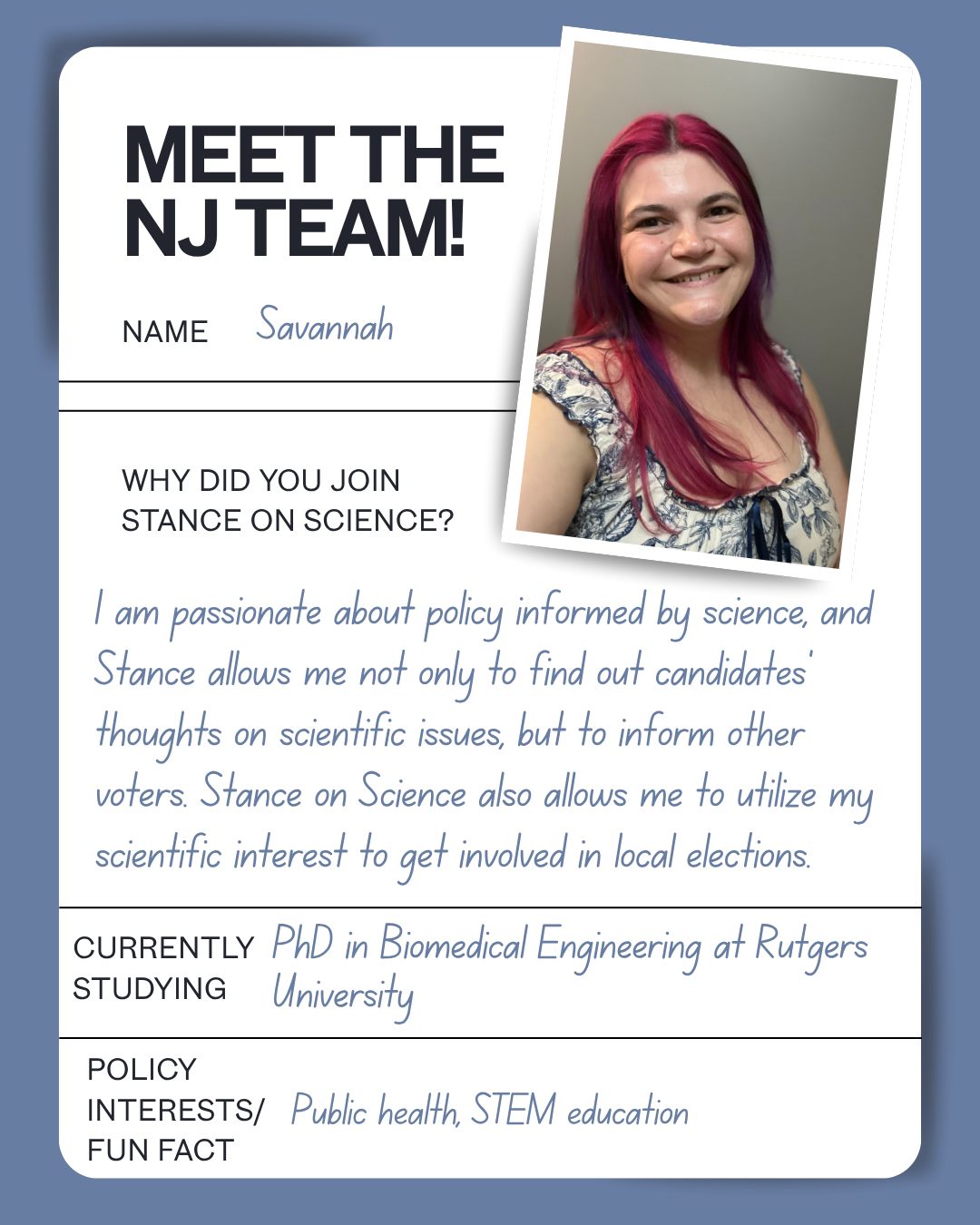
  • Meet the New Jersey team: Savannah — PhD student in biomedical engineering at Rutgers University, interested in public health and STEM education
  • Meet the New Jersey team: Alex — PhD student in plant sciences at Cornell University, interested in sustainable agriculture and science education and funding
  • Meet the New Jersey team: Bryanna — PhD student in neuroscience at Rutgers University, interested in regulatory science, patient outcomes, and science communication
  • Meet the New Jersey team: Hem Angne — studies human cognition at Rutgers University and is interested in technology's effects and community-driven research incentives
  • Meet the New Jersey team: Casey — PhD student in chemistry at Stanford University, interested in agricultural chemicals and sustainable agriculture