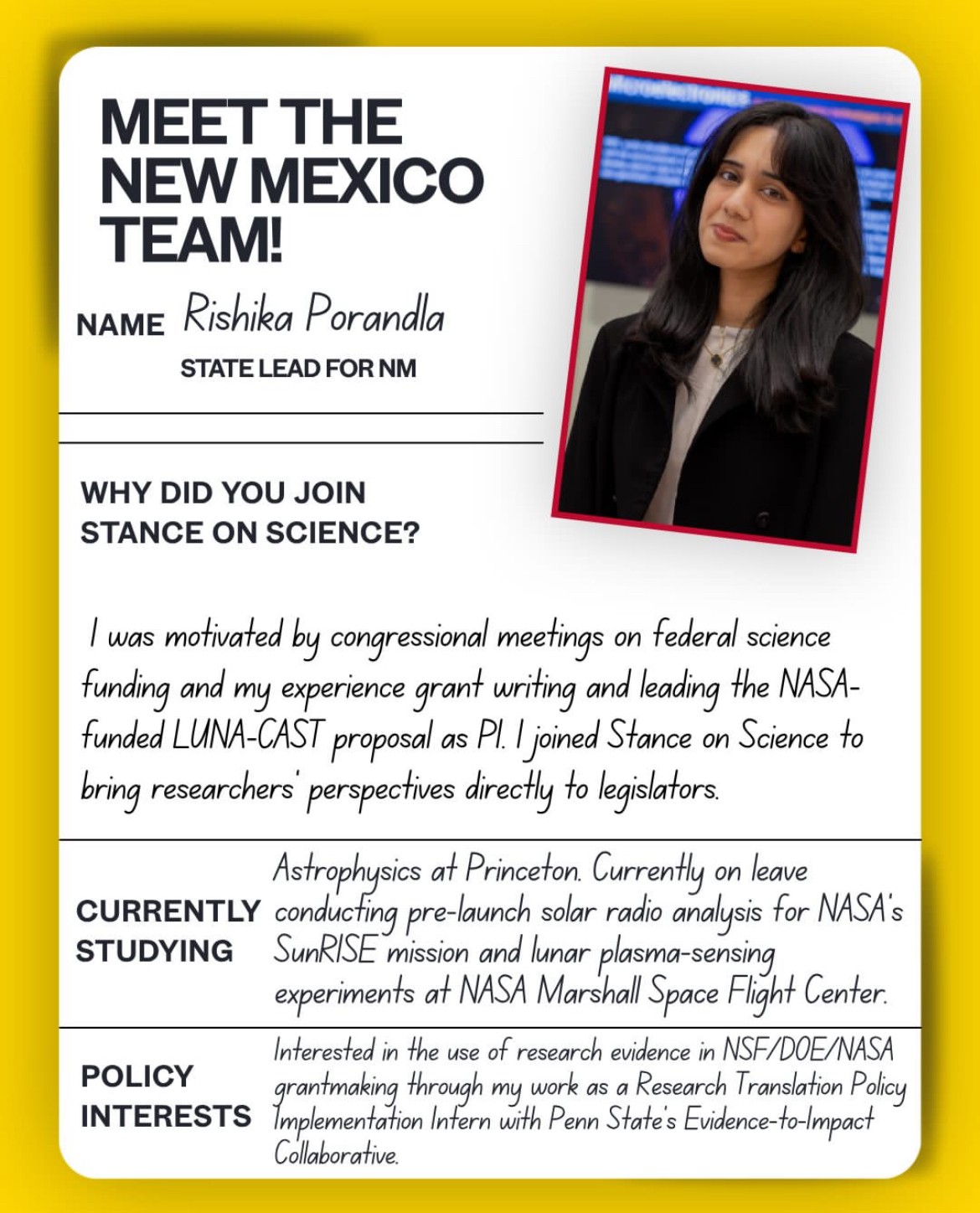
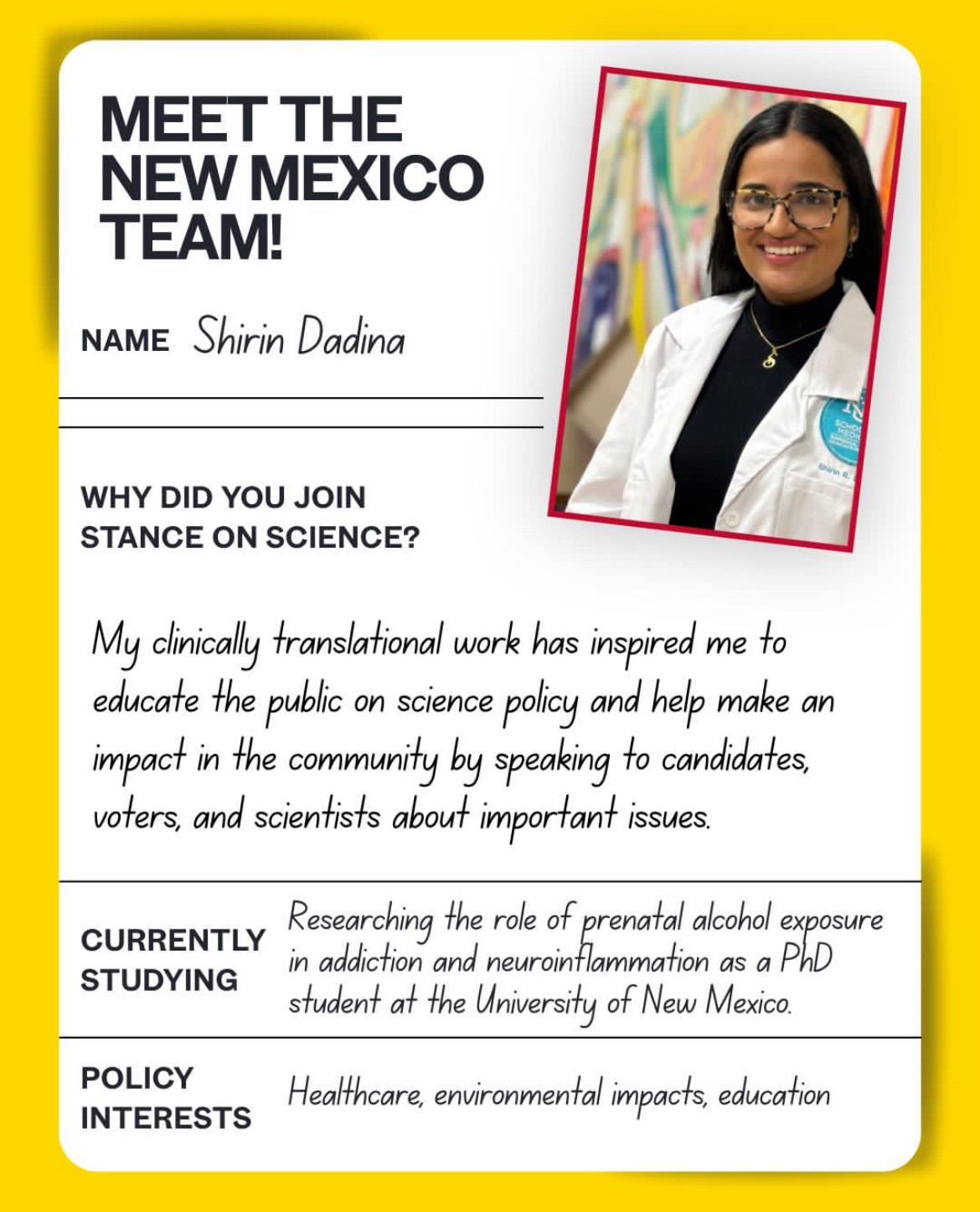
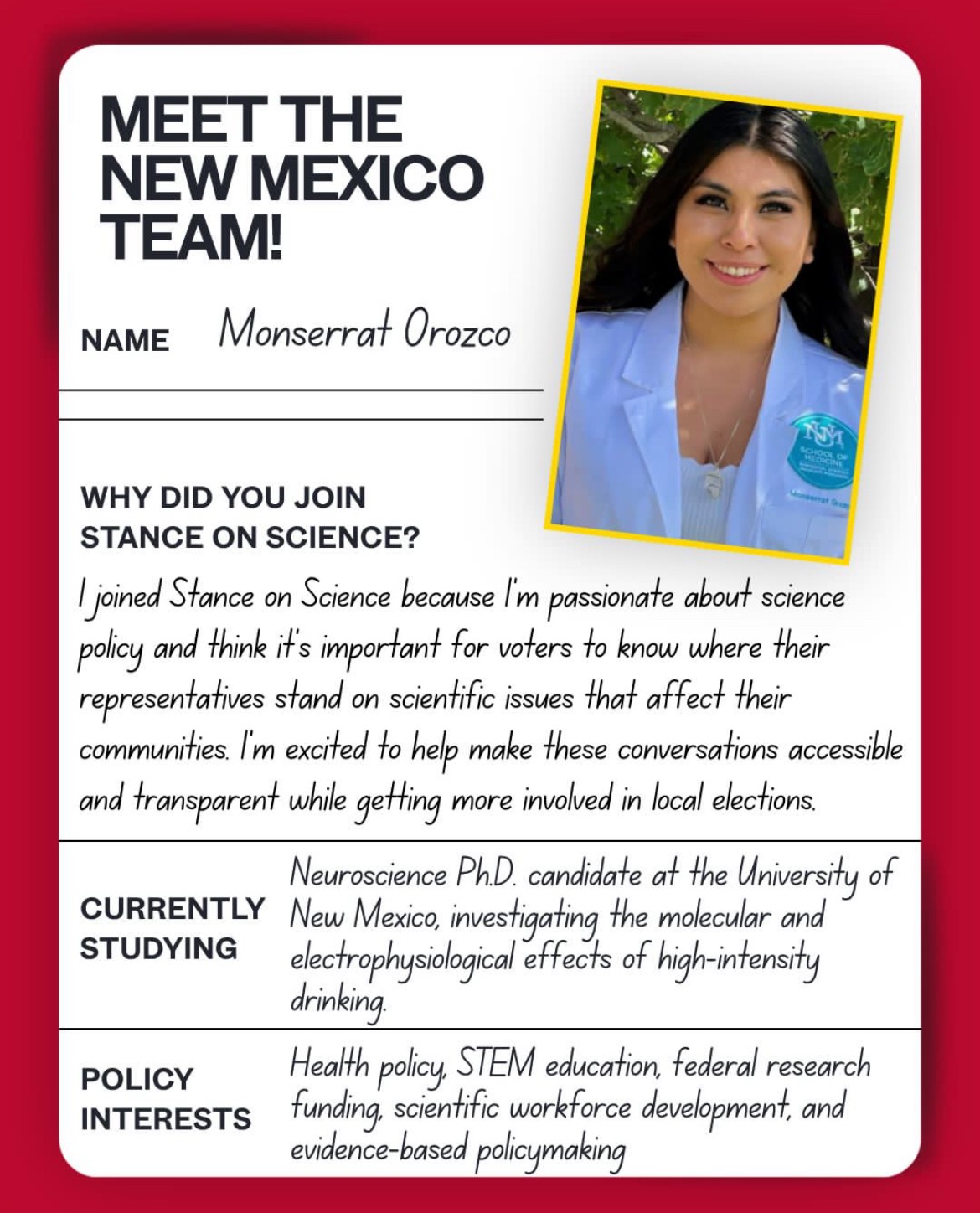
New Mexico
Created by the New Mexico Stance on Science team. Please contact stanceonsciencenewmexico@gmail.com with any questions. Follow us on Bluesky.
New Mexico will face many challenges in the coming years, and it is increasingly critical that our policymakers understand the importance of evidence-based decision-making. The goals of this resource are to:
- Provide voters with clear, accessible information so they can see how candidates value science in decision-making.
- Hold candidates accountable by sharing their responses publicly on our website and via local media.
- Encourage thoughtful engagement between communities and policymakers on science policy-related topics in our state.
Through Stance on Science, we hope to help New Mexicans understand how their elected representatives will utilize science to improve the state that they love. Learn more about this initiative on the home page.
How to use this resource
This webpage houses the responses to 9 questions crafted by the New Mexico Stance on Science team.
Only official candidates who will appear on ballots were contacted.
Candidates were contacted in October 2026 (with a follow-up to those who did not initially respond) and given the opportunity to answer all questions. Only the responses of candidates who answered the questions are included. None of the candidates' responses were modified in any way before being published on this resource page.
For the November 2026 general election, only candidates in the following elections were contacted:
All candidates for:
The questions posed
-
Q1 (Produced Water and Oil and Gas): New Mexico’s oil and gas industry generated 2.7 billion barrels of produced water in 2025. This wastewater can contain salts, chemicals, and radioactive materials, and underground disposal has raised concerns about earthquakes in the Permian Basin. State regulators have also identified gaps in evidence about treatment and environmental safety. What policies, if any, would you support for produced-water treatment, monitoring, disposal, or reuse outside oil and gas operations? What scientific evidence would inform your position? (see "Climate", "Energy", and "Environment")
-
Q2 (Water Security): New Mexico’s 50-Year Water Action Plan identifies water conservation, improved storage and delivery, groundwater monitoring, and protection of existing water resources as approaches to long-term water challenges affecting communities, agriculture, and economic development. What policies, investments, research, or new technologies would you prioritize to strengthen New Mexico’s long-term water security? How would you measure whether they increase water availability or reduce water loss? (see "Environment" and "Public Health")
-
Q3 (Uranium Mining and Cleanup): The EPA reports 523 abandoned uranium mines on or near the Navajo Nation, including 30 mines in New Mexico within one mile of Navajo Nation lands. Past uranium mining and milling have raised environmental and public-health concerns, while new proposals raise questions about water use and contamination. What policies, if any, would you support regarding existing sites, cleanup costs, and new uranium mining proposals? What role should scientific evidence and the decisions of affected Tribal governments play? (see "Environment" and "Public Health")
-
Q4 (Commercial Aerospace): New Mexico has invested public funds in Spaceport America and the commercial aerospace sector, prompting questions about environmental impacts and taxpayer investment. What conditions, if any, would you place on future state investment, and how should operating, infrastructure, and environmental costs be divided between public and private entities? How would you evaluate economic benefits alongside safety, wildfire, debris, and community impacts? (see "Environment", "Jobs and Workforce", and "Policymaking Process")
-
Q5 (Nuclear Waste): The Waste Isolation Pilot Plant near Carlsbad is the nation’s only deep geologic repository for defense-related transuranic waste, storing radioactive waste like plutonium and americium. What position would you take on WIPP’s future mission and proposals to change the types or amount of waste it accepts? What oversight policies, if any, would you support for transportation safety, worker safety, and radiation protection, and how would you evaluate their effectiveness? (see "Energy", "Environment", and "Transportation")
-
Q6 (Data Centers): Large data-center proposals, including Project Jupiter in Doña Ana County, have raised community questions about jobs and investment, water use, electricity generation and prices, air quality, noise, and light. What standards, if any, should New Mexico apply when reviewing these projects, and what role should residents have in approval decisions? How should added infrastructure and resource costs be allocated, and what evidence would you use to evaluate promised benefits and actual impacts? (see "Artificial Intelligence", "Environment", and "Policymaking Process")
-
Q7 (Rural and Tribal Healthcare): A New Mexico analysis found that rural residents travel three to four times farther, on average, than urban residents for the hospital-based services it examined. What policies would you support to improve healthcare access in rural and Tribal communities? How would you work with Tribal governments on their priorities, and what measures would you use to assess progress? (see "Public Health" and "Transportation")
-
Q8 (K-12 Science Education): In 2025-26, science proficiency fell from 35% to 33% statewide and from 40% to 32% in Taos Municipal Schools in Northern New Mexico. In Southern New Mexico, Las Cruces Public Schools has described uneven broadband access for students in rural Doña Ana County communities. What policies would you support to strengthen K-12 science instruction across the state, particularly in rural and Tribal communities? How would you improve access to qualified teachers, laboratory learning, and advanced courses, and measure progress? (see "K-12 Science Education" and "Policymaking Process")
-
Q9 (Federal Research Funding): Federal research supports jobs, scientific innovation, universities, and local businesses across New Mexico, while growth associated with major research facilities can affect housing and infrastructure. Changes to federal budgets and rules governing research grants and oversight can affect how institutions receive and administer funding. What priorities would guide your position on federal research funding in New Mexico, and what changes, if any, would you support? How would you evaluate scientific value, benefits to residents, local infrastructure and environmental costs, and accountability for public funds? (see "Investment in Higher Education", "Policymaking Process", "Science Funding", and "Trust in Science")
Disclaimer
The responses of candidates shared on this webpage do not reflect the views of the New Mexico Stance on Science team or the Scientist Network for Advancing Policy (SNAP) Coalition. SNAP is a non-partisan organization (please see more about SNAP here). SNAP and the New Mexico Stance on Science team do not endorse any candidates. The goals of this initiative can be found here. Please contact stanceonsciencenewmexico@gmail.com with any questions.
To find your districts for state and federal races and see who is on your ballot, please visit the Voter Information Portal NMVote.
November 2026 general election
No candidate responses have been published yet. Please check back soon.
Press Mentions
None yet! Check back soon for updates!