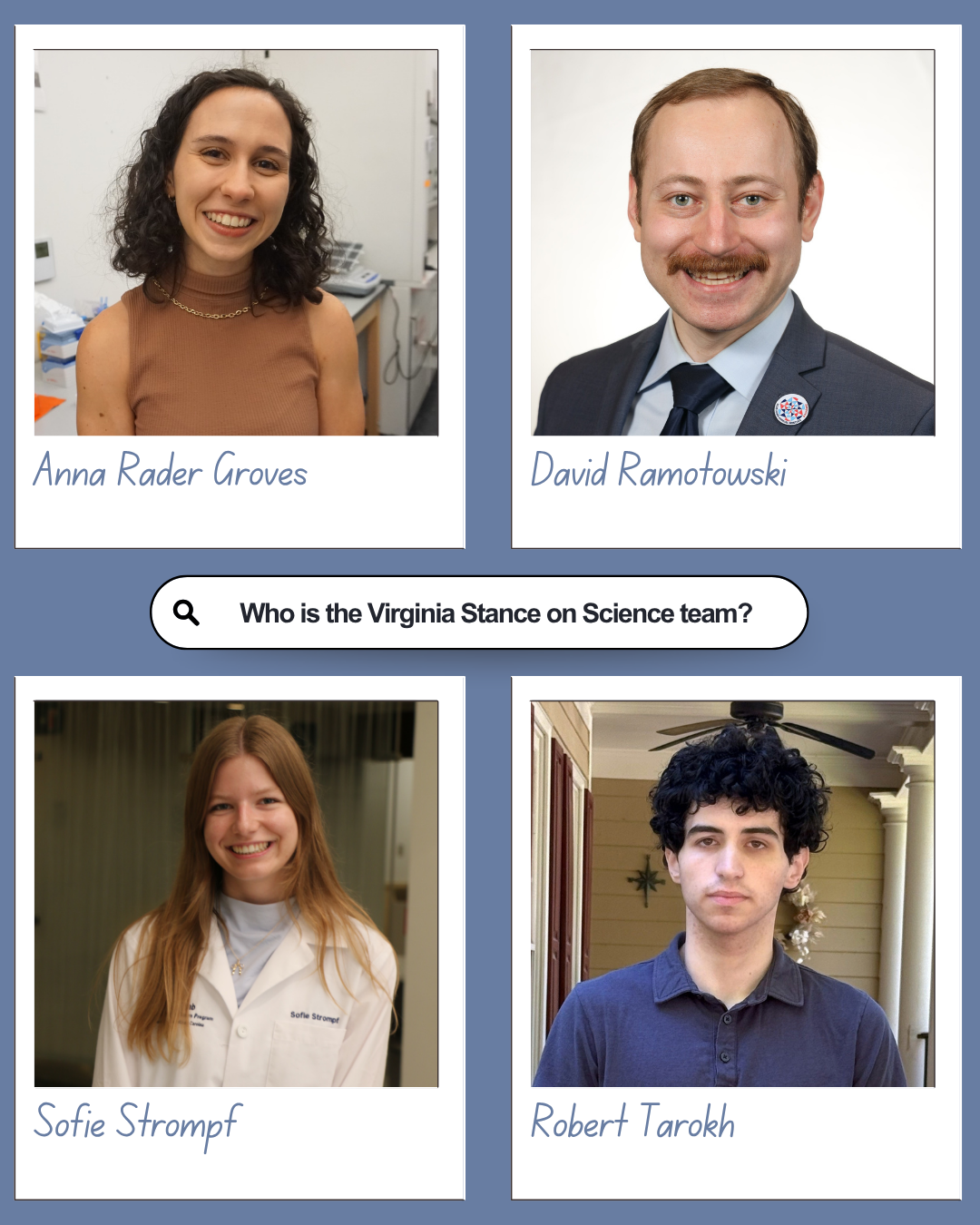
Virginia
Created by the Virginia Stance on Science team. Please contact stanceonscienceva@gmail.com with any questions. Follow us on Instagram and Facebook.
Virginia will face many challenges in the coming years, and it is increasingly critical that our policymakers understand the importance of evidence-based decision-making. The goals of this resource are to:
- Provide voters with clear, accessible information so they can see how candidates value science in decision-making.
- Hold candidates accountable by sharing their responses publicly on our website and via local media.
- Encourage thoughtful engagement between communities and policymakers on science policy-related topics in our state.
Through Stance on Science, we hope to help Virginians understand how their elected representatives will utilize science to improve the state that they love. Learn more about this initiative on the home page.
How to use this resource
This webpage houses the responses to 15 questions crafted by the Virginia Stance on Science team.
Only official candidates who will appear on ballots were contacted.
Candidates were contacted in September 2026 (with a follow-up to those who did not initially respond) and given the opportunity to answer all questions. Only the responses of candidates who answered the questions are included. None of the candidates' responses were modified in any way before being published on this resource page.
For the November 2026 general election, only candidates in the following elections were contacted:
US House of Representatives
- VA-01 (House): Rob Wittman (Incumbent), Shannon Taylor (Challenger)
- VA-02 (House): Jennifer Kiggans (Incumbent), Elaine Luria (Challenger)
- VA-03 (House): Bobby (Robert) Scott (Incumbent), Edwin Rivera (Challenger)
- VA-04 (House): Jennifer McClellan (Incumbent), Robert Murray (Challenger)
- VA-05 (House): John McGuire (Incumbent), Tom Perriello (Challenger)
- VA-06 (House): Benjamin Lee Cline (Incumbent), Beth Macy (Challenger)
- VA-07 (House): Eugene Vindman (Incumbent), Douglas Ollivant (Challenger), Taner Demirci Lopez (Challenger)
- VA-08 (House): Donald Beyer Jr. (Incumbent), Tony Sabio (Challenger), Shelly Arnoldi (Challenger)
- VA-09 (House): Morgan Griffith (Incumbent), Joy Powers (Challenger)
- VA-10 (House): Suhas Subramanyam (Incumbent), Dave Beckwith (Challenger)
- VA-11 (House): James Walkinshaw (Incumbent), Arthur Purves (Challenger), Dianne Blais (Challenger)
Senate
- Mark Warner (Incumbent)
- Bert Misuzawa (Challenger)
The questions posed
-
According to a 2025 study, Virginia’s coastal counties have amongst the highest percentages of people living in areas at risk from a severe flood in 2050, compared to all other U.S. states. Nearly all VA coastal communities are at risk of floods, with the highest concentration of at-risk individuals being in Poquoson. What policies, if any, would you support regarding coastal flood risk in Virginia’s coastal communities? (see "Environment")Asked of: VA-1 candidates.
-
The Coastal Virginia Offshore Wind project off the coast of Virginia Beach is the largest offshore wind development under construction in the United States, expected to generate enough electricity to power up to 660,000 homes once complete. What is your view on the role of offshore wind and other renewable energy sources in Virginia’s energy mix, and what policies, if any, would you support regarding their development? (see "Energy")Asked of: VA-2 candidates.
-
NASA Langley Research Center and Thomas Jefferson National Accelerator Facility represent two major federally funded research centers located in Virginia’s 3rd district. What role do you see these research centers playing in this district and how would you consider these in science funding related legislation? (see "Science Funding")Asked of: VA-3 candidates.
-
Southside Virginia has seen growing investment in new agricultural technologies, including vertical farming and industrial hemp cultivation, as the region works to diversify its economy beyond traditional crops like tobacco. What is your view on the role of agricultural research and technology in Virginia’s rural economies, and what policies, if any, would you support related to it? (see "Agriculture")Asked of: VA-5 candidates.
-
In Culpeper County and neighboring localities, several large data center campuses have been approved on land previously zoned for agricultural use, and similar proposals have spread to nearby Spotsylvania and Orange counties. What is your view on how local and state governments should balance data center development with preserving farmland and rural land use, along with the natural resources necessary for agriculture, and what policies, if any, would you support on this issue? (see "Artificial Intelligence" and "Agriculture")Asked of: VA-7 candidates.
-
The National Science Foundation, which funds about a quarter of all federally supported basic research at U.S. colleges and universities, is headquartered in Alexandria and employs roughly 1,600 people there. What is your view on the federal government’s role in funding scientific research, and what policies, if any, would you support regarding federal science agencies headquartered in Virginia, particularly in the 8th district? (see "Jobs and Workforce" and "Science Funding")Asked of: VA-8 candidates.
-
A 2026 Virginia Joint Commission on Health Care report found 13 of Virginia’s 36 rural hospitals are at immediate or distant risk of closure, with six of those located in the VA-9 congressional district. What is your approach to rural hospital access in Virginia, and what policies, if any, would you support related to it? (see "Public Health")Asked of: VA-9 candidates.
-
Fairfax County is home to a life sciences and biosciences workforce of more than 60,000 people, supported by federal research institutions, private companies, and public universities in the region. What is your view on the state’s role in supporting scientific research and the research workforce in Northern Virginia, and what policies, if any, would you support related to it? (see "Jobs and Workforce")Asked of: VA-11 candidates.
-
Healthcare affordability and access are major issues for Virginians. A 2025 survey by Altarum found that 72% of Virginians worry about paying for healthcare in the future. If elected, what action would you take to address healthcare affordability and access? (see "Public Health")
-
Healthcare access and affordability can also vary by demographics and need (e.g., rural areas, maternity care, mental healthcare). Are there any targeted programs you would support for specific needs or populations? (see "Public Health")
-
Virginia hosts the largest data center market in the world. Dominion Energy has proposed a 14% rate increase for residential customers in 2026, citing data center growth and AI-driven demand. What is your view on how the costs and benefits of data center growth should be divided between developers and residential ratepayers, and what policies, if any, would you support on this issue? (see "Artificial Intelligence")
-
According to the Virginia Department of Education, there are currently overall fewer vacant teaching positions in public schools than in years’ past. However, teacher shortages are still a major concern, particularly in areas such as special education, STEM (science, technology, engineering, and math), and early childhood. Through what policies, if any, would you address teacher shortages in Virginia’s K-12 schools in these high-demand areas, particularly in STEM? (see "K-12 Science Education")
-
As a member of Congress, you would vote on appropriations for federal science agencies, including the National Science Foundation and the National Institute of Health. What priorities, if any, would guide your decisions on federal science funding? (see "Science Funding")
-
As a member of Congress, you would also vote on appropriations affecting federal civilian positions, and the availability of these positions. Specifically focusing on workforce positions related to public health, science, and research and development, how would you approach appropriations/funding for federal civilian positions? (see "Science Funding")
-
Scientific and technical expertise can inform decisions related to healthcare, energy, infrastructure, manufacturing, and emerging technologies. What role, if any, should scientific evidence and expert input play in your policymaking process, and how would you communicate scientific uncertainty or evolving evidence to the public? (see "Policymaking Process")
Disclaimer
The responses of candidates shared on this webpage do not reflect the views of the Virginia Stance on Science team or the Scientist Network for Advancing Policy (SNAP) Coalition. SNAP is a non-partisan organization (please see more about SNAP here). SNAP and the Virginia Stance on Science team do not endorse any candidates. The goals of this initiative can be found here. Please contact stanceonscienceva@gmail.com with any questions.
To find your districts for state and federal races and see who is on your ballot, please visit the Virginia Department of Elections "Casting a Ballot" webpage.
November 2026 general election
No candidate responses have been published yet. Please check back soon.
Press Mentions
None yet! Check back soon for updates!