October 2026 Newsletter
TLDR: This month, SNAP is hosting a free two-part science communication webinar next month, led by Camille Rey, PhD, PMP! Our 2026 Congressional District Visits wrapped up with 115 early-career scientists holding 65 meetings across 26 states, and we’re encouraging anyone who missed out to join the op-ed program. Need SciPol resources? We launched SciPol 101, a free open-access science policy curriculum with five modules, and we selected eight organizations as the first SNAPStart mini-grant recipients! Stance on Science is still looking for volunteers, especially in Colorado, Hawaii, Idaho, Maryland, North Dakota, South Dakota, South Carolina, Montana, Virginia, and West Virginia. Readers, follow our Medium blog for the latest articles by SNAPpers!
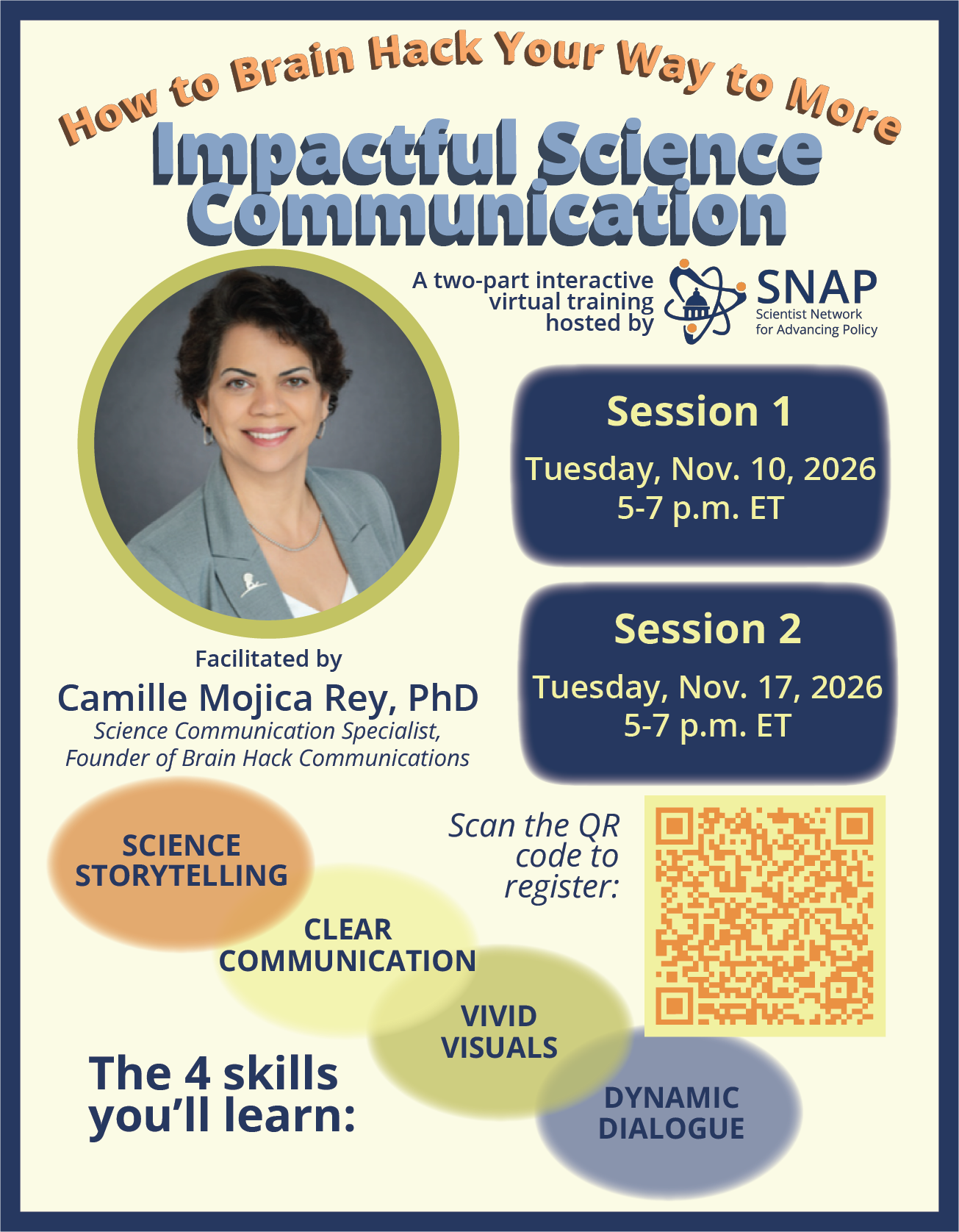
Upcoming 2-part Webinar on Science Communication!
We are thrilled to invite you to join us for a free, two-part science communication training webinar next month! Led by Camille Rey, PhD, PMP, these sessions will give you all the tools you need to build practical skills you can use right away to communicate your science with clarity, creativity, and greater impact. Register ahead of time on Zoom and find more information on LinkedIn.
2026 SNAP Congressional District Visits
Year two of our 2026 SNAP Congressional District Visits initiative was a big success! We trained 115 early-career scientists who held 65 meetings with Congressional offices across 26 states. Notably, 71% of these meetings were held with the House offices that voted on a C.R. mentioning the proposed OMB rule changes shortly after returning from August recess.
Due to the time-sensitive nature of scheduling visits, we recognize not everyone had a chance to participate in the initiative despite high interest.
In light of this, we are encouraging people to write and publish Op-Eds to continue this conversation with the public about the benefits of fundamental research, the potential implications of rules like OMB-2026-0034, and the importance of prioritizing both accountability and stability of funding.
If you are interested and have not yet filled out this op-ed interest form, please do! Upon filling out this form, we will provide additional resources to help you write, including 1) advice from the former New York Times Opinion Editor Clay Risen, 2) SNAP guides to writing an Op-Ed and 3) assistance with editing and/or help pitching to outlets.
Science Policy in a SNAP - SNAP Blog
You can access our blog, Science Policy in a SNAP, on our website or give us a follow on Medium, where you’ll hear from a variety of SNAP member voices on diverse science and science-policy topics.
Disha Patel and Ashley Eng kicked off the stretch with a post on “Combating the antimicrobial resistance public health crisis with next-generation tools”, discussing how emerging tools like sequencing, CRISPR-based diagnostics, and computational models can detect drug-resistant pathogens faster than traditional lab methods. The “Member SNAPshot: September 2026” spotlighted members Olivia Asher, Brandon Emanuel León, and Emily Selland, sharing how they got involved in science policy, their research, and their work with SNAP. Last week, Megan Garcia reflected on how to hold onto compassion amid ongoing uncertainty for US science funding in her post, “Keeping My Heart in Uncertain Times for Science”, which pairs an original poem with an update on federal research funding.
Be sure to follow us on Medium to read the upcoming pieces!
Have an idea for a post? Contact us and let us know.
Stance on Science
Stance on Science participants are asking science policy-related questions of candidates running in local, state, and national races during the 2026 elections. State teams are developing questionnaires, doing candidate outreach, promoting the resource we’ve created. This is a great time to get involved and make sure science policy issues important to your community are included.
We still need volunteers! Volunteer now to help get the word out about candidate positions on important issues. Please spread the word, and follow us on socials! We are particularly looking for constituents in Colorado, Hawaii, Idaho, Maryland, North Dakota, South Dakota, South Carolina, Montana, Virginia, and West Virginia to help these teams grow!
Don’t see your state in this list? That means you get to join a larger team! The more people we have from as many districts in as many states as possible, the broader the reach of the initiative, so please sign up! Reach out to snapscipolorg@gmail.com with any questions.
Our SciPol Course is LIVE
We are proud to announce that earlier this month we launched SciPol 101! This open-access curriculum to educate and empower scientists to engage in science policy and advocacy is available on our website for use and covers five topics: What is Science Policy?, How Government Works, Writing for Science Policy, Science Communication, and Science Diplomacy.
Check them out, use and modify the modules as you need, and let us know what you think!
SNAPStart: Mini-Grant Program for New SciPol Orgs
We are excited to share that we have selected eight incredible science policy organizations as the inaugural recipients for our SNAPStart mini-grant program! We’ll be sharing an announcement soon with details on the winners.
External Opportunities
Fellowships and Jobs: Newly Hiring
- Union of Concerned Scientists is hiring a Science Ambassador Fellow
- The Marine Conservation Institute is hiring a Communications (Social Media) Intern (paid)
- Applications for the 2027 Switzer Fellowships are due December 14, 2026
- 2026 Progressive Talent Pipeline Endorsement Application due October Sunday, October 25, 2026. PTP identifies, trains, and endorses candidates interested in applying for roles in Congress and government agencies
- Astera is hiring a Data and Partnerships Associate.
- The National Academies is hiring a Program Officer - Biomedical and Health Sciences Program
- The University of Michigan is hiring a Civic Science Fellow.
- Undergraduate students at the University of Colorado Boulder and Science For Good are helping coordinate distribution for a national, IRB-approved research study (#26-0184). The study investigates the impact of recent science policy changes on undergraduate students’ outlooks on science, including their academic engagement and career aspirations. Fill out the survey here by December 22nd.
- Berkeley Lab has 2 named fellowships in the Computing Sciences Area: The Alvarez and The Hopper fellowships are both open for applications, which are due by October 30, 2026.
- Switzer Fellowship for environmental improvement is due December 14th.
- MIT is hiring a Senior Advisor Science and Innovation Policy Advocacy
- Summer Academy on “Science Imagines Its Future” Applications due November 1st.
Fellowships and Jobs: From Last Newsletter (Still Hiring!)
- Applications for the University of Chicago’s Harris Social Impact Fellowship are now open.
- Conserve Wildlife New Jersey is hiring a Communications & Development Manager.
Events
- Register now for an upcoming SNAP panel event on the State Science Policy Fellowships available to early career scientists on December 10th, at 4 pm ET, co-organized with the S&T Impact Advisory Group! More information and panelist information coming soon - stay tuned.
Resources and Opportunities
- Deadline October 23rd: National Science Policy Network (NSPN) is launching two pilot working groups focused on building community connection and scipol trainings. These are two month-long sprints, with concrete deliverables and 5-10 hours of expected commitment per month. Links to the working groups description and application are below.
- AIBS is now accepting applications for the 2027 Emerging Public Policy Leadership Award, which recognizes graduate students in the biological sciences who are demonstrating an interest and aptitude for working at the intersection of science and policy.
- The Massachusetts Science and Technology Policy Fellowship’s Scientific Citizenship Initiative is looking for input informing the creation of a new fellowship program! Have a minute? Even if you aren’t a Massachusetts resident, you can complete this survey!
- Alternatives for Community and Environment (ACE)’s Environmental Justice Assistance Network invites Massachusetts, Connecticut, and Rhode Island residents to join their Data Center Working Group.
- Are you a graduate student who has been the lead author of a peer-reviewed article published in BioScience in the past year? If so, you are eligible for the AIBS Diana Wall Graduate Student Publication Excellence Award, which is accepting applications on a rolling basis.
- A searchable menu of policy, advocacy, and civic-engagement resources for environmental epidemiologists is now available with the ISEE North American Chapter Policy Engagement Dashboard
DID YOU KNOW? SNAP hosts a community calendar where you can find these events and more!
Want to see your events shared with the SNAP community? Shoot us an email at snapscipolorg@gmail.com, and we will get it posted!
✨SNAPper Highlights and Achievements ✨
Check out these recent works by SNAP members and works mentioning SNAP members or initiatives!
- The MIT Science Policy Review Volume VII featured published interviews conducted by several SNAPpers: “On American scientific isolationism: A conversation with Dr. Sudip Parikh, CEO of the American Association for the Advancement of Science” by Brendon Davis and John Soltis; and “Artificial intelligence companionship for loneliness in older adults: An interview with Vijeth Iyengar and Elizabeth Broadbent” by Priyam Joshi, Anna Rader Groves, and Shreya Venkatesh
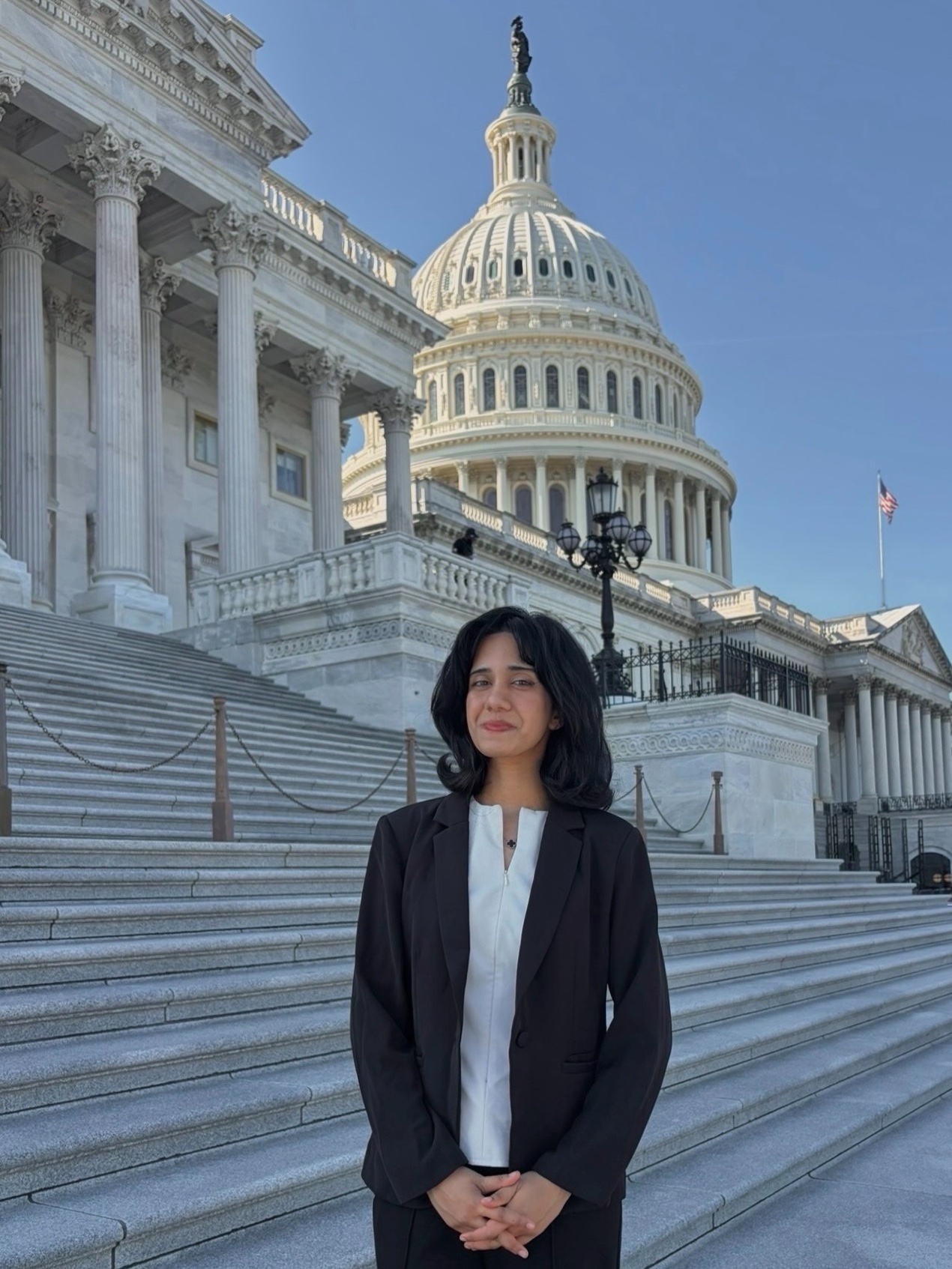
- SNAPper Rishika Porandla (pictured) met with Texas senators with AGU’s Congressional Visits to discuss the proposed OMB rule!
Know someone who’d like to receive this newsletter? Have them join our Google Group Listserv. Email snapscipolorg@gmail.com with questions about SNAP or if you’d like to join our Slack.